



In Summary:
Drone incursions and hybrid attacks across Europe have increased since 2025, with Russia suspected of being behind them.
The EU’s European Drone Defence Initiative (EDDI) aims to build a connected, multi-layered counter-drone system, but as of October 2026 it remains largely a framework.
Open questions remain on how EDDI will work with NATO, on member states’ differing views of the threat, and on whether funding covers detection as well as interceptors.
On October 12, General Alexus Grynkewich, NATO’s Supreme Allied Commander Europe presented the alliance’s new “Theory of Victory” plan, aimed at deterring a possible Russian attack. The plan arrives as tensions in Europe rise and many ask whether Russia could one day wage war on the EU (for a more detailed analysis of the plan, see HIG’s recent article). Following the drone attack attempts on the Leipzig/Halle Airport, which were identified as Russian planned by German authorities, the Danish Defence Intelligence Service has warned:
“Russia will intensify its hybrid war by carrying out more frequent attacks
against the West and NATO, with greater consequences for the
targeted countries than in the past”
The Theory of Victory is NATO’s shared vision for deterring aggression and defending allied territory, where AI and drones have a prominent place with the latter being one of the most significant technologies in modern warfare. By some estimates, drones cause 70-80% of daily combat losses in Ukraine. A few years ago drones were considered a cheap alternative to missiles. Now the technology developed into sophisticated systems that are expected to reach 800-900 km/h, according to the Deputy Commander of the Ukrainian Air Force.
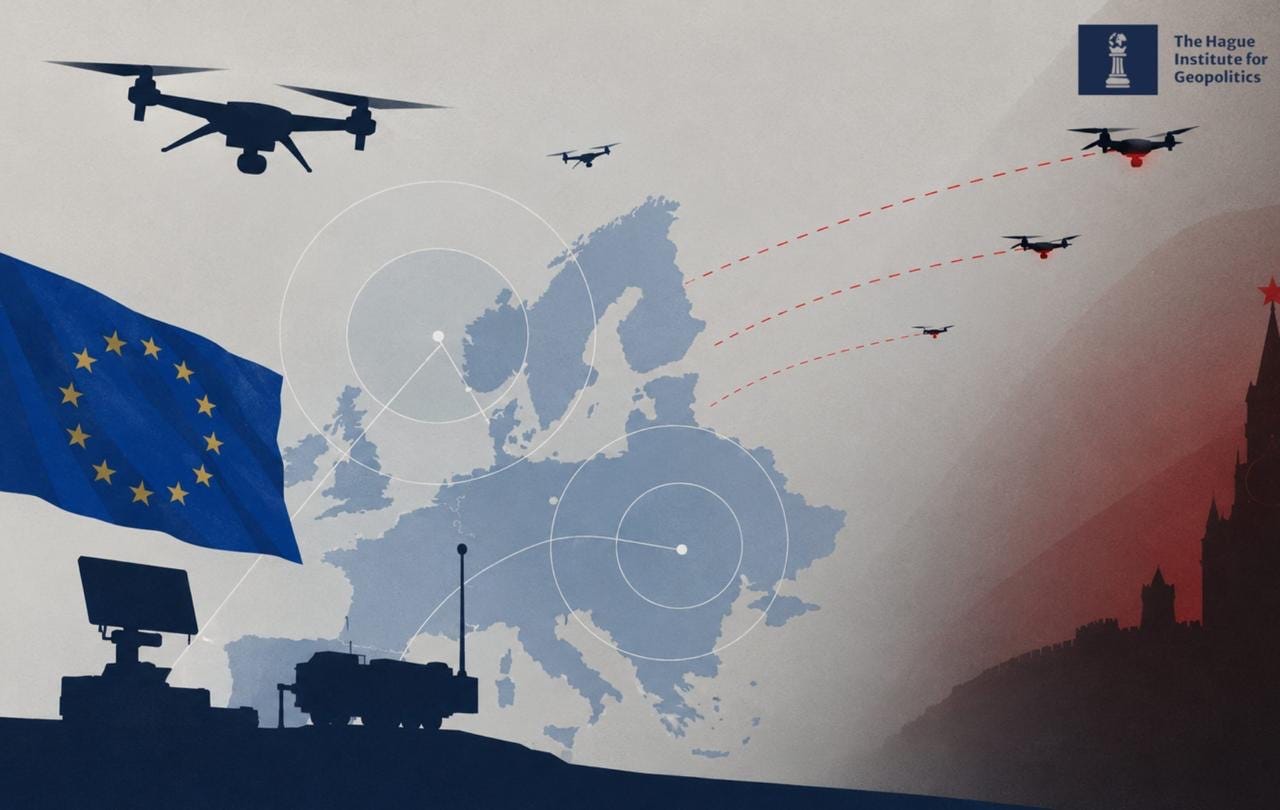
In response to the hybrid drone attacks on its member states, including Poland, Romania, Belgium and Germany, the European Commission is presenting the new European Drone Defence Initiative (EDDI) that aims to provide a 360° shield against the hybrid threats. EDDI is a flagship of the Defence Readiness Roadmap 2030 and addresses one of the seven capability areas named in the White Paper for European Defence: drones and counter-drone systems.
NATO’s three-phase plan to block, blunt and break an attack relies partly on drones and counter-drone systems, yet it has not been publicly tied to EDDI, an EU programme that the Commission says should work “together with NATO.”
“A drone costing tens of thousands of euros forces Europe to scramble fighter jets and fire missiles worth around a million dollars each. Russia will keep exploiting that imbalance during the period of US and some European elections.”
- Dr. Victoria Vdovychenko, Joint Programme Leader of the Future of Ukraine Prog. at the Centr. of Geopolitics
However, with a prospect of the significant threat, the initiative has not been fully operationalised, and therefore raises the question, to what extent will the European Drone Defence Initiative fulfill the gaps in Europe’s Air Defence?
Threats
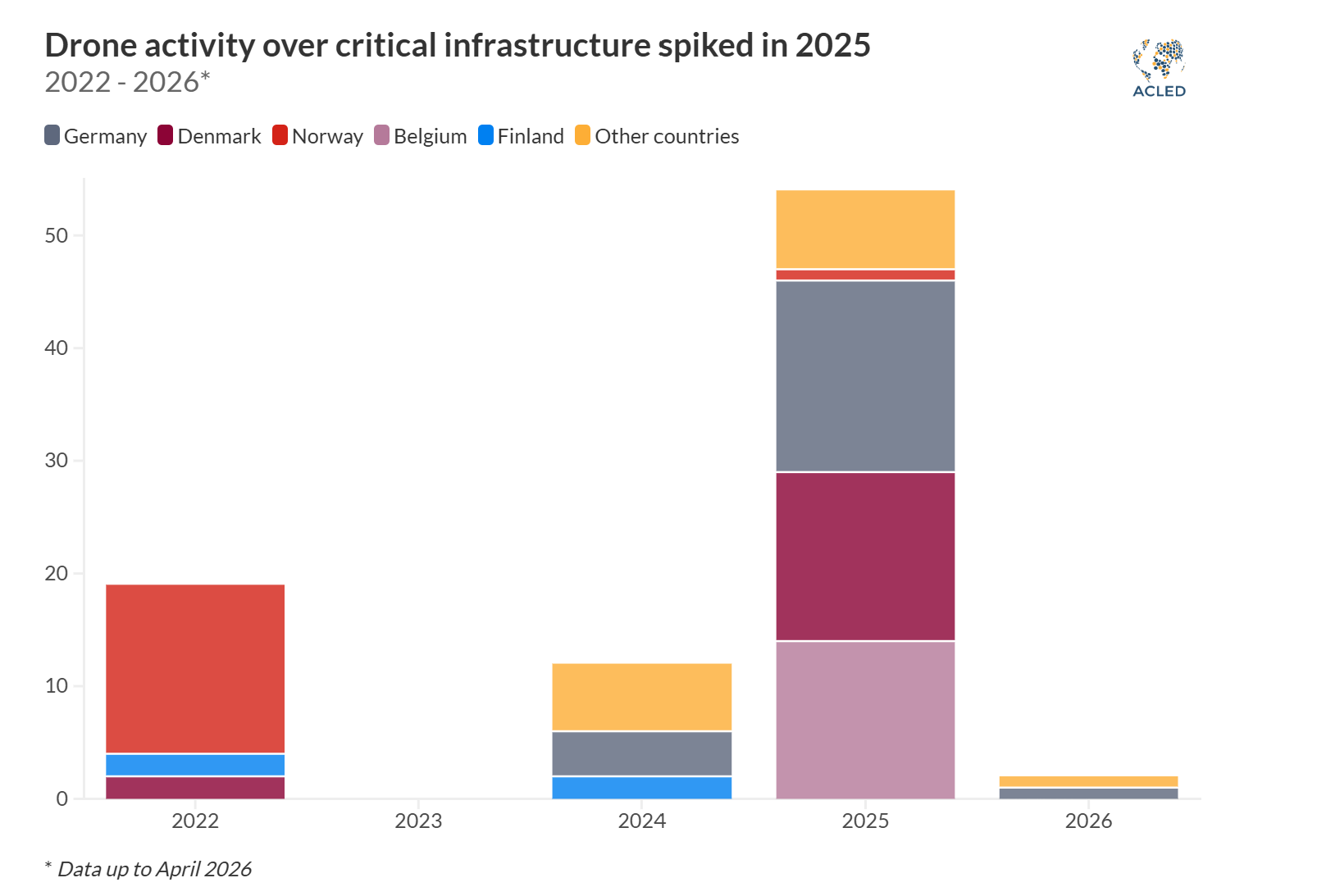
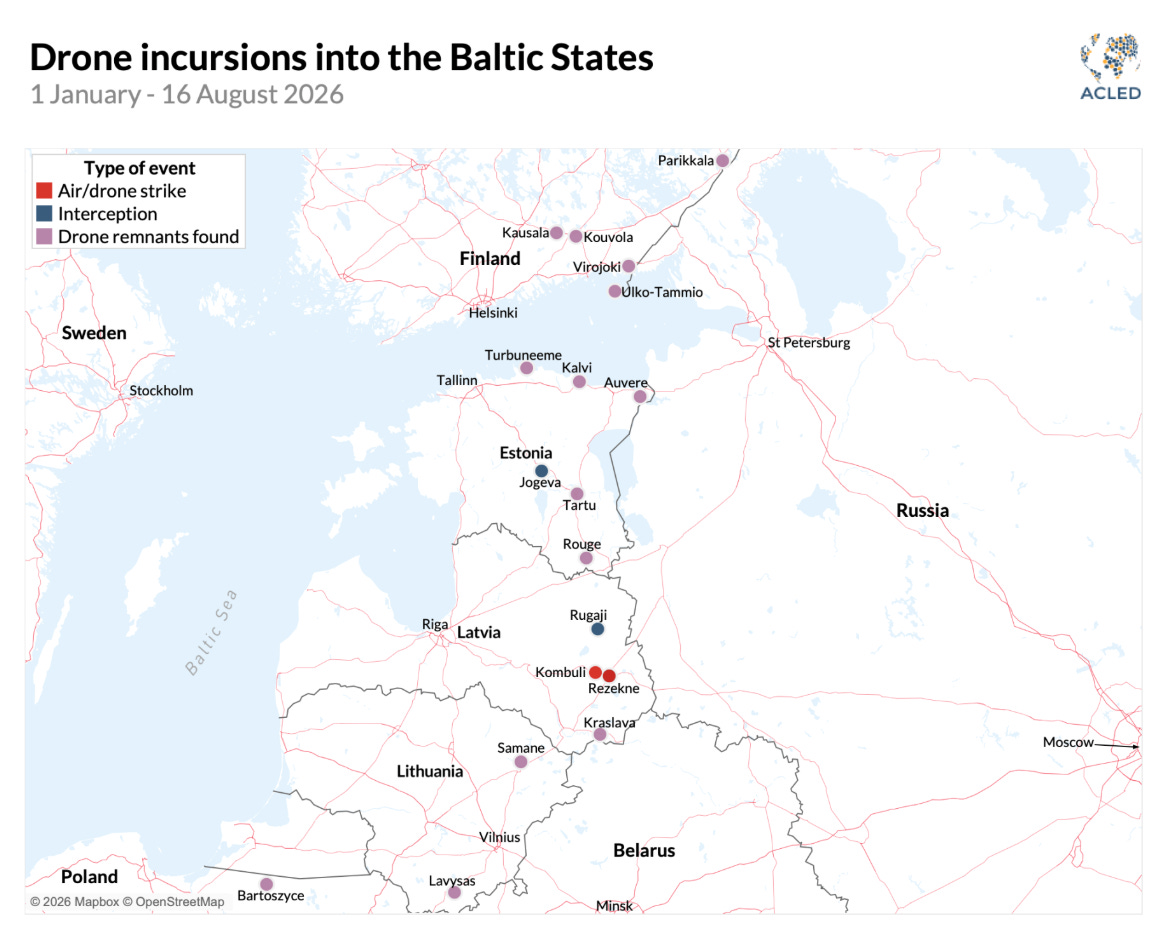
Reports on hybrid attacks, drone incursions, and the spotting of Uninhabited Aerial Vehicles (UAVs) have increased since 2025 across Europe. While several reported cases turn out to be false alarms or have no confirmation of its origin, there have been many cases of drones flying over airport and military bases in different NATO countries. In September 2025, there have been reports confirming Russian drone incursions in Poland and Romania, and a Russian fighter jet incursion in Estonia’s airspace, followed by unidentified drones spotted in multiple European airports throughout the fall of 2025. The incursions have been continuing across Europe in 2026, with the UK spotting continuous UAV activity near its military sites, unauthorised drones detected in Romania and near a US missile defence base in Poland, and a Russian helicopter entering Polish airspace this September. Michel Don Michaloliákos, geopolitical and geo-economic analyst at HIG, explained that because it is hard to attribute these acts to Russia, which follows strategic “credible deniability”, it makes it harder to counter these actions.
There is a growing suspicion of Russia being behind the events and using hybrid attacks combining drones with cyber and information operations, increasingly AI-enabled, to gain information, disrupt Europe’s cybersecurity and undermine political stability and public trust by targeting weak points in European societies.
“Each incursion is also a message, designed to make citizens feel unprotected and governments look slow, in particular, prior to elections.”
- Vdovychenko
Leaders of Eastern European countries, such as Lithuania, Poland, and Romania, alongside Germany, France, and Nordic NATO members perceive the events as serious threats, and believe that Russia poses a long-term threat to NATO countries but Mark Rutte, Secretary General of NATO, said on September 30 that there is no imminent threat to NATO territory from Russia.
Olena Kryzhanivska, Editor at the NATO Association of Canada, sees the hybrid campaign shifting from isolated incidents to regular, systematic attacks on infrastructure sites across Europe. Their main effect, she says, goes beyond the damage to facilities: they spread fear among civilians and carry economic costs. Several attacks have been linked to Russia, yet Europe has so far shown no unified response.
The expert also expects the threat to spread:
“On one side, drones and missiles might fly from Russia into neighbouring European countries. On the other, Russian agents will carry out sabotage throughout Europe, regardless of distance from the Russian border. Russia has spent years working with criminal groups and investing in such operations, which means that no country in Europe is safe.”
- Kryzhanivska
EDDI
Due to the recent increase in violations of EU Member States’ airspace and continued aggression against Ukraine by Russia, the EU has announced its European Defence Readiness Roadmap 2030, aimed at reinforcing Europe’s resilience against emerging hybrid and military threats. It operationalises the White Paper and proposes four European Readiness Flagships to strengthen collective defence through coordinated investment and technological development.
One of those priority flagships is the European Drone Defence Initiative (EDDI, also known as the European Drone Wall), with a mission to “develop a cutting-edge interoperable system for countering and deploying drones”, as described by the European Parliamentary Research Service (EPRS). This is expected to happen through a multi-layered network to detect, track and neutralise hostile drones, alongside drone platforms for precision strikes. It began with a call from Commission President Ursula von der Leyen for a “drone wall”, made hours after Russian drones entered Polish airspace in September 2025, and was later expanded into a region-wide scheme.
According to the Commission’s Action Plan, EDDI’s integrated approach is meant to spread key operational steps across the entire response chain instead of handling them separately. It builds on dual-use Command and Control (C2) systems, a software that connects sensors to countermeasures, developed to protect critical infrastructure, so the same technology could serve civilian contexts as well as military purposes. Therefore, EDDI is meant to link detection, tracking and neutralisation within one interoperable system, but as Vdovychenko explained, the decision to engage a drone sits with the nation whose airspace is violated, keeping national defence a sovereign matter.
The initiative is supposed to draw on Ukraine’s battlefield experience with interoperable data management systems, and is closely tied to the EU-Ukraine Drone Alliance, which focuses on cooperation in developing drones and counter-drone technologies. It will also strengthen the Eastern Flank Watch Initiative by building a foundation for drone capabilities, air defence, early warning, and C2 and data management.
“The workable model, in my view, is a ‘coalition of the willing and doing’ inside an EU framework. Ukraine should be a co-designer because it alone has tested these systems against Russian drones at scale.”
- Vdovychenko
The EDDI is meant to fill the gap exposed by the rapid proliferation of drones and repeated violations of European airspace, where Europe’s costly air defences cannot match the cost and scale of Russia’s mass drone production. It also targets the lack of a connected counter-drone system, aiming for an interoperable system linked among member states.
For the initiative to be effective, the established network of defence industries, start-ups, academia and governments should be supported by a financial structure. The flagships are cross-sectoral, with Member States leading and the High Representative ensuring alignment with EU priorities and coherence with NATO defence plans. The EDDI draws on the European Defence Industry Programme and SAFE financing, under the Commission’s coordination.
“Real capability is being built nationally. Poland’s integrated counter-drone system, contracted in January 2026, is the clearest example.”
- Vdovychenko
While there have been no reports on its progress, the EDDI was expected to launch in Q1 2026, reach initial operational capacity by the end of 2026 and be fully functional by the end of 2027, with coordination frameworks agreed by spring 2026.
Does EDDI fill the gap?
As described above, the EDDI is meant to close two gaps: the mismatch between the cost of Europe’s air defences and the scale of Russia’s drone production, and the lack of an interoperable counter-drone system among member states to counter drone attacks. However, several questions about how the EDDI would work in practice remain unanswered.
EU documents do not specify which communications architecture will network the sensors and effectors and amongst member states. Vdovychenko also explained a risk of mismatch with NATO, when it comes to technical requirements for counter-drone systems and differing membership. Ukraine, for example, is part of DECODER, one of five projects the Council approved on 28 September 2026, but not NATO. The UK and Canada are part of the Eastern Sentry NATO initiative that focuses on collaboration with NATO countries in air defence against Russia, but cannot draw on EDIP funds, the EU’s €1.5 billion programme to strengthen its defence industry.
“The gap is that no single chain links EU-funded sensors to NATO-commanded interceptors. Closing it is a doctrinal task as much as a technical one.”
Vdovychenko.
The same split appears in other analysis: Eastern Sentry runs under SACEUR command and draws on non-EU allies, while the EDDI is funded through the Commission, and the two frameworks have no shared procurement pipeline.
Another misalignment is the different threat perception of the Member States. The initiative started out focused on the eastern border states, and countries in the south pressed for it not to stop there. Vdovychenko explained that Warsaw, Vilnius and Helsinki see an existential threat, while some Western and Southern capitals see a costly distraction, and that governments are reluctant to share detection data, since it reveals vulnerabilities.
“By the end of 2027 we may see funded national capabilities, labelled and loosely connected under the EDDI. We are unlikely to see an integrated European system with a common air picture” said Vdovychenko on the operationalisation of EDDI by 2027.
There is also the concern that the EDDI will likely underdeliver, as its funding goes mainly to producing interceptors through large European contractors, while detection is largely overlooked.
For Kryzhanivska, success means drone threats “detected and neutralized at an early stage, without harm to civilians or disruption of civilian life”, and speed is the problem:
“European countries, with their long decision-making processes, may not be able to keep pace with this rapidly evolving threat. (...) The EDDI project’s timeline was set for 2026, yet we still have no public information about its progress.”
- Kryzhanivska