


In Summary:
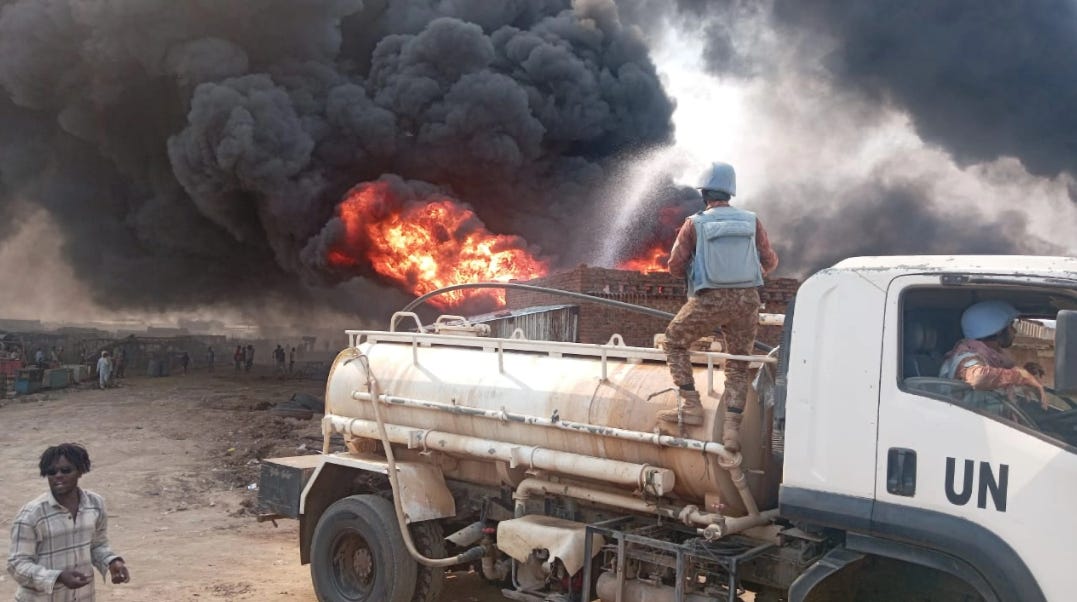
On 19 October 2026, a drone strike on Amiet Market killed over 150 people in Abyei, a disputed territory whose final status remains unresolved under an interim UN-backed administrative arrangement.
The attack exposes how cross-border supply networks that sustain local livelihoods also serve RSF operations, drawing civilians into Sudan’s war and putting an essential trading hub at risk.
UNISFA can respond to imminent threats to civilians but lacks the capacity and mandate to intercept drone attacks or ensure accountability, exposing the gap between necessary protection and the threat on the ground.
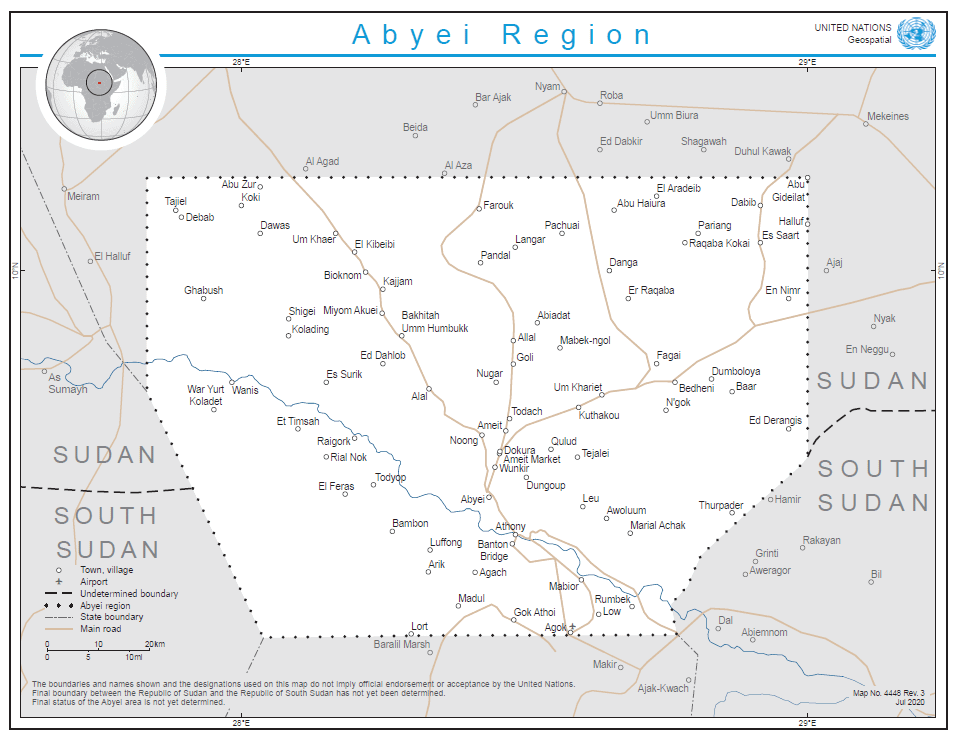
On 19 October 2026, drones struck Amiet Market in Abyei. The territory remains disputed, with both Sudan and South Sudan claiming it. As the two countries have yet to agree on Abyei’s final status or establish permanent joint administrative structures, an interim security arrangement, supported by the UN, administers the region. By 20th of October, Abyei’s caretaker minister, Yohana Akol Ngor, reported over 150 deaths, while others remained missing. South Sudan blamed Sudan’s Armed Forces (SAF), and in response, summoned Sudan’s ambassador to protest.
The strike hit a fuel depot that diplomats and analysts cited by Reuters describe as part of a supply route feeding the Rapid Support Forces (RSF). Indeed, according to Reuters, fuel imported into South Sudan passes through Abyei, where RSF-linked networks divert it into Sudan to sustain its military operations. The strike thus underscores the wider consequences of these supply networks: supply routes running through the disputed territory help sustain the RSF’s war effort, while civilians bear the consequences of a war fought across the border.
As Sudan’s war turns Abyei into a transit corridor, the strike on Amiet Market raises a hard question: has civilian protection in the territory failed, and if so, what would it take to fix that?
A war reaches a contested borderland
“Leaders in neither Sudan nor South Sudan have had the political will to resolve Abyei’s final status,” said Joseph Tucker, senior analyst for the Horn of Africa at the International Crisis Group. Tucker points to internal crises that have “prioritized time and resources” elsewhere. More significant, he said, are the Ngok Dinka and Misseriya, communities that form “important blocs in each country” and are likely to push their governments toward “a zero-sum approach,” which Tucker warned “could cause inter-communal violence between them” when neither country “can afford any more instability.” Thus, Abyei’s unresolved question has shaped its security environment for long, predating the current war in Sudan.
The war between the SAF and the RSF began in April 2023 and has increasingly affected Kordofan, which borders Abyei. Especially due to Abyei’s special status, describing the strike simply as the war “spilling into South Sudan” misses the uncertainty that has already shaped the region’s security for long. Indeed, the 2005 Comprehensive Peace Agreement designated Abyei as a special administrative area, with a referendum planned to determine its final status. Yet, such a referendum never took place. When South Sudan became independent in 2011, Abyei, in turn, became a contested territory, marked by violence, with both countries claiming authority and its final status remaining unresolved, as Tucker pointed out above.
Benedict Arwa, researcher and lecturer at the University of Nairobi and Zetech University, is also cautious about whether the strike should be read as an indication of the war spreading into South Sudan and emphasizes that “whether it spreads into South Sudan proper is a different and harder question, and the available evidence points to risk rather than inevitability.”
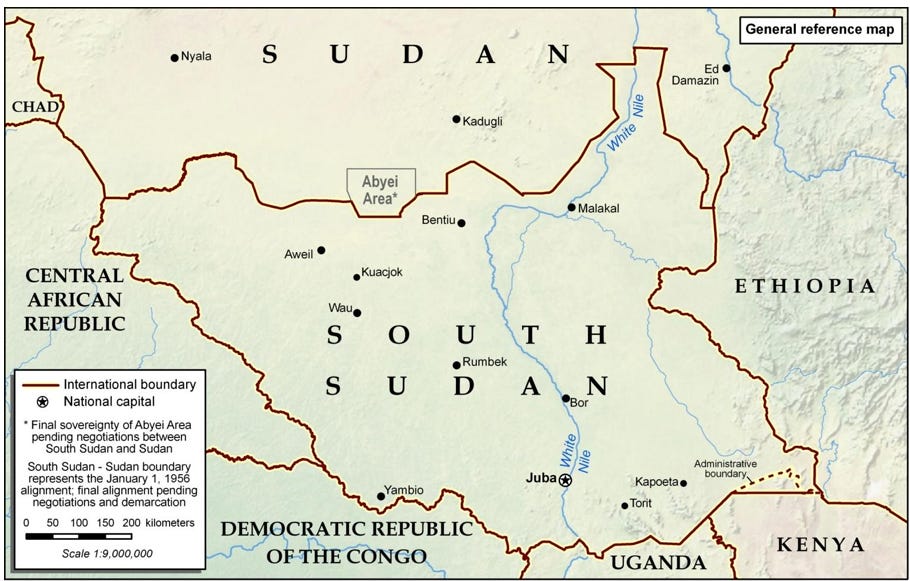
Notably, “the recent attack on Abyei fits into a pattern that has been building for about two years, and so far, it is one of the clearest cases of the war directly reaching a neighbor’s territory,” said Arwa. He sees this pattern through the humanitarian spillover into Chad and South Sudan in 2023 and 2024, the smuggling networks along the Chad axis, and more direct incidents since 2025, such as a December 2025 drone strike near Tiné, Chad. In Arwa’s words, “the Abyei incident was not an isolated case (…) it is a continuation of a trend of escalation of the war beyond the borders of Sudan.”
When a market becomes a military target
Amiet Market is a trading hub for essential goods between South Sudanese and Sudanese communities. The market was established through “inter-community dialogue” between the Misseriya and Ngok Dinka in 2016, it has become an important source of livelihoods and affordable food, with up to 10,000 people reportedly using the market each day.
Yet, the same cross-border trade that sustains livelihoods and provides an economic incentive for peaceful relations has also drawn the market into wider security concerns. As Tucker points out, Sudan’s porous borders have long been open to “illicit networks, smuggling, and movement of rebel groups,” now under “increased scrutiny” as reports grow of South Sudanese territory being used to move supplies into Sudan.
That said, the presence of suspected supply routes and wider security concerns do not, in itself, remove the obligation to protect civilians. International humanitarian law requires parties to distinguish civilians from military objectives. Claiming that fuel intended for the RSF does not automatically make everyone at the market a lawful target; an independent investigation would be needed to establish what the attackers knew and which precautions were taken.
The limits of peacekeeping
The mandate of the United Nations peace operation, authorized in Abyei, called UNISFA, includes protecting civilians under imminent threat of violence. Accordingly, following the strike UNISFA deployed medical personnel, firefighting equipment and quick-reaction forces. In May 2026, UNISFA had already warned that the RSF’s presence was increasing insecurity and put civilians and UN personnel at risk.
That matters, but it is not the same as preventing an airstrike. In fact, UNISFA’s mandate gives the mission no means to intercept drones or hold anyone accountable. The mission “was not designed to combat the widespread use of drones” now defining the war, Tucker said. Hence, if peacekeeping cannot prevent such attacks, what would it take to keep Abyei’s civilians safe in the future?
On the one hand, Tucker highlights that South Sudan “is unlikely to be able to prevent drone strikes in the area,” and its priority will likely be “trying to stay out of the conflict in its northern neighbor.” Arwa, on the other hand, is more specific. “One promising approach is to apply the Heglig model to Abyei,” he said. In December 2025, South Sudanese troops secured the Heglig oil field under a three-way deal with Sudan’s army and the RSF, while remaining neutral. Arwa suggested a similar written agreement for Abyei, “with Kiir as guarantor (...) however, Juba would need to offer something in return, likely addressing the supply-route issue the Sudanese army cites to justify its strikes.” Yet, Arwa also argues that “enforcement would remain difficult, since neither side fully controls all units or drone operators.”
A more far-reaching option, according to Arwa, would be to tighten inspections along the routes used to transport fuel and goods through Abyei. This, however, could mean lost revenue, resistance from traders and a likely RSF response. Arwa considered this option “only somewhat likely.”
Whose security is being decided?
Abyei shows that raising the alarm is not the same as protecting civilians. Despite earlier warnings, a busy market became the site of a deadly strike. As Arwa explained, “the unresolved status has left Abyei without the institutions needed to protect its population, while Sudan’s war has increased its value as a transit corridor.” Yet, Arwa stresses that “protection cannot wait for a final-status agreement but requires immediate measures (...) namely a functioning joint police force, an enforceable demilitarization commitment from both states, reliable deconfliction arrangements for strikes near Abyei, and a UNISFA mandate and resources that match the threats on the ground.”
Equally important, protection also means addressing the external support sustaining the war. Arwa pointed to such external powers that “supply the warring parties with means such as drones, weapons, fuel, and financing, and the political cover that lets both Sudanese sides keep fighting.” Although the UAE denies backing either side, Arwa said “ there is plenty of evidence it has supplied weapons to the RSF.” Moreover, Saudi Arabia has shifted towards the Sudanese army, partly in response to its rivalry with the UAE, while Egypt denies supplying weapons despite reports of a secret drone base. Arwa therefore calls for “a clear no-strike and no-transit agreement for Abyei, enforcing the current arms embargo on Darfur and limiting drone supplies.”
Concluding remarks
The recent drone strike confirms that Abyei’s civilians are neither protected of the states disputing their territory nor of the war being fought around them. Ultimately, Abyei’s unresolved status alone does not explain the strike, and the full circumstances remain to be established. The attack nevertheless exposes how unresolved sovereignty, regional supply networks and inadequate protection mechanisms converge at the expense of civilians. Protecting Abyei’s population requires more than diplomatic protests and emergency responses. It, in fact, demands accountability, practical measures to prevent further attacks, and a political process that gives the people living in Abyei a say in their future. Their security cannot remain secondary to the interests negotiated in Khartoum, Juba or international forums.