


Key Points
The US-led Pax Silica and China-led WAICO are distinctly different initiatives, and neither currently requires ASEAN members to pick one over the other. A recent US draft letter suggests changes to this, which puts pressure on ASEAN’s long-standing strategic ambiguity.
The region of Southeast Asia is not unified. The variety of their strategies reflects difficulty in arriving at a consensus on AI and may create a wide gap in technological capacity across member states.
Dr. Karryl Kim Sagun Trajano of RSIS captures the ASEAN approach: What unites ASEAN isn’t a shared stance on AI; it’s a shared instinct to keep options open and to stay flexible.” Its influence may come from interoperability and from shaping what companies can do within the region, rather than from writing hard rules.
Introduction
On August 14, Reuters released an article on a US draft to 35 members of the US Initiative Pax Silica. According to the letter, “To be part of everything is to be part of nothing. Signing Pax Silica is not merely a membership subscription, but a commitment.” Though this draft has not been confirmed, it reveals the US’ zeitgeist regarding the new digital economy; you cannot partake in China’s order if you want a seat at Washington’s table.
This creates an uncomfortable question for ASEAN. It has spent years cultivating strategic ambiguity between the world’s two largest powers. ASEAN has generally resisted being reduced to an arena for great-power rivalry, particularly US-China relations. Technology is now making that balancing act convoluted. The question then is: how does ASEAN navigate strategic and economic choices amidst the US-China tech competition, and is this rivalry reshaping ASEAN’s entire geopolitical strategy?
What are Pax Silica and WAICO?
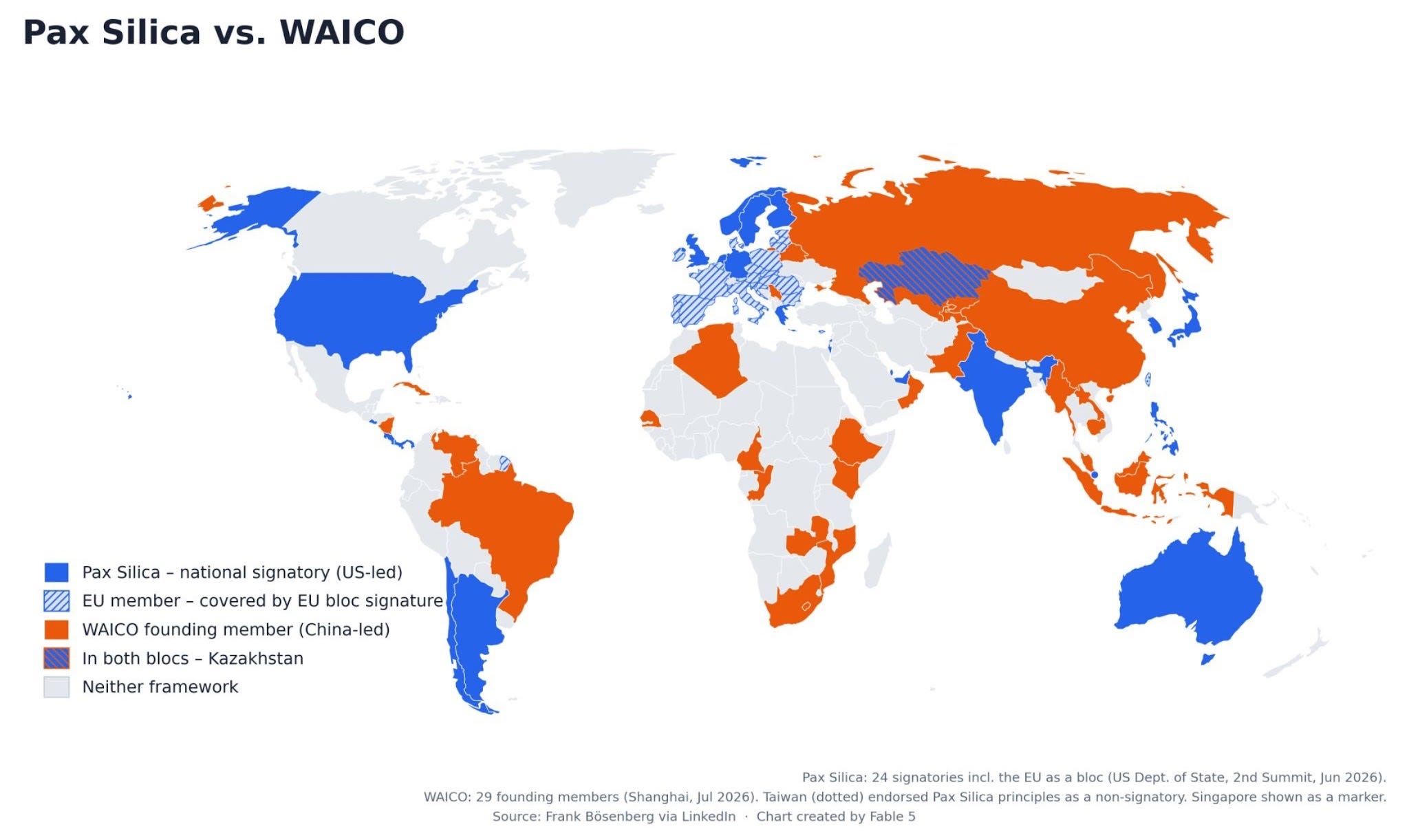
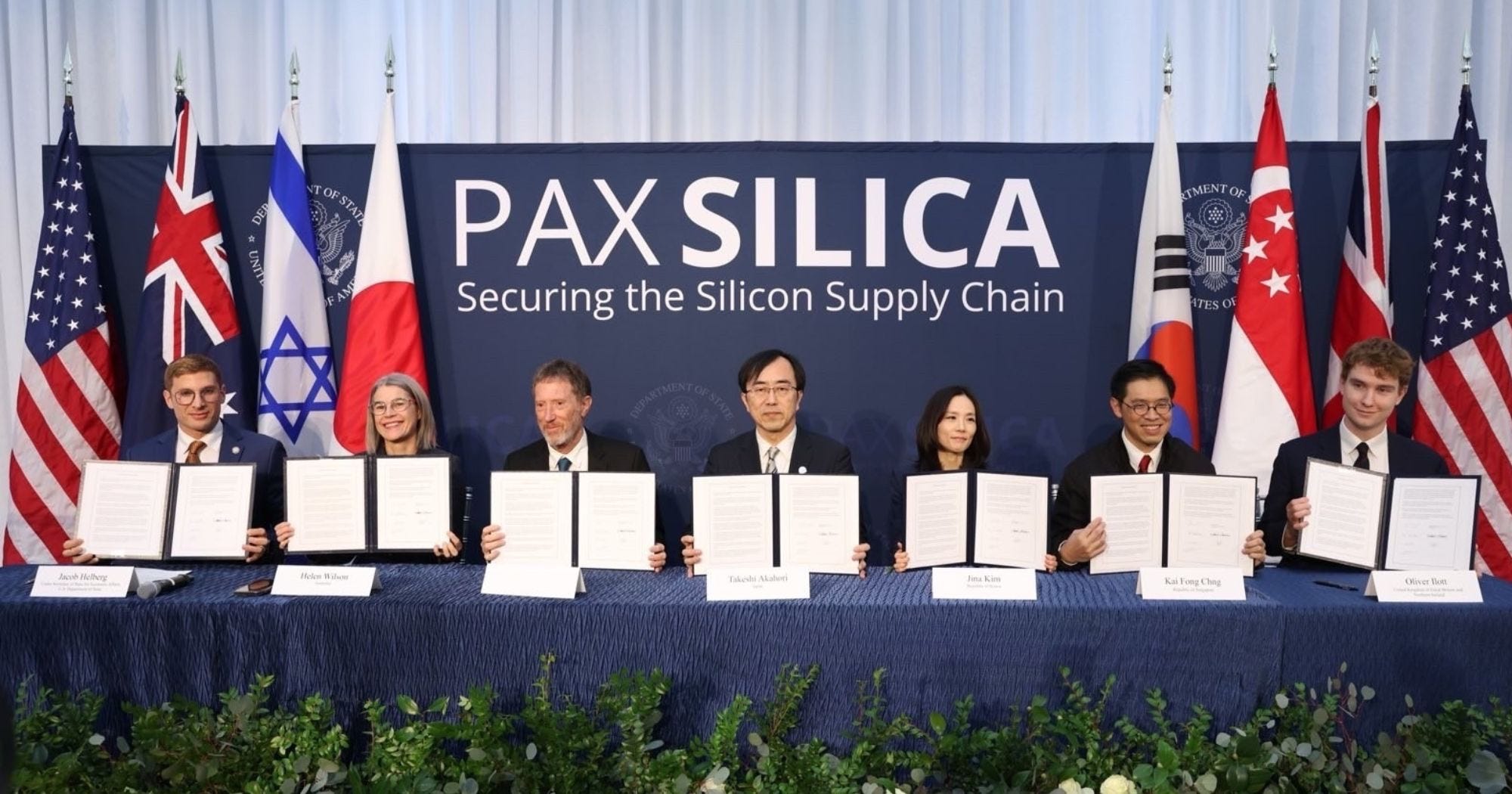
It is easy to categorize Pax Silica and WAICO as two opposing organizations created to rival one another. However, they are distinctly different. Pax Silica is a US-led coalition concerned with the tangible foundations of the AI economy. It aims to cover everything from critical minerals to semiconductor manufacturing and data centers. Its central premise is that technological security depends upon resilient supply chains and trusted economic partners. Singapore was among its founding participants in 2025, with the Philippines joining in 2026.
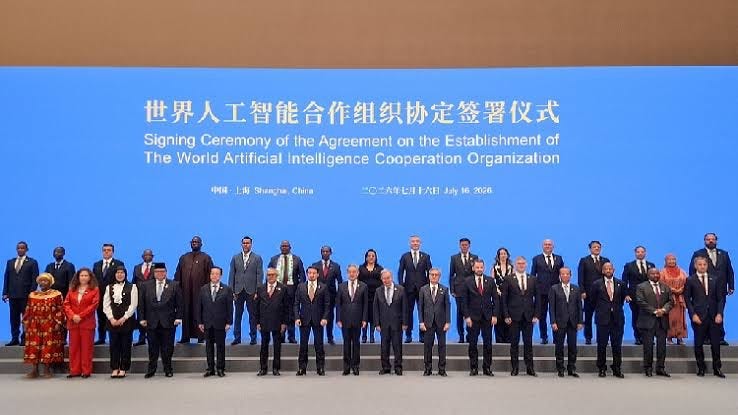
WAICO, on the other hand, was established by China as an intergovernmental organization and presents itself as a platform for international cooperation on AI. It focuses on international cooperation and capacity-building in partnership with Chinese developers, particularly for Global South countries. At its establishment in July 2026, 29 countries signed on, including Southeast Asian countries Indonesia, Malaysia, Laos, Cambodia and Myanmar.
When asked about the difference, Dr. Liu Han-Wei, Associate Professor of Law at Singapore Management University, explains, “Pax Silica is a supply-chain security arrangement, whereas WAICO is framed around AI governance cooperation. Neither presently functions as a regulatory regime requiring ASEAN members to adopt harmonized substantive AI rules, but both may influence access to chips, models, and compute.” At the moment, neither Pax Silica nor WAICO requires ASEAN members to adopt one and exclude the other. However, the most recent draft tells a different story and, with it, the possibility of further complications.
Southeast Asia’s Response
Southeast Asia’s response to the competing technological coalitions so far has been less of a choosing game and more one of keeping doors open. Even when the camps have already been chosen, these memberships have not proven to be exclusionary. Instead, three broad strategies are emerging across the region: alignment with a single coalition, engagement with both, and non-alignment through domestic self-reliance.
For the first strategy, the Philippines represents the clearest case. When Manila joined Pax Silica, it clearly aimed to build its focus on semiconductor and AI infrastructure through initiatives such as the Luzon Economic Corridor. Its approach places greater emphasis on integrating the country into US-led technology and supply-chain networks.
The more common strategy is to maintain strong relationships with both sides. For example, Malaysia and Indonesia have pursued significant economic engagement with the United States while also joining WAICO. Singapore has also chosen to take a similar approach. It has remained open to engagement with WAICO, even as a founding member of Pax Silica. As Minister for Digital Development and Information Josephine Teo noted, “There is no ASEAN Position on either WAICO or Pax Silica. Singapore therefore [will] consider the (WAICO) invitation alongside broader engagements with China and other international AI cooperation initiatives.”
A more interesting strategy has been that of non-alignment and self-preservation. The most interesting case of this can be seen with Thailand. Bangkok has not joined either coalition and has instead sought to strengthen its own technological capabilities. In July 2026, Bangkok proposed Siam Silica, a national roadmap intended to strengthen its semiconductor infrastructure and reduce vulnerabilities amid intensifying US-China competition.
It is uncertain which of these strategies are most effective, but their variety demonstrates that ASEAN is far from unified in how it understands the emerging digital economy. This fragmentation reflects not only differences in national interests and external partnerships, but also significant disparities in technological capacity across the region. As Dr. Karryl Kim Sagun Trajano of S. Rajaratnam School of International Studies notes, “ASEAN cannot impose one regulatory floor on all of that, so soft law isn’t a failure of ambition; it’s the only realistic option given the readiness gap. What unites ASEAN isn’t a shared stance on AI; it’s a shared instinct to keep options open and to stay flexible.”
ASEAN Governance Amidst it All
Amidst the hedging between competing technological ecosystems, ASEAN’s answer to the question of whether it can still make its own rules matter has traditionally been soft law. According to Dr. Liu, “The label ‘soft law’ describes the form of ASEAN-level instruments, but not the region’s entire regulatory landscape. These operate alongside domestic legislation, sectoral regulation and non-binding guidance.” The 2024 ASEAN Guide on AI Governance and Ethics illustrates this as it is voluntary, offering principles and recommendations rather than the binding obligations found in frameworks such as the EU AI Act.
When asked about the Guide, Dr. Trajano notes, “it has no teeth, and yet every member state has used it as the reference point for their own national playbooks.” For her, ASEAN’s diversity is precisely why this model exists. A common binding regime would be difficult to impose, notably seen with Singapore possessing a mature AI ecosystem while other member states are still developing basic technological capacity.
Additionally, the region influences norm-setting even beyond regulations, even without a strong framework. Take, for instance, the case of the January 2026 restrictions on Grok by Indonesia, Malaysia and the Philippines. The restrictive measures targeted concerns about harmful online content. This demonstrated how ASEAN member states can respond to shared AI-related harms without waiting for the ‘go signal’ from ASEAN. For Dr. Trajano, “That, to me, is where the influence actually bites: not in ASEAN writing rules, but in ASEAN shaping what global platforms feel they can get away with in this region.”
It cannot be discounted, though, how challenging a feat navigating Pax Silica and WAICO is for the region. With supply chains, infrastructure, and AI models becoming increasingly tied to geopolitical partnerships, ASEAN’s ability to maintain a shared regulatory space could face external pressure. The ability of their norms to function is now under interrogation. Dr. Liu, however, argues they might. “ASEAN may retain some scope to play a bridging role, because its framework uses a system-based vocabulary with broad international relevance”. This could mean ASEAN could provide a common reference point that allows different national systems to remain compatible. He elucidates further, “Much may depend on whether ASEAN-level soft law can serve as a common normative floor while member states build national ceilings of varying heights, and whether those layered approaches can support practical interoperability across the region.”
This can already be noticed in Vietnam and Thailand. The former has adopted AI laws, and the latter is considering proposals. Additionally, Singapore has adopted what Dr. Liu describes as an “adjacent-law model”. This entails using existing legislation and administrative rules rather than building AI legislation from the ground up. He notes, “effectiveness therefore cannot be inferred from legal form alone.” Moving forward, this may be ASEAN’s most important challenge. If ASEAN can maintain interoperability and speak a common regulatory language, this may allow it to project norms across both Pax Silica and WAICO.
The emergence of Pax Silica and WAICO places great pressure on the region to preserve the flexibility that has long defined its approach to competition amongst global powers. Though ASEAN’s diversity complicates the creation of a unified technological strategy, it also gives member states a plethora of avenues to engage and build capacity. In Dr. Liu’s perspective, “They may also shift how ‘trustworthiness’ is understood: from a property of an AI system, assessed through transparency and oversight, toward a question of origin.” Furthermore, the lack of structure may allow ASEAN regional states to respond and adapt more quickly as well. As Akhil Ramesh, Chief Development Officer of Pacific Forum, notes, “the initiatives could give ASEAN economies a global platform to leverage their comparative advantage for wider reach.” The challenge now is ensuring that this opportunity strengthens ASEAN’s technological agency rather than narrowing it.
Madiyev signed Kazakhstan's accession to Pax Silica on 25 June. Three weeks later Kazakhstan was one of the 29 founding signatories of WAICO. Neither text made the other impossible.
The hardware reads differently. Both Kazakh entries on the TOP500 run NVIDIA H200 — the operator describes Alem.Cloud as 64 HPE Cray servers with H200 accelerators. Huawei presented Ascend 950 and Atlas in Kazakhstan in May and counts more than two hundred local partners there, and has not named an installation.
Dual membership has not yet cost anything at the procurement layer, because nothing has had to be bought twice. What would test it is a tender whose conditions exclude one of the two ecosystems.