


In Summary:
Language is central to Ukrainian identity, and there are various accounts of Ukrainians shifting towards the Ukrainian language since Russia’s full-scale invasion.
Russia uses propaganda, historical narratives, and coercion to weaken Ukrainian identity and reduce support for Ukraine at home and abroad.
European support for Ukrainian-language education, culture and independent media can help preserve Ukrainian identity and counter Russian propaganda.
Why Language Matters in the Russo-Ukrainian War
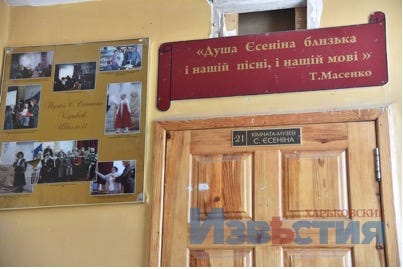
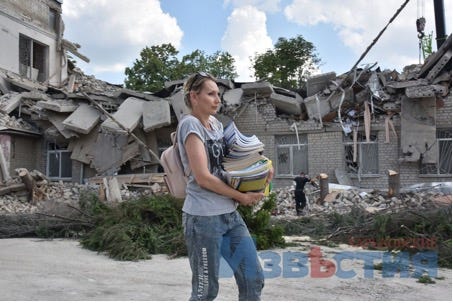
Before 2022, many Russian-speaking Ukrainians in cities such as Kharkiv rarely thought about the language they spoke. Russian was the language of education at schools and universities. For example, school №17 in Kharkiv (destroyed by the Russians in 2022) housed the only museum in Ukraine dedicated to the Russian poet Sergei Yesenin. However, after Russia’s full-scale invasion in 2022, the share of Ukrainians who spoke Ukrainian as their primary language rose from44% in 2012 to 57.4% in December 2022, and to 68% by August 2025. The street artist Gamlet Zinkivskyi explains this switch: “Unfortunately, I grew up speaking Russian, but it’s not pleasant to speak the same language as the army that is destroying whole areas of our country”.
For many Ukrainians, language has become a marker of national identity. Russia’s war, however, shows how language can not only construct identity, but also deconstruct it. While presenting its invasion as an effort to “protect” Russian-speaking Ukrainians in Donbas, Russian authorities in occupied territories have imposed Russian curricula, restricted Ukrainian-language education, and destroyed Ukrainian books. Ukrainian has thus become another target for Russification.
This article answers the question of how Russia has used language to demolish Ukrainian identity, and what this means for European security.
The Power to Construct and Deconstruct Identity
Language has never been simply a means of communication. By shaping how people think, feel, and perceive the world, it can construct and deconstruct identities. In wartime, these processes become battlegrounds, and language becomes a weapon.
Language shapes people from early childhood. In an interview with HIG, Anzhelina Chopikyan, a teacher of Ukrainian at School No. 17 in Kharkiv, explains that the language children first hear becomes part of how they express their sense of self later in life. It is one of the early building blocks of identity.
In the eighteenth and nineteenth centuries, language became an essential tool of nation-building. Camiel Hamans, a linguist and a former secretary general of the Dutch social democrats in the European Parliament, points to nineteenth-century linguistic essentialism, when the idea of “one people, one nation, one language,” linked to German Romanticism, helped unite separate German regions under a single state in 1871. In post-Revolution France (1789), the state promoted French at the expense of regional languages. These historical examples show that language can unite a population under a common national identity, but it can also marginalise identities that do not fit that model.
Additionally, language has been treated as a symbol of prestige. As Hamans explains, one language can signal education, trustworthiness, and power, while another can be treated as inferior. Over time, people would gradually abandon the latter, because speaking it came at a social cost.
Propaganda can reinforce this process. As Egbert Fortuin, Professor of Russian Language and Linguistics at Leiden University Centre for Linguistics, explains in the interview with HIG, media, education and political institutions can shape public perception by portraying only selected facts and omitting context. For example, Russian state-controlled television has repeatedly portrayed Ukrainians as Nazis. In 2014, Channel One Russia aired a widely discredited story alleging that Ukrainian soldiers had crucified a child in Sloviansk. Such messages can portray one nation as dangerous or evil and make hostility towards them easier to justify.
This reveals a contradiction about language: the same tool that helps a nation define itself can be used to deny another nation the right to do so.
Russia’s Attempt to Demolish Ukrainian Identity
Russia’s attempts to suppress the Ukrainian language follow the historical pattern. The Valuev Circular of 1863 restricted Ukrainian-language publishing in the Russian Empire, while the Ems Ukase of 1876 banned most Ukrainian-language publications, their import from abroad, and public readings and performances in Ukrainian. During Russia’s full-scale invasion, this pattern has intensified in occupied territories: Russia’s Ministry of Education Order No. 729, which came into force on 15 December 2025, removed Ukrainian language and literature from federal primary and lower-secondary education programmes.
“Ukraine is dealing now with the consequences of a multi-century war for its identity.”
Anzhelina Chopikyan
Hamans argues that Russia seeks to “demolish Ukrainian identity at its spine”, using three mutually reinforcing methods:
The first is pressure from within. Russian state media have portrayed Ukrainian as an inferior “village dialect” of Russian. More recently, in June 2024, pro-Kremlin posts falsely claimed that the UN had recognised Ukrainian as a dialect of Russian. Such claims reinforce the idea that Ukrainian is inferior, potentially encouraging families to steer their children toward favouring Russian.
The second is a historical myth. The concept of a single Russian nation, the Russkiy Mir (“Russian World”), is the idea that Russia, Ukraine, and other neighbouring societies belong to one Russian-centred cultural and political space. Putin’s 2021 essay, “On the Historical Unity of Russians and Ukrainians”, first frames Ukrainian as a regional dialect within a single Russian people, then portrays the separate Ukrainian language and national identity as threats to Russian speakers.
The third element is force, which comes when persuasion fails. Human Rights Watch documented Russian authorities replacing Ukrainian schooling with the Russian curriculum and restricting Ukrainian-language instruction. In the occupied Luhansk region, Ukrainian authorities reported that about 22,000 Ukrainian history textbooks were seized from schools in June 2022; in Borova, Kharkiv region, teachers later reported that occupying forces burned some Ukrainian books and took others before retreating.
The methods used to target the Ukrainian language have evolved alongside changes in media. According to Egbert Fortuin, digital media have expanded the reach of Russian propaganda. Vladimir Solovyov, a presenter on Russian state television, uses his programme to advance Kremlin narratives; major state channels such as Channel One and Rossiya-1, as well as Telegram channels and bot networks, amplify similar messages. Their aims, Fortuin explains, are twofold: (1) sustaining support for the war inside Russia and (2) weakening support for Ukraine among audiences abroad.
For many, Russian propaganda appears persuasive. Propaganda does not have to invent everything, Fortuin highlights; it is enough to draw misleading conclusions from the presented facts. Putin’s 2021 essay “ On the Historical Unity of Russians and Ukrainians” illustrates this well. The essay presents Russians and Ukrainians as one historical people, then casts the Ukrainian language and a separate Ukrainian identity as threats to Russian speakers. This manipulation allows the Kremlin to portray Ukraine as both inseparable from Russia and dangerous when it exists independently.
Through language, Russia attempts to deconstruct the history, culture, and sense of belonging that give Ukrainian identity its meaning.
Ukrainian Identity and European Support
Russian propaganda also seeks to undermine European support for Ukraine and fuel unrest within European societies. As Camiel Hamans warns, the Kremlin’s efforts to spread the Russkiy Mir worldview abroad, together with the growing presence of Putin’s far-right supporters in Europe, pose a challenge to European unity in its support for Ukraine.
However, language can strengthen EU–Ukraine ties. The EU promotes multilingualism and has 24 official languages, reflecting language’s place in the Union’s cultural heritage. Under the precedent set by previous enlargements, Ukrainian would be expected to become an official EU language if Ukraine accedes. This would give Ukrainian a stronger institutional role, although, as Hamans cautions, EU membership alone cannot guarantee the language’s protection, since many rules governing language use within Member States remain primarily national responsibilities. Protecting Ukrainian therefore requires action beyond the accession process. One example is the European Citizens’ Initiative “Preservation and development of Ukrainian culture, education, language, and traditions in EU states”, registered by the European Commission on 16 August 2023. It called for stronger EU action to support Ukrainian refugees while preserving their language and culture.
In practice, European support could mean funding Ukrainian-language teaching and learning materials, supporting Ukrainian publishers and cultural organisations, and helping independent Ukrainian-language media reach displaced communities. Anzhelina Chopikyan argues that Europe must recognise Ukraine as part of their shared cultural history and not as a distant country on the continent’s periphery. At a time when Russian propaganda seeks to strip Ukraine of its place in Europe, language can help deepen Europe’s understanding of Ukraine and strengthen its support for the country.
Protecting Ukrainian Identity Through Language and Education
Over the past decades, Ukrainians have had to decide not only what language to speak but what kind of nation to become. Egbert Fortuin notes that both Ukrainian and Russian have long been spoken in the country, and that speaking Russian has never made Ukrainians feel any less Ukrainian. However, Anzhelina Chopikyan argues that the war has accelerated this nation-building process. For many Ukrainians, speaking Ukrainian has become a way of affirming their national identity, while Russian has increasingly become associated with the language of the enemy.
Education plays an important role in helping people recognise and resist attempts to manipulate their perceptions and sense of identity through tools such as propaganda. Egbert Fortuin argues that Russian propaganda also targets younger generations, shaping their perceptions before their critical-thinking skills are fully developed. While the older generation primarily watches state-controlled television, young people fall victim to new media propaganda and ideological indoctrination in schools, implemented through changes to the curriculum. He therefore stresses the importance of education and critical thinking.
A well-educated mind is one of the best defences against propaganda.
Egbert Fortuin
Anzhelina Chopikyan similarly stresses the importance of education from an early age: “The children educated in Ukrainian schools since 1991 are the heroes who are now defending the country,” she says.
The case of Ukraine shows that even something as subjective as language can have material geopolitical effects. Geopolitical analysis often focuses on objects, such as states, territory and resources, while paying less attention to subjects: the people whose identities and choices shape these realities. It also demonstrates how attacks on language and identity can help legitimise aggression against a nation. Russian propaganda has helped facilitate this process through media propaganda that shapes perceptions among Russian, Ukrainian and European audiences.
When Ukrainian identity is weakened, Russia gains more room to portray Ukraine as part of its own political and cultural space, potentially eroding European public support for Ukraine. The forcible erasure of a nation’s language and identity would set a dangerous precedent in Europe, normalising the idea that a neighbouring power can erase another nation’s identity. European governments and institutions should therefore invest in Ukrainian-language education, culture and independent media as part of European security policy. Strengthening critical thinking about Russian narratives and developing a better understanding of Ukrainian language and culture are essential to counter Russian influence across European societies, and to strengthen European support for Ukraine.
“To extinguish a language means to extinguish people’s identity.”
Camiel Hamans
In this war, language is one way in which Ukrainians declare who they are and what they refuse to give up.