


In Summary
From bromance to rift: The warm relationship between Trump and Modi during Trump’s first term (2017–2021) – characterised by joint rallies and economic cooperation – has completely turned into a trade war and political estrangement by 2025.
Escalation via tariffs: Within a few months, Trump imposes hefty import tariffs (two rounds of 25% each), rendering around 70% of Indian exports to the US unsustainable and causing ongoing free trade negotiations to collapse.
Trump’s arguments: Trump accuses India of unfair trade practices, misuse of H1B visas, lining Russia’s war chest through oil imports, and military cooperation with Russia (including fighter jets and drones).
Indian response: India rejects this interpretation, views the measures as a containment policy similar to that against China, and has chosen to continue following its own path, backed by its BRICS partners and with growing support from China.
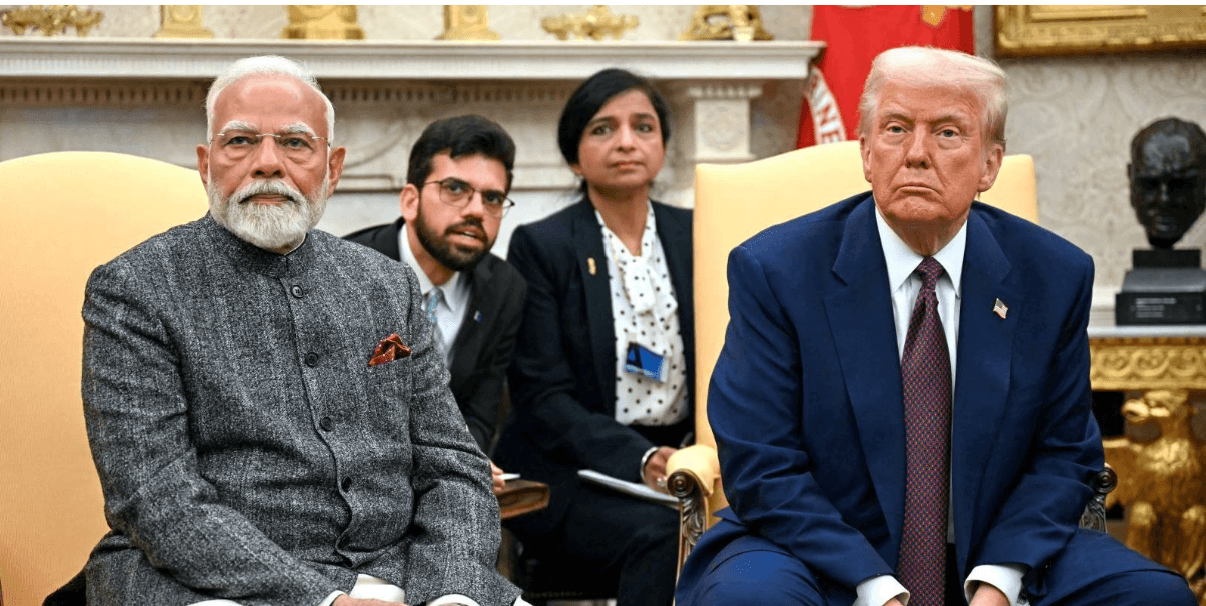
India Regional Update | Little remains of the alleged ‘bromance’ between Modi and Trump. Nevertheless, expectations were high following the US elections in November 2024. Trump’s re-election and the start of his second term in early 2025 were, according to many, set to breathe new life into the relationship between Washington and New Delhi.
During his first presidency (Trump I), Trump built on the cooperation with India that had been growing for decades, primarily in response to China’s rise. In 2019 and 2020, this rapprochement was evident in two massive rallies: Howdy, Modi! in Houston and Namaste Trump in Ahmedabad.
Under Trump I, companies such as Apple were offered incentives to relocate their production from China to India. This led to billions in investment in the Indian economy. In addition, India was officially positioned as a strategic partner in the power struggle with China, whilst Pakistan was sharply criticised as an unreliable ally. Geopolitical alignment improved, trade grew, military cooperation was expanded, and an increasing number of Indian STEM specialists found work in the US.
It was therefore no surprise that, in February 2025, Modi was one of the first world leaders to travel to Washington. His aim: to strengthen ties with Trump once again following the cooler Biden years and to kick-start new free-trade negotiations. It seemed the beginning of a promising new phase.
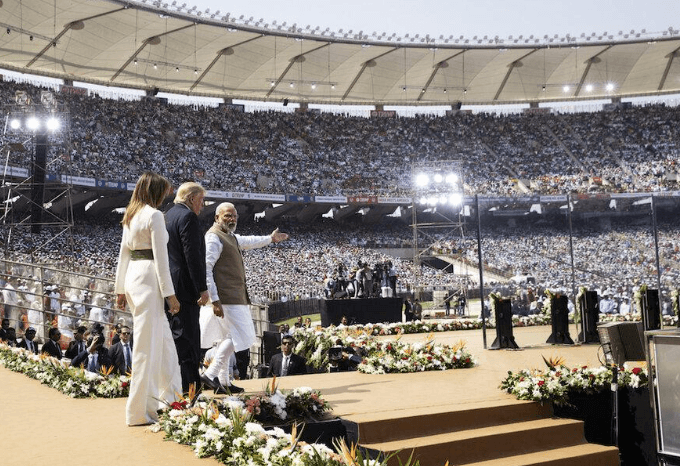
(Photo: the Namaste Trump rally in 2020)
Six months later, people might well be talking about one of the biggest geopolitical break-ups of the 21st century. What began as a red rose of cooperation has now turned into a black, withered flower.
On 2 April 2025, Trump announced a 25 per cent tariff on Indian goods, made visible with his famous tariff board. That measure came into force on 1 August. Barely a week later, on 6 August, a second round followed: another 25 per cent in tariffs, which were introduced on 27 August. The result: in the space of a single month, nearly 70 per cent of Indian exports to the US were brought to a standstill. For the time being, 30 per cent was spared, but the blow was severe. After all, the US accounts for around 20 per cent of India’s total exports, and the free trade negotiations between the two countries were already nearing completion after five rounds of talks.
Within a matter of weeks, the Indians witnessed Trump’s transformation from partner to betrayer. And that is without even taking into account the increasingly close relationship between Trump and the Pakistani military regime – following the four-day war between India and Pakistan in May 2025. For India, one harsh lesson remains: in today’s geopolitics, there are no friends, only temporary allies.
The reasoning behind Trump’s heavy tariffs on India – the Trump perspective
The first round of 25 per cent tariffs was defended by Trump and his trade adviser Peter Navarro on the grounds that India had an excessive trade surplus with the US — $45.8 billion in 2024 — whilst at the same time imposing high tariffs and other barriers on American companies. Shortly afterwards, the tone shifted: suddenly, the issue was linked to H1B visas. According to Trump, Indians were abusing the system, as they claimed 70 to 75 per cent of these work visas annually and were thus taking ‘high-quality jobs’ away from Americans.
The image of India became increasingly negative. Washington portrayed the country as one that was taking advantage of the US, of American companies and of American workers. It was the same harsh rhetoric that Trump also used against European and other Asian partners. India, the White House argued, had to make further concessions in the ongoing free trade negotiations and, moreover, cooperate in curbing Indian migration — both legal and illegal — to the US.
In contrast, the US claimed that American companies were ‘entitled’ to unhindered access to the Indian market: 1.4 billion consumers in an economy that has grown by an average of around 7 per cent in recent years and has now become the world’s fourth-largest economy, with a size of nearly four trillion dollars.
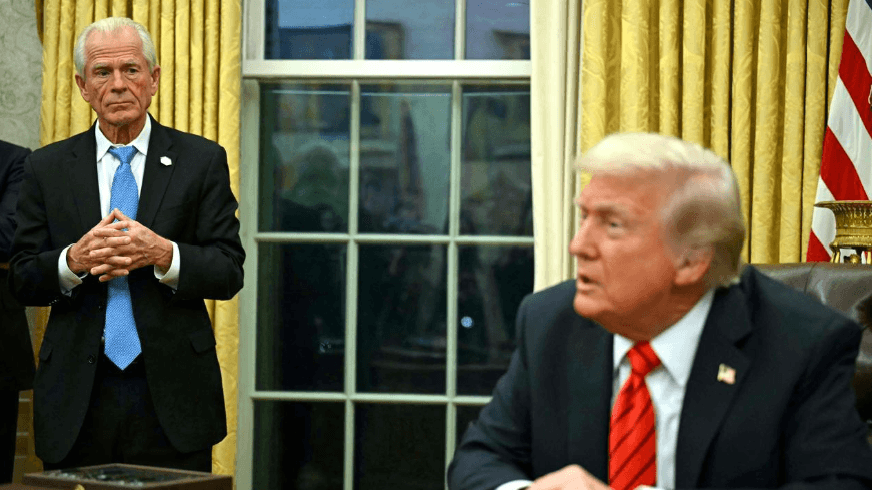
(Photo: President Trump with his trade adviser Peter Navarro)
As the weeks went by, more and more issues came to the fore. Whilst during his first term Trump urged US companies to move production out of China and invest in India, the tone in his second term is quite different. Companies are now being pressured to scale back their operations in India and shift production to the US as much as possible. Apple was even personally taken to task by Trump over its expansion in India — a signal that may be linked to the bleak employment figures in the United States. Meanwhile, anti-Indian rhetoric in the MAGA camp is on the rise, and is increasingly taking on an openly racist tone.
India’s role as a founding member of BRICS-plus is also a thorn in Trump’s side. In his view, New Delhi is undermining American power by promoting multipolarity and actively encouraging alternative trade financing outside the US dollar. In doing so, he argues, India is demonstrating that it is not a reliable partner for the US.
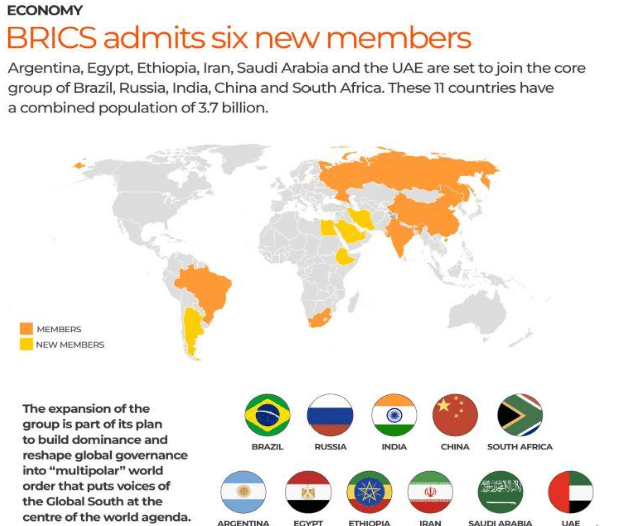
(Image: BRICS Plus with the recent expansion)
Trump justified the second round of 25 per cent tariffs by arguing that India is filling Russia’s war chest. Since the invasion in 2022, Indian imports of Russian oil have indeed grown explosively: whereas New Delhi previously purchased hardly anything, it now accounts for half of Russia’s total exports. “India is funding Putin, doesn’t care about Ukrainian lives and is imposing costs on the American taxpayer,” said trade adviser Peter Navarro. He failed to mention that since Trump’s second term, US support for Ukraine has virtually ground to a halt.
But the criticism goes further. According to Trump, India is also exploiting the war in another way. Whilst Western countries have drastically cut back on their Russian oil imports, India — together with China — is taking over the volumes that have become available, at substantial discounts. Russian tankers from the so-called ‘shadow fleet’ deliver the oil to Indian refineries, which then resell it.
Trump claims that India exports this oil to Europe at enormous profit margins, thereby shamelessly profiting from a war that he himself says he wants to end. In doing so, the argument goes, India enables Russia to circumvent Western sanctions and weakens the position of the US and Europe. (Part II of this series explains why this picture is inaccurate and why the West has in fact encouraged India to do just that.)
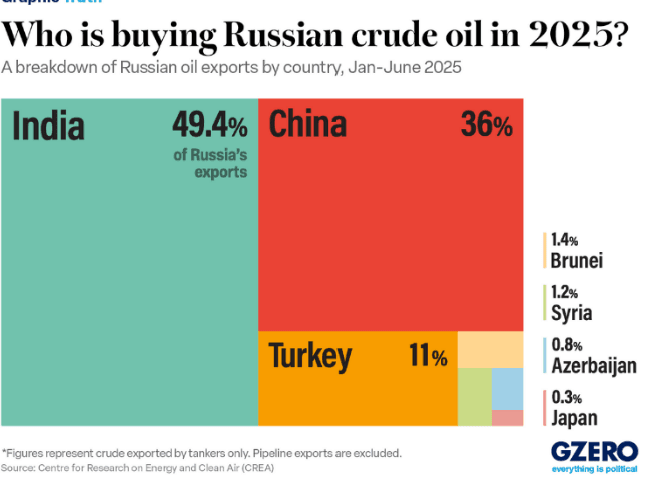
(Image: Russian crude oil exports in 2025)
And then there is the military dimension. According to Trump, India is deepening its cooperation with Russia by supplying components for Russian drones and by continuing to import weapons from Moscow on a massive scale. In doing so, the accusation goes, New Delhi is not only keeping the Russian arms industry afloat, but is even helping to expand it further — although it is glossed over that total Russian arms exports have plummeted by 64 per cent since the invasion.
Furthermore, according to US sources, India is considering gaining access to the SU-57 Sukhoi, a fifth-generation fighter jet, via Russia. Moreover, New Delhi is working with Moscow on the joint development of its own aircraft of that calibre — rather than opting for the American F-35. For Trump, these are more than enough signs that India is turning its back on Washington.
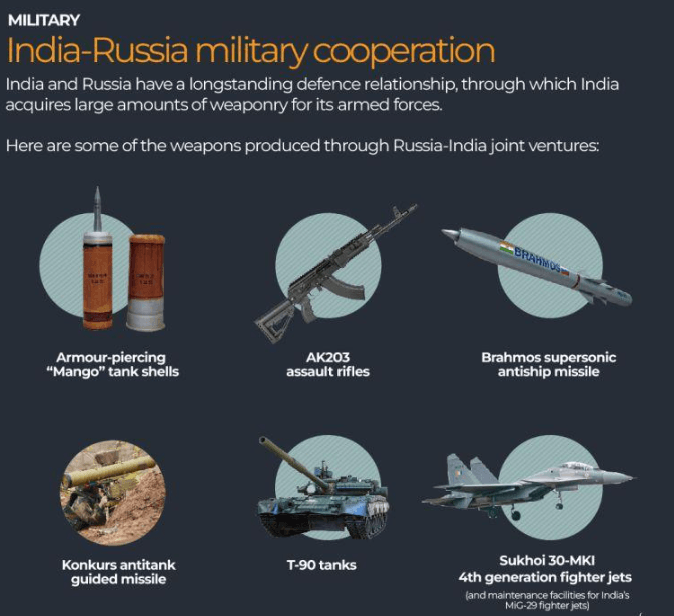
(Image: Indian defence imports from Russia)
India takes a completely different view
According to New Delhi, Trump’s reasoning masks the real motives behind his sudden rift with India. In India’s view — and particularly given the weak reasoning put forward by trade adviser Peter Navarro — this is not about trade surpluses or oil, but about a broader strategy of containment. Just as with China, the interpretation goes, Washington is attempting to contain India.
The Chinese embassy in New Delhi has since aligned itself with this view and declared its “firm” support for India in its battle against the US trade war. According to Beijing, India must prepare for the same geopolitical pressure and attempts at containment that China has been experiencing for some time.
India itself is, for the time being, refusing to go along with Trump’s narrative and has chosen to continue on its own course. The next instalment in this series will discuss why New Delhi resolutely rejects Trump’s reasoning, what alternative explanations it considers plausible for the US change of course, and how the EU is unexpectedly playing a role in fuelling this crisis.
This article was translated, find the original here.
