


In Summary
F-16s, HIMARS, Storm Shadow, Leopards: all ‘game-changers’ according to the media, which were said to be the key to turning the tide in Ukraine, not least because they were supposedly many times better than Soviet-era equipment.
In the defence sector, there are no ‘game-changers’ that make it possible to win easily.
It’s all about the balance and complementarity of different weapon systems, although there are indeed systems that are truly indispensable.
Game-changers in Ukraine?
Defence Regional Update | If there is one thing that stands out in the military aid provided to Ukraine over recent years (and certainly since the large-scale Russian invasion in February 2022), it is the hesitant stance of Western countries when it comes to supplying certain weapons. Time and again, governments have hesitated, worried that Russian ‘red lines’ might be crossed. After more than three years of war, it is quite clear that the Kremlin’s red lines are suffering severely from inflation. However, the influence of these so-called red lines was amplified by the way Western weapons were discussed in the media.
Every new system was said to be a ‘game-changer’ that would alter the course of the war. In the early stages, this mainly concerned anti-tank weapons, such as the illustrious Javelins, which played an undeniably important role in destroying Russian tank columns around Kyiv. Subsequently, the focus often shifted to the alleged superiority of Western artillery, Western tanks – such as the Leopard 2s supplied by the Netherlands – Western fighter jets (think of the F-16 debate) and, perhaps most controversially, the supply of long-range missiles such as ATACMS and Storm Shadow.
What all these systems have in common is that they are, in fact, the equipment NATO would use in the event of a conflict with Russia. Rather than systems purchased abroad or obsolete equipment from reserves, these were relatively modern systems, drawn directly from the arsenals of NATO and its member states. This also gave rise to high expectations: state-of-the-art Western weapons would surely make short work of the ‘old-fashioned’ Russian armed forces.
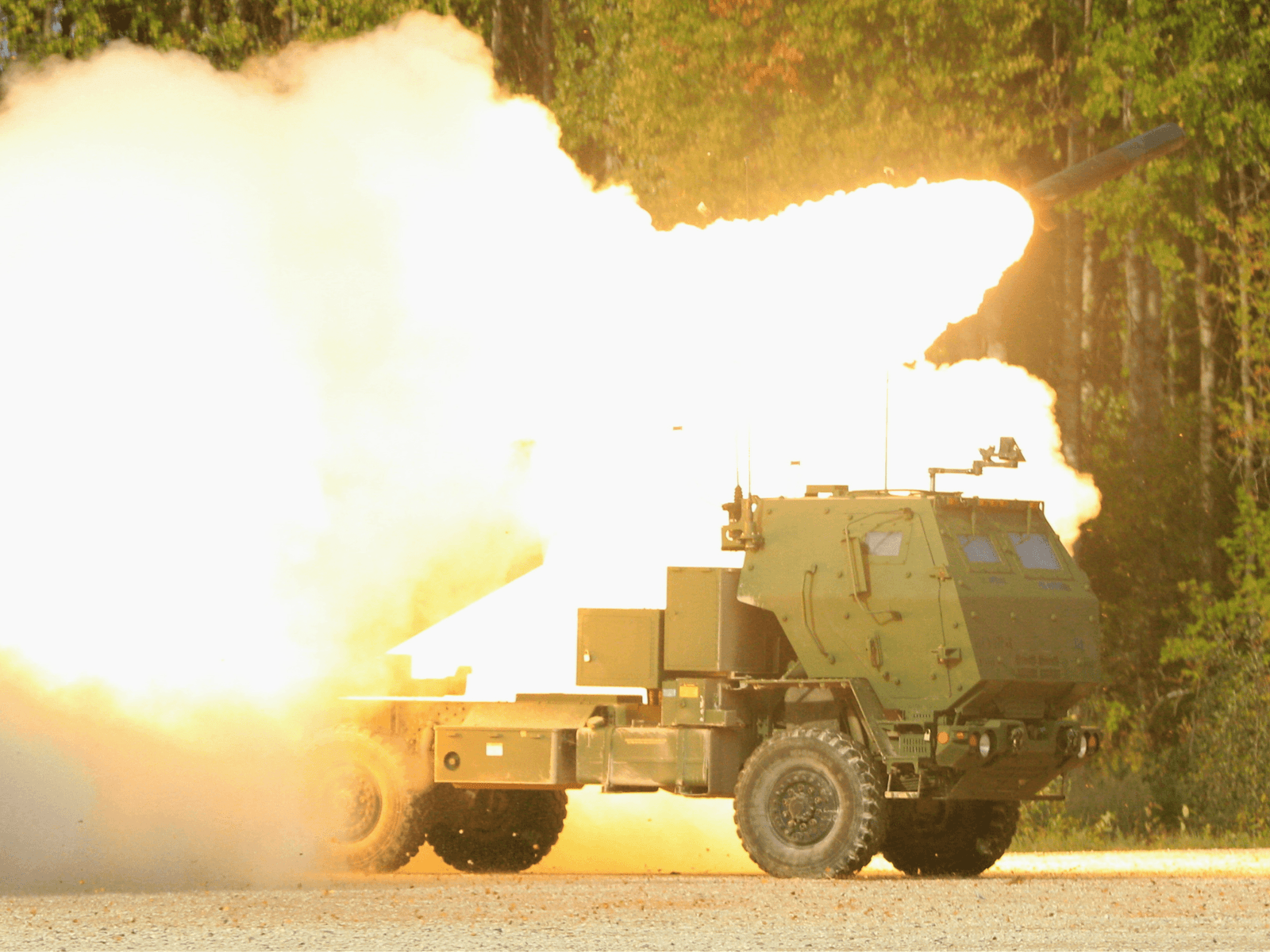
Many Western systems are playing a key role in Ukraine: PATRIOT systems are protecting cities such as Kyiv from Russian ballistic and cruise missiles. F-16s are shooting down drones and providing air support to troops on the front line. Dutch YPR armoured tracked vehicles protect infantry from artillery strikes, and American HIMARS rocket artillery has had a massive impact on the Russian rearguard. Yet there has been no turning point on the front line.
Why no game-changers?
How is it that all this military aid has not led to a massive change on the battlefield? First and foremost, the numbers are a problem. The war in Ukraine is extremely intense, resulting in high material losses. Consequently, the delivery of, for example, 31 Abrams tanks by the US makes hardly any difference.
What’s more, the multitude of different systems also creates logistical challenges: the Ukrainian army now operates thirteen (!) different types of tanks, with five different types of ammunition and highly complex supply lines for repairs and spare parts.
Furthermore, the political wrangling within Western governments meant that the delivery of certain systems had no element of surprise whatsoever. The Russian armed forces were able to anticipate the arrival of certain systems and adjust their strategy even before the systems were actually deployed. And even when governments proceeded with secret deliveries, information regularly leaked through the media before the deliveries had taken place.
But the most important point is that the delivery of a single specific system, even in large numbers, does not amount to a complete transformation. The delivery of, for example, more than a hundred Leopard 2 tanks (as happened a few years ago) or dozens of F-16s (as is currently taking place) does not mean that the Ukrainian army or air force is suddenly fully modernised. In addition to the delivery of weapon systems, training, personnel, ammunition, integration into communications systems and maintenance are also required – all of which are in short supply. A tank is a powerful weapon, but its true strength lies in its interaction with other systems, such as artillery, air support, intelligence, communications and reconnaissance.
A painful example of this is the 155th Mechanised Brigade. It was supposed to be fully trained and equipped in France. However, there were problems with personnel deserting, the brigade was not deployed as a single unit, and the commander was arrested. But perhaps even more strikingly: the brigade was not equipped with drones or electronic warfare equipment, such as ‘jammers’. These are assets that are indispensable on the battlefield in Ukraine, and their absence leaves a unit highly vulnerable. The brigade may well have been trained to Western standards, but these do not translate directly to what is required on the front line in Ukraine.
Finally, Russia is also adapting. After three years of war, and countless failed and successful operations, the Russian armed forces now know the weak spots of even the most modern Western systems. For instance, GPS-guided weapons can be successfully jammed, thereby reducing their effectiveness, and thanks to investments in, for example, (kamikaze) drones and surveillance, Russia regularly succeeds in repelling Ukrainian attacks using Western equipment.
For instance, Russia has successfully destroyed HIMARS and PATRIOT systems, taken out part of Ukraine’s Leopard 2 fleet using compact FPV drones, and neutralised artillery using Lancet drones. Although the front line in Ukraine is very static, the opposite is true of military developments, which are unfolding at a very rapid pace – and are therefore barely being kept up with by the Western defence industry.
So what is the answer?
What, then, is the key to success? Ultimately, the strength of any military formation lies in its ability to ensure that different systems work together successfully. Every system has weak points, which must be covered by other systems. For example, a tank such as the Leopard 2 is the best-protected vehicle with very heavy armament – but it is vulnerable to infantry armed with anti-tank weapons and well-aimed drones. That is why, in today’s theatre of operations, a tank must be accompanied by short-range air defence against drones, whilst infantry and reconnaissance drones are needed to detect enemy infantry armed with anti-tank weapons.
The strength lies in mitigating the vulnerabilities of individual units or systems, thereby enhancing the overall strength of the formation. It was precisely these kinds of weaknesses that ultimately caused the Russian invasion of Ukraine in 2022 to falter: tanks were deployed without infantry or reconnaissance units, leaving them easy prey for small groups of Ukrainian infantry equipped with anti-tank weapons who were able to set up successful ambushes.
The bottom line is that supplying a single system will never be the ‘game-changer’. This holds a lesson not only for how arms deliveries are discussed in the media and in politics, but also for the armed forces themselves: cutting back on a single component (such as tanks or short-range air defence) creates a ‘gap’ that is many times larger than expected. Essentially, an entire unit can be put at risk if just one element is missing.
As a result, the Netherlands is now rushing to reacquire precisely those capabilities that were cut a decade ago – and at a much higher cost. To illustrate: around ten years ago, the Netherlands sold one hundred Leopard 2 tanks to Finland for two hundred million euros, but is now spending between one and two and a half billion euros on the purchase of 46 new Leopard 2 tanks. Sixty anti-aircraft guns were also sold to Jordan for a mere 21 million euros – which Jordan subsequently sold to the US for 110 million dollars for delivery to Ukraine.
For policymakers
Do not be swayed by talk of ‘game-changers’. It is only very rarely that a system is decisive or can actually replace a large number of existing systems.
Temper (public) expectations regarding the significance of a very limited number of Western systems being supplied to Ukraine.
Recognise that any military formation is only as strong as its weakest link and that arbitrarily cutting back on certain capabilities jeopardises the entire formation. Therefore, exercise caution when selling off seemingly ‘surplus’ equipment.