


Summary
The Kaladan Project (KMMTTP) is meant to connect India’s Northeast with Myanmar’s Sittwe Port, reducing dependence on the Siliguri Corridor and strengthening trade and regional connectivity.
The route runs through Rakhine and Chin States, which are heavily affected by the Myanmar conflict, which poses security risks for the project
Dr. Datta and Dr. Routray consider completion by 2027 unlikely and explain security concerns while Ms. Banerjee stresses that the project’s value depends on stability along the corridor.
Introduction
In 2008, India signed a Framework Agreement with Myanmar on the construction of a transport facility along the Kaladan River, with the objective of enhancing bilateral relations and economic cooperation. The project was initially planned to be completed by 2014, but it has experienced several delays and missed the completion deadline of 2023. Security concerns around the project date back to 2019, when India supported a joint operation with Myanmar’s army against the Arakan Army, known as Operation Sunrise, to avert a possible threat to the project. Today, while the route is set to be operational by 2027, the expected strategic value of the project could also become a security liability with the changing political situation in Myanmar.
The Kaladan Project
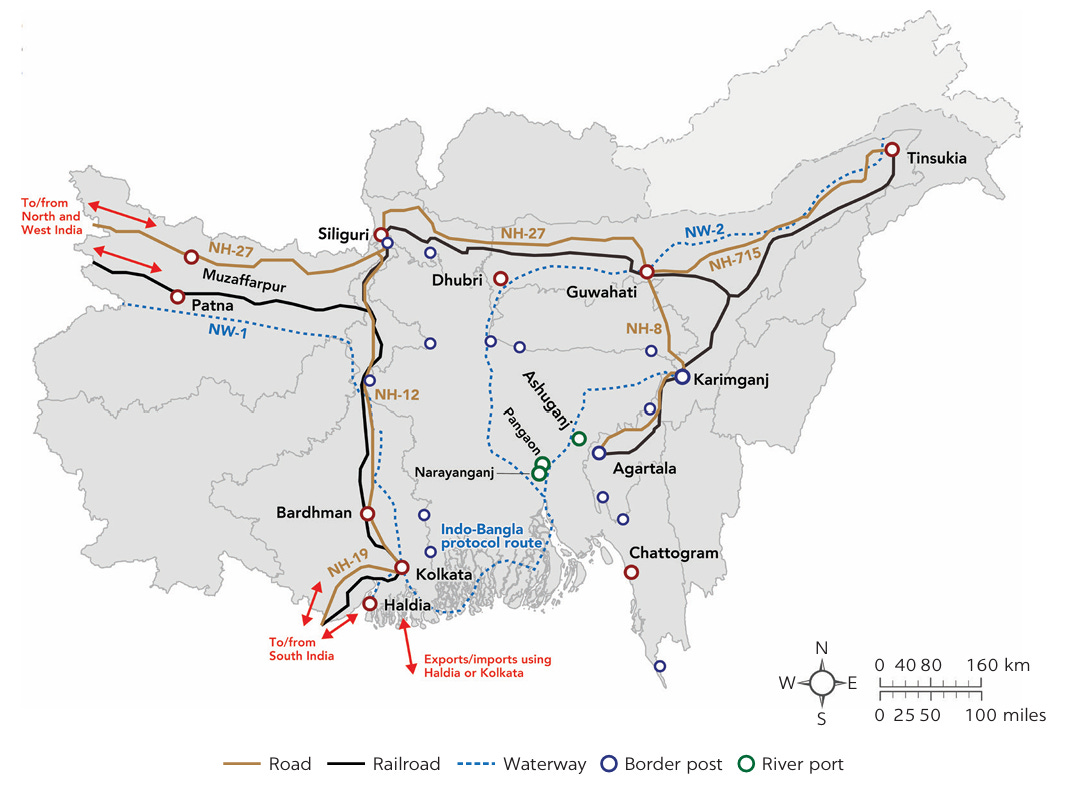
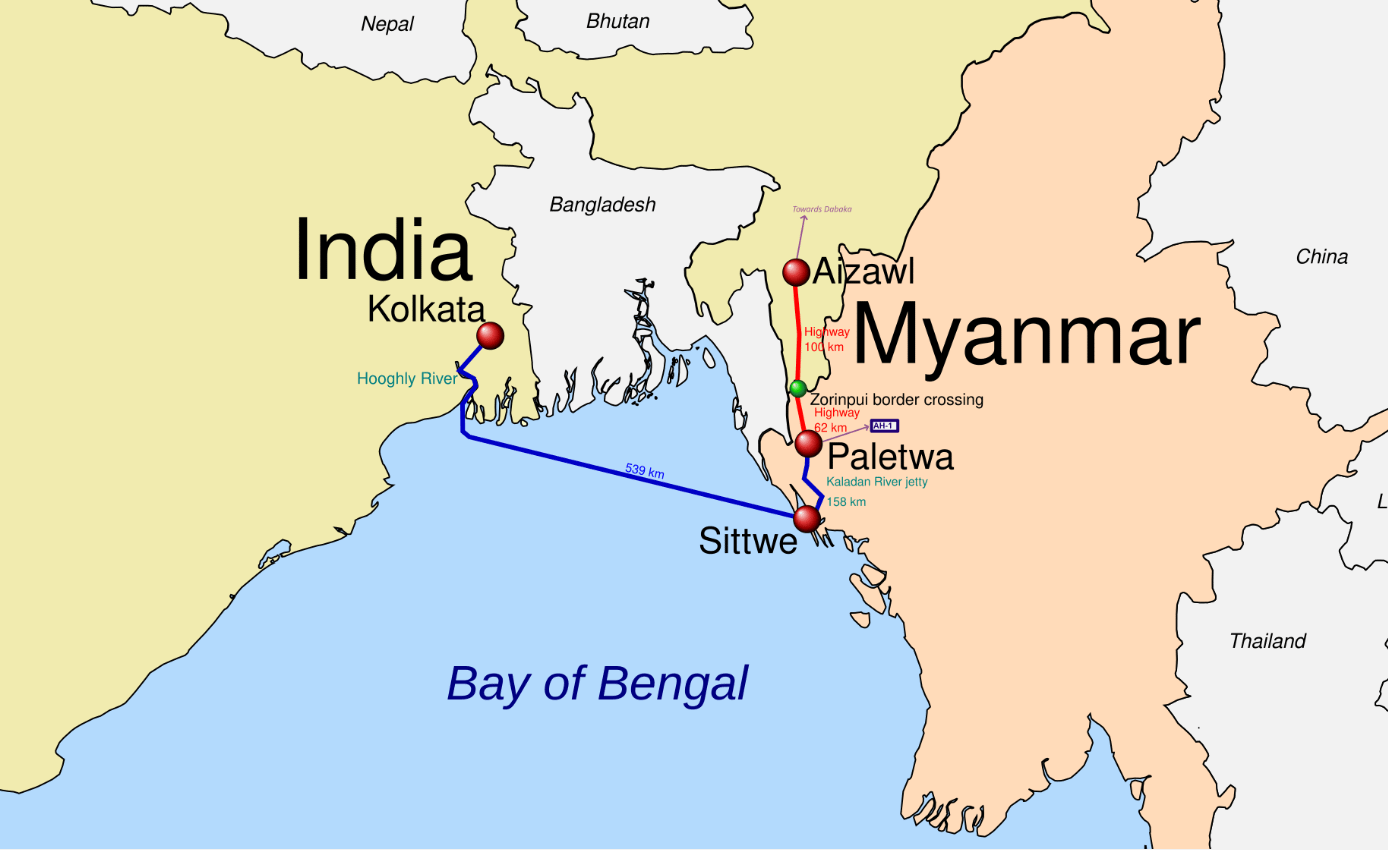
The Kaladan Multi-Modal Transit Transport Project (KMMTTP) connects Myanmar’s Sittwe Port with Mizoram State in India, using sea, inland water, and road transport (which is why it is called multi-modal). Through the new route, India is expected to be able to transfer goods to its Northeastern region without passing through the Siliguri Corridor (also known as the “Chicken’s Neck Corridor“), offering an alternative route.
The 60-km-long Corridor, which is only 22 km wide in some parts, connects India’s Northeastern states (home to approximately 45 million people) to the rest of the country. As the only land bridge between the two parts of India, the Corridor carries all road and rail traffic to the Northeast, along with critical energy infrastructure and military logistics, making it one of the most sensitive points of the country.
Two recent developments have drawn further attention to the area around it. Ties between India and Bangladesh grew tense after Hasina was pressured to step down and India decided to give her refuge. China, meanwhile, continued its infrastructure build-up around Doklam, which India perceives as part of a broader attempt at strategic encirclement. Against this backdrop, according to Rajeev Lachmipersad, Geopolitical & Geo-economic analyst at HIG, the area around the Siliguri Corridor has become a growing concern for India. In his view, the Kaladan project is a way for New Delhi to avoid depending on one narrow corridor alone, or on Dhaka’s goodwill.
The alternative route would reduce dependence on the Corridor by allowing goods to flow to India’s own territories and to Southeast Asia through the Bay of Bengal, even when land routes are congested, boosting trade and strengthening regional connectivity. The route would also reduce travel time and costs for passengers.
Dr. Sreeradha Datta, Professor of International Affairs & Senior Fellow with the Institute of South Asian Studies, mentioned that “in the larger affair of India working closely with ASEAN, this would have been a great milestone”. She highlighted the project’s importance for Myanmar, which would benefit from development and more employment and livelihood opportunities for local people. This infrastructural growth is also expected to reduce road dependency and bring in foreign investment, further boosting Myanmar’s economy.
“Its potential goes beyond trade. It could support regional supply chains, border trade and greater economic integration of Mizoram and the wider Northeast with Myanmar and Southeast Asia.”
Sreeparna Banerjee, Associate Fellow in the Strategic Studies Programme of ORF
While right now the KMMTTP is a bilateral project between India and Myanmar, Dr. Bibhu Prasad Routray, Director of the Mantraya Institute for Strategic Studies (MISS) has mentioned that India would like to extend the project to countries like Thailand, once it is completed. This also aligns with India’s Act East Policy, that focuses on developing economic and strategic relations with Southeast Asian countries. However, Rakhine State also holds strategic value for China, as the site of the Kyaukphyu deep-sea port, roughly 120 km from Sittwe, where the oil and gas pipelines to Yunnan begin. Rajeev Lachmipersad therefore describes Kaladan as India’s counter to China in the Bay of Bengal, and whether India can complete it as China expands its presence is a test of the Act East Policy’s future

The States of Rakhine and Chin
The area of construction runs through Rakhine and Chin States in Myanmar, which are heavily impacted by the civil war. Even so, the Indian government has been developing the project in cooperation with the Myanmar government. Since April 2026, coup leader Min Aung Hlaing has led Myanmar as president, and representatives from India, China, Thailand and 20 other countries attended his inauguration. However, there have been reports of challenges and delays in the construction due to the ongoing armed conflict in Myanmar, with a 109-km-long road connecting India to Paletwa in Chin State still unfinished.
One of the armed groups active in the region is the Arakan Army (AA), which gained power throughout the civil war and now controls 14 out of 17 townships in Rakhine, excluding the Sittwe, where the port developed by India is located . By January 2024, the AA took over Paletwa, and later that year, the group had gained control over almost the entire Myanmar territory involved in the project (apart from Sittwe). Ms. Banerjee also added that it is not only the AA but also Chin armed groups that control or contest areas close to the Indian border, making the environment highly fluid.
“We are looking at a scenario of intense militant confrontation without an easy path to a settlement”
Dr. Routray, Director of MISS, Former Deputy Dir. at National Security Council Secretariat, Gov. of India
As a result, cooperation with the Arakan Army and other ethnic groups was necessary to progress with the project, and since then India has been engaging with both the government and the ethnic armed organisations (EAOs). At the regional level, Mizoram’s government has also stated that it has a good relationship with the AA, and the KMMTTP was discussed in its assembly.
“At this point of time, the country is so unstable, the military establishment is the only entity that provides stability,(…) while the ethnic groups, if you listen to them one group at a time, you will feel they are in total control (…) but actually on the ground, no. They do control some specific areas, but inter ethnicity rivalry prevents them from functioning as a consolidated political group.”
-Dr. Datta
All interviewed experts described India’s approach as centred on official engagement with the appointed government in Myanmar, in order to uphold state relations, combined with informal communications with other actors (such as EAOs), that have control around India’s border and the infrastructure. “The challenge will be doing this without appearing to formally recognise or endorse any particular armed group.” added Ms. Banerjee. In contrast to the Western approach of isolating the Myanmar government, India refrains from choosing a side.
“India does not do regime-change diplomacy. It talks to whoever holds the territory. In Myanmar that pragmatism is both its strength and its risk: it keeps the doors open, but it also means New Delhi is betting on everyone and fully trusted by no one.”
Rajeev Lachmipersad
Security Concerns
Although Arakan Army leaders have assured India that their operations will not hinder the construction, the fighting continues in the region and security challenges still remain. Dr. Routray explained that while the AA can ensure that the construction of the project goes ahead as long as they have control over the territory, this can change, since they cannot control the actions of other actors in the area. Ms. Banerjee similarly cautioned that, given the project’s exposure to conflict, India would need concrete security arrangements and continued communication rather than relying on political assurances alone.
So let’s say by miracle, the road gets completed, the project takes off (…) Just to put some pressure on the military administration, these ethnic groups are bound to, create a kind of a hostile and difficult environment.”
Dr. Datta on the risks after completing the project
Both Dr. Datta and Dr. Routray consider the completion of the KMMTTP by 2027 unlikely given the unstable circumstances. Dr. Routray argued that the project was conceived around a stable, single-authority Myanmar, which no longer exists and is unlikely to return. Dr. Datta noted that the armed groups have not supported construction so far because the project was designed with the Myanmar government. She added that while the groups are not against India itself, she sees no reason for them to change their stance by 2027. While India has been cooperating with the Myanmar government on the project, the project is also at risk of attacks from the country’s military forces since they have launched attacks in Paletwa in both 2025 and 2026.
Another security concern is the tension between the AA and the Chin groups, which has to be considered when looking at the wider dynamics of the situation. Ms. Banerjee explained that these tensions can affect the security of the roads, workers and supply lines, even if the AA provides assurances.
“For India, there are many complexities to be negotiated which include the AA’s ties to and tolerance of Chinese interests, the junta’s sensitivity to any India-AA contact, and the risk that Indian-funded assets become targets in the crossfire”
Dr. Routray
In addition to the security concerns, India also has to consider reputational risks that come with engaging with the Arkan Army, since the UN and other human rights organisations have reported that group has committed serious abuses of human rights against the Rohingya.
Conclusion
The Kaladan Project was designed to bring significant geopolitical and economic advantages for India by reducing its reliance on the Siliguri Corridor, boosting trade and strengthening regional connectivity. However, the project was designed around a stable Myanmar that no longer exists. While Dr, Routray and Dr. Datta consider the finalisation of the project by 2027 doubtful given the unstable situation, even if it was finished, it is unlikely to deliver its strategic value in the near future. With India being drawn into Myanmar’s conflict, making Indian-funded assets targets for both EAOs and the military group supporting the government, the project is exposed to several security threaths, and additional reputational risks that come with engaging with armed groups.