


In Summary
The development and use of super-fast hypersonic weapons – for example, by Russia in Ukraine – appears to be opening a new chapter in the arms race between the West and countries such as China and Russia.
However, not all hypersonic weapons are actually revolutionary – or even new.
Europe must not allow itself to be swayed by Russian propaganda, but should invest in its own systems and be prepared for the next generation of weapons systems.
Defence Regional Update | Subsonic, supersonic and hypersonic weapons
Subsonic, supersonic and hypersonic weapons
Weapon systems can sometimes be difficult to compare, particularly as countries (and defence manufacturers) often have an interest in exaggerating their capabilities in order to instil fear in their adversaries. A prominent example of this is Russia, which has been deploying its ‘hypersonic’ weapons against Ukraine for several years now.
Russia claims that these weapons are invulnerable, capable of bypassing any form of air defence, and are strategic ‘wonder weapons’. In short – the perfect way to unsettle both Ukraine and the rest of Europe and to convince them of Russia’s military and technological superiority.
But what exactly is a hypersonic weapon? Put simply: a weapon that travels at more than five times the speed of sound, or more than 6,125 kilometres per hour. Compare this with supersonic weapons, which travel faster than the speed of sound (more than 1,225 km/h), and subsonic weapons, which travel slower than the speed of sound. In short: ‘hypersonic’ refers to the speed of a missile, but this does not automatically equate to an invincible weapon.
Hypersonic missiles have been around for decades
Hypersonic missiles have, in fact, been around for decades. Virtually all (nuclear) ballistic missiles reach hypersonic speeds. These are missiles that spend the majority of their ‘journey’ in space, after being accelerated to speed by rocket propulsion. These types of missiles often consist of several ‘stages’ (just like a rocket used for space missions), with ultimately just one or more ‘warheads’ – containing nuclear, conventional, chemical or biological weapons – striking their target. These missiles reach very high speeds, even as they re-enter the atmosphere.
Due to their ballistic trajectory and high altitude, these types of missiles are generally easy to track using radar systems. Furthermore, whilst these missiles often have only limited manoeuvrability upon re-entry into the atmosphere, this is sometimes sufficient to evade air defences or to ‘steer’ towards a specific target. The first operational system to utilise this type of technology was the notorious V-2 ballistic missiles used by the Nazis during the Second World War (although these fell just short of hypersonic speeds).
The real innovation (and danger) lies in weapons systems that combine hypersonic speed with a different flight path, making them many times more difficult to predict and intercept. For example, several countries are working on hypersonic cruise missiles. Cruise missiles (such as the well-known Tomahawk) fly at low altitude and can perform complex manoeuvres, such as evading air defences.
The lower altitude also means that radar systems may struggle to track them. These characteristics, combined with extremely high speed, make hypersonic cruise missiles very difficult to intercept – but their development is complex and many such systems are not yet ready for use.
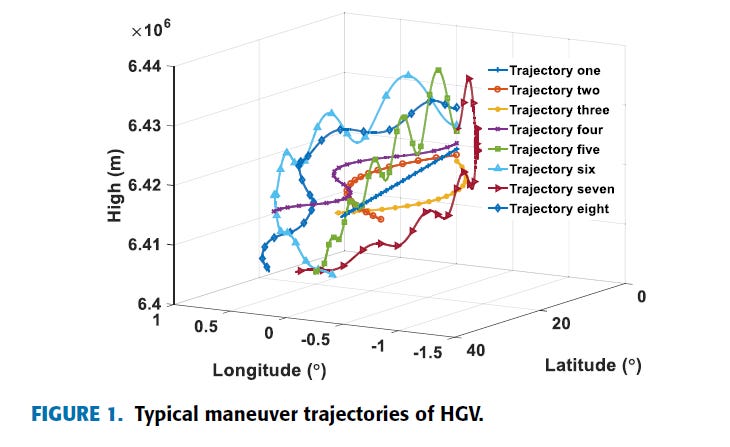
Another innovation is the so-called ‘glide’ missile. This type uses a ballistic missile to build up speed and altitude, but unlike a traditional ballistic missile, a ‘glider’ (which has no propulsion of its own) – rather than a traditional warhead – subsequently follows a highly unpredictable trajectory, with significant variation in altitude but at very high speed. The image below shows various trajectories, which clearly illustrate the complexity and unpredictability.
Image: Shen et al., 2022. https://doi.org/10.1016/j.ast.2022.107363
What is Russia using in Ukraine?
Russia has (probably) deployed three different hypersonic weapons in Ukraine. The most commonly used is the Kinzhal missile, which is launched from Air Force fighter jets. Despite the propaganda surrounding this system, the consensus is that it is in fact a modified version of the older Iskander ballistic missile. The Kinzhal is therefore not a glider and does not possess the advanced propulsion system of hypersonic cruise missiles. Ukrainian air defences have already successfully intercepted Kinzhal missiles on several occasions using American PATRIOT air defence systems, which highlights the limitations of this Russian ‘wonder weapon’.
Another weapon deployed by Russia is the Zircon, a hypersonic cruise missile which reportedly uses highly advanced propulsion to reach hypersonic speeds. The exact capabilities of this weapon system are unknown and shrouded in secrecy, although Ukraine claims to have successfully shot down Zircons using PATRIOTs and Italian-French SAMP/T systems, as the Zircon (like the Kinzhal) flies (possibly) much more slowly and is no longer hypersonic as it approaches impact, making interception possible.
Finally, Russia deployed the mysterious Oresjnik against Dnipro once, in November 2024. This is in all likelihood a medium-range ballistic missile, based on an older design from the Soviet era, but not equipped with one or more nuclear warheads. What is more, it appeared that the Oresjnik deployed against Dnipro was carrying ‘dummy’ warheads. A striking detail is that the development of the Oresjnik’s predecessors was probably prohibited under the INF Treaty, and Russia was therefore clearly not complying with the rules of this treaty, given that development had been underway for many years before the US withdrew from the INF Treaty in 2019.
In short, Russia primarily deploys hypersonic ‘wonder weapons’ for intimidation and propaganda purposes. The Oresjnik attack on Dnipro, in particular, was highly symbolic, causing minimal damage. Russia is primarily trying to demonstrate to Ukraine’s partners that it remains a military superpower with advanced weapons systems, whilst suffering heavy losses on the battlefield. Furthermore, Ukrainian air defences have become increasingly adept at intercepting more conventional Russian weapons systems, prompting Russia to seize every opportunity to ‘pierce’ these defences.
Just hype?
So are hypersonic weapons merely ‘hype’ and designed for intimidation? Far from it! The development of new systems by Russia, China and the US points to a cat-and-mouse game between increasingly fast and manoeuvrable missiles on the one hand, and radar and interception technology on the other. Russia, China and the US are investing billions in hypersonic weapons (and defences against them), with successful tests of complete hypersonic gliders and cruise missiles.
In addition to the systems mentioned above, Russia is also developing more advanced systems, such as the Avangard glider. By comparison, development in Europe is lagging behind, although testing is taking place in the United Kingdom and France.
Furthermore, defending against various hypersonic systems presents a challenge. Although the PATRIOT air defence system, used by the Netherlands among others, can successfully counter ‘simple’ hypersonic ballistic missiles, hypersonic cruise missiles may require more advanced defences.
However, the threat posed by some systems is far from being the greatest danger from Europe’s potential adversaries. Countering a handful of experimental Russian hypersonic weapons is important, but the damage that could be caused by many hundreds of ‘conventional’ cruise missiles and many thousands (!) of ‘kamikaze’ drones is potentially far greater.
For policymakers
Be realistic about the threat posed by Russian hypersonic ‘wonder weapons’, and do not let Russia’s propaganda surrounding them distract from Russia’s very significant shortcomings and weaknesses on the battlefield in Ukraine.
Recognise that reaching agreements with Russia on weapons development serves little purpose, given that Russia has developed many weapons systems that contravened the INF Treaty, which was in force at the time.
Do not underestimate the damage that ‘traditional’ weapons can cause! Europe lacks air defence in all forms, not just against hypersonic weapons. So do not fixate solely on the risks posed by a select few systems, but be aware of the overall threat posed by countries such as Russia.
Invest in the development of Europe’s own hypersonic weapons and the defences against them. It is unacceptable for Europe to lag behind technologically in a hypersonic arms race or to be dependent on the US. Although hypersonic weapons are not a replacement for traditional systems, they do offer the capability to attack highly protected strategic targets and are therefore certainly useful in a military conflict against a technologically advanced adversary.