



In Summary
The political crisis in Bangladesh has led to Prime Minister Hasina’s flight.
India views the situation in Bangladesh with concern due to the potential resurgence of separatism and terrorism.
The Netherlands and the EU must actively support Yunus’s democratic reforms and strengthen their strategic position in South Asia.
Diplomatic cooperation with India is essential, with priority being given to concerns regarding minority rights, anti-democratic forces and cross-border terrorism.
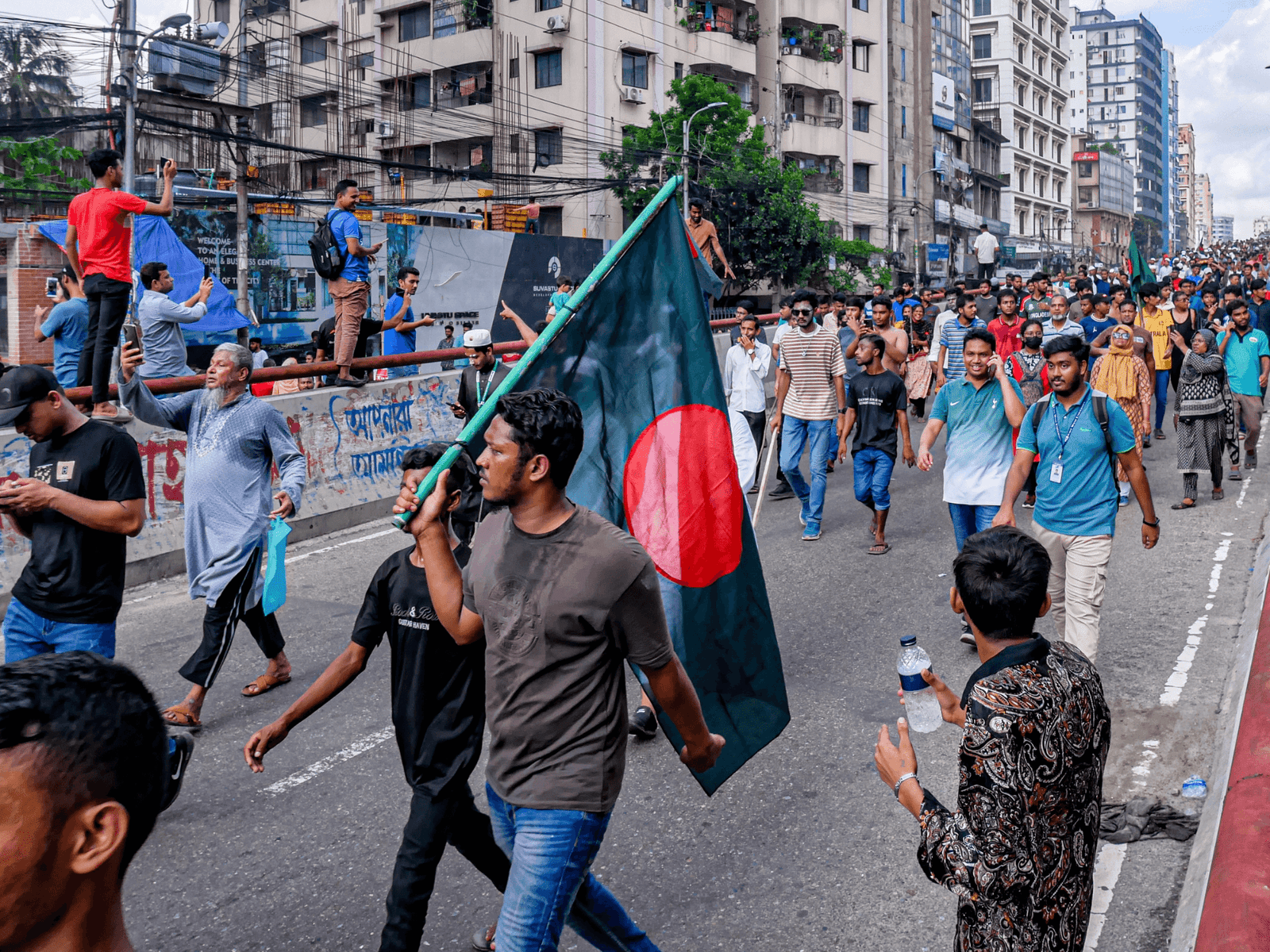
Update: India | A shiver must have run down the spine of Prime Minister Modi and the entire Indian security community when, on 5 August 2024, the Bengali Prime Minister Sheikh Hasina fled her country, Bangladesh, by helicopter to India. Many must have wondered ‘how could this have escalated to such an extent?’. At the start of the protests on 6 June 2024 – just two months earlier – Prime Minister Hasina and her secular-oriented Awami League party still had a firm grip on all levels of government and the security apparatus. From 2009 onwards, Prime Minister Hasina had managed to keep the opposition at bay, which included the BNP (Bangladesh Nationalist Party), an Islamist-nationalist party, and the Jamaat-e-Islami, a deeply conservative Islamic and pro-Pakistan party.
The Indian security establishment and the established parties (both Prime Minister Modi’s BJP and the Congress Party of the Gandhi dynasty) had been investing their political and economic capital in the Awami League regimes for decades. This began as early as 1971, when Awami League founder Sheikh Mujibur Rahman (and father of Prime Minister Hasina) led the brutal war of independence against Pakistan. During this conflict, Pakistani soldiers and pro-Pakistani Bengalis (mainly from the Jamaat-e-Islami party) committed genocide against predominantly Bengali Hindus, resulting in 3 million deaths within nine months, 400,000 women falling victim to ‘genocidal rape’ and 30 million Bengalis being displaced. Indian Prime Minister Indira Gandhi (of the Congress Party) saw no alternative but to launch a military invasion of Bangladesh (then East Pakistan) in order to decide the war in favour of independence. The Awami League transformed East Pakistan into the secular and socialist ‘People’s Republic of Bangladesh’.
Although India’s geopolitical concerns were resolved in its favour following Bengali independence, this did not mark the definitive end of them. The wider Indian political elite, too, was left traumatised by the war, which led to decades of broad political and economic support for the Awami League.
In the past, there have been allegations that the BNP and certain elements within their governments indirectly supported militant groups active in India’s north-eastern states, such as Assam, Tripura and Meghalaya. These groups often fought against the Indian government and sought autonomy or secession from India. However, the alleged support was often implicit and difficult to prove directly. Nevertheless, this deepened the trauma felt by the Indian political elite and security community.
From 5 August 2024, Bangladesh has been led by an interim government, chaired by Nobel laureate and economist Muhammad Yunus. Yunus himself was long a critic of the Hasina regime and a fervent advocate of economic development and reform, poverty alleviation through microfinance (for which he founded the Grameen Bank) and women’s rights. Yunus gained international recognition and goodwill for putting his principles into practice. At present, Interim Prime Minister Yunus enjoys widespread support amongst broad sections of the population: the urban middle class and young professionals, the (predominantly female) rural population and microfinance clients (although there are complaints about the financial burden of the loans), academics and journalists, civil society organisations and the large Bengali diaspora.
Nevertheless, there are two major groups that could undermine Yunus’s position and, potentially, the continued political stability of Bangladesh. These are the Islamic nationalist groups led by the BNP and the hardline Islamic groups led by Jamaat-e-Islami. Following Hasina’s downfall, the Bangladeshi army decided that the Jamaat-e-Islami, which had been banned until then, should also be invited to the table to discuss the future of Bangladeshi democracy. By bringing all the parties to the table (with the exception of the Awami League), the army is seeking to garner broad political support for the interim government and for Yunus’s presidency as interim prime minister.
The BNP and Jamaat-e-Islami are now (for the time being) supporting Yunus as an alternative, due to his broad domestic and international support and recognition. Political reality will show that the BNP will increasingly focus on its own political survival and on winning public support rather than explicitly aligning itself with Yunus. Jamaat-e-Islami is generally more critical of Yunus because of his progressive and secular views and his ties with Western countries. It has also, in the past, questioned Yunus’s intentions, particularly regarding his support for women’s rights and inclusive programmes.
‘India will always remain our most important neighbour; indeed, it is our only neighbour,’ Yunus stated in September 2024 during an interview with Deutsche Welle (public broadcaster). Yunus indicated that relations with India must be reshaped as soon as possible, with stability and mutual respect for national security at the forefront. There are serious concerns about stability in eastern India amongst both the Indian political elite and the Indian population. This was fuelled by deadly violence against Bengali Hindus following the fall of the Hasina regime, during which extensive damage was also inflicted on Hindu homes, businesses and temples. On top of this, a stream of refugees began flowing towards India, and the Jamaat-e-Islami was not only legalised but also invited to the political table. There is also considerable uncertainty as to what the BNP’s prominent role will mean for a possible resurgence of Islamic and ethnic militant separatism in East India.
The Indian security community already has its hands full with the ethnic violence in the eastern state of Manipur. Ethnic tensions in the neighbouring states of Nagaland and Mizoram, as well as the growing Chinese military infrastructure near Arunachal Pradesh, do not make matters any easier. The great fear is that Bangladesh will, in effect, once again become an ‘East Pakistan’, where, just as in Pakistan, terrorists will have a safe haven for ‘cross-border’ terrorism. If Yunus issues these security guarantees and is able to enforce them, India will ultimately be on his side.
For the Netherlands and the EU, it is important to continue investing politically in Bangladesh, particularly in the democratic process that Prime Minister Yunus is trying to set in motion. Strengthening Yunus’s position and the inclusive and democratic ideals associated with it presents the Netherlands with a unique opportunity not only to build significant political capital amongst the new Bengali political elite, but also amongst broad sections of the Bengali population. Bangladesh’s unique geographical position as a gateway to the Strait of Malacca and a potential future Thailand Canal means that the Netherlands, as a trading nation, simply cannot remain indifferent. Furthermore, economic growth in Bangladesh is set to continue apace in the coming years, particularly if Yunus’s economic reforms go ahead. Once the India–Bangladesh economic relationship is further strengthened, Dutch companies and geopolitical interests will be well placed within this potential new South Asian security architecture.
In this regard, it is equally important to take India’s geopolitical concerns into account in diplomatic dealings with Bangladesh. As Prime Minister Yunus pointed out, India is Bangladesh’s ‘most important and only neighbour’, and Bangladesh’s democratic process will depend in part on New Delhi’s cooperation and security expertise. Particularly now that India is increasingly viewed in Dutch geopolitical circles as a key geopolitical partner in an ever-more-fragmented world order, the Netherlands can demonstrate that it, too, can be a strategic partner to India on a reciprocal basis. In this regard, it is important that the Netherlands begins now to cultivate goodwill with future (and current) regional powers and potential global powers, by incorporating geopolitical concerns and interests into its own diplomatic engagements.
In working together with India, the Netherlands must take a critical look at the role of the more Islamist fundamentalist parties and groups in the political process and what this means for the position of minorities, such as Hindus, Christians, Buddhists and Ahmadiyya Muslims in Bangladesh. It must also be made clear that there is no scope for Dutch (and EU) partnership in the further shaping of the new world order for countries that permit cross-border terrorism (let alone use it as an active policy instrument, as Pakistan does). By already investing diplomatic capital in principles of respect for territorial integrity, the democratic right to self-determination and respect for regional security interests, the Netherlands (and the EU) can help shape the world order, particularly in this crucial initial phase (after all, the wax is still very hot before it hardens).
Bearing in mind that Yunus himself is performing a daring political balancing act in the aftermath of a revolution, the Netherlands’ geopolitical ‘carrot’ must be far greater than the ‘stick’. After all, the stigma of neo-colonialism is ever-present, and the Islamic parties will be all too eager to exploit it. Make it clear that the Netherlands is keeping a critical eye on anti-democratic actors and actions in Bangladesh and that its partnership with the country depends on this. At the same time, demonstrate the benefits that a strong partnership with the Netherlands can bring to Bangladesh through direct, positive diplomatic and economic measures. Give Prime Minister Yunus the opportunity – and, above all, the political and economic ammunition – to ensure that his democratic vision prevails over the autocratic vision of Bengal’s future.
This article was translated, find the original here.

