


In Summary:
• Throughout the 2010s, Saudi Arabia and the UAE developed a close strategic partnership, cooperating particularly in Yemen
• however, their relationship has since become increasingly competitive, with diverging interests in Yemen, Sudan and the Red Sea
• Economic rivalry and differing foreign policy priorities have further strained relations even though shared security interests and political ties have prevented a diplomatic rupture
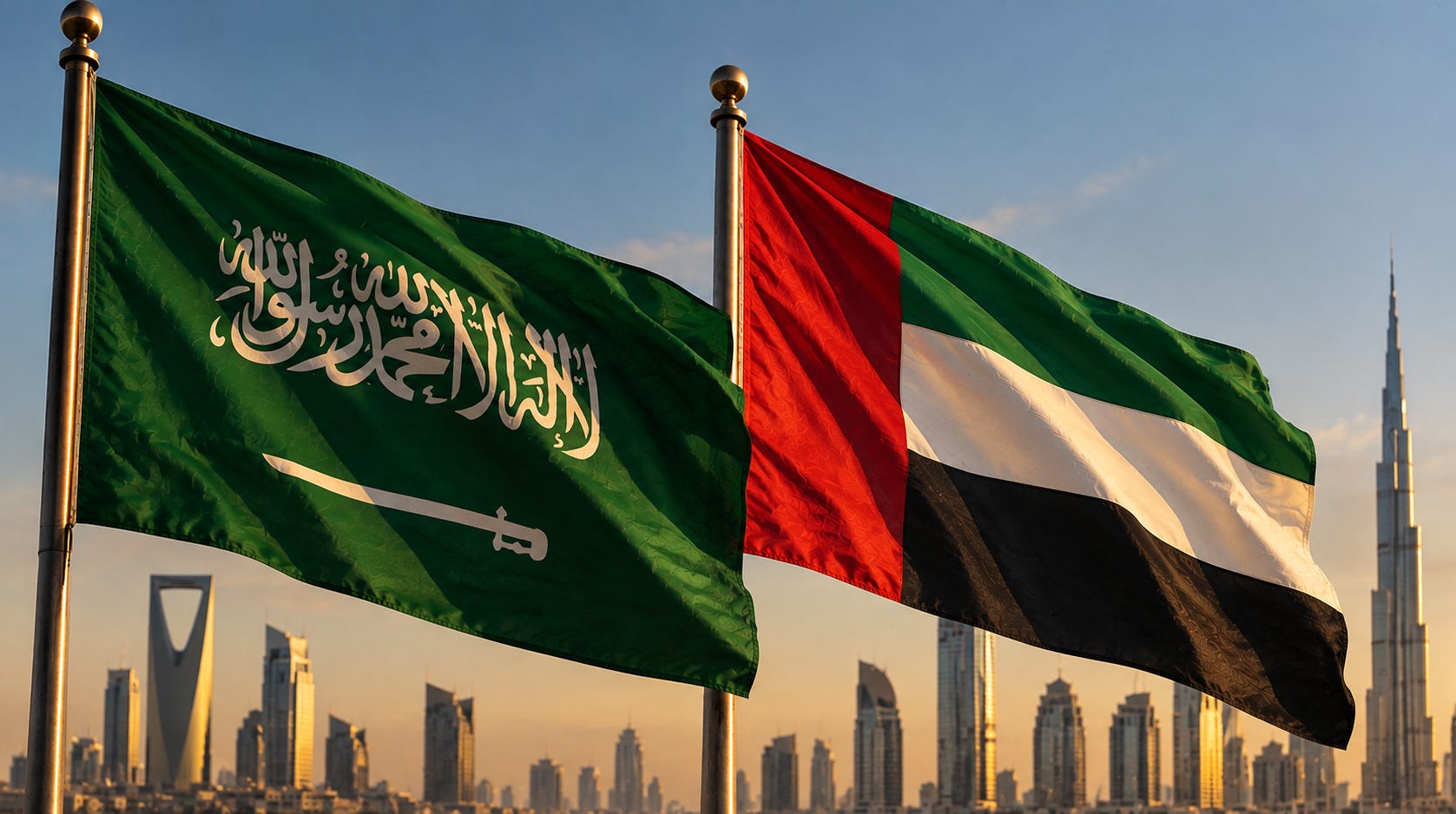
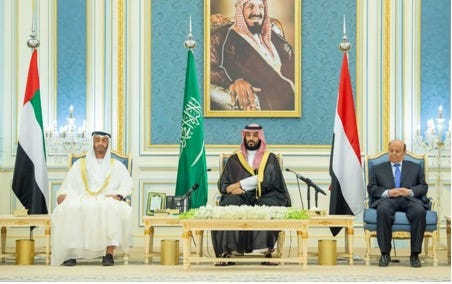
On 29 September, UAE Vice President Sheikh Mansour bin Zayed Al Nahyan travelled to Riyadh for talks with Saudi Crown Prince Mohammed bin Salman. It was the first Emirati visit to the Kingdom since relations between the two Gulf powers deteriorated over Yemen at the end of 2025. For much of the previous decade, Saudi Arabia and the United Arab Emirates acted as partners in the Gulf as they intervened together in Yemen, took a common position during the Qatar crisis and shared concerns over tensions with Iran and the rise of political Islam after the Arab uprisings. This partnership has gradually given way to a more complicated relationship which has turned into a relationship of rival competition where both countries have increasingly become more ambitious. Understanding how Riyadh and Abu Dhabi reached this point, and why they continue to cooperate despite this competition, offers insights into the balance of power in the Gulf and the wider Middle East.
From Partners to Competitors
The close relationship between Riyadh and Abu Dhabi was built around a period of collaboration throughout much of the 2010s, particularly from 2015. The rise of Saudi Crown Prince and Prime Minister Mohammed bin Salman in Saudi Arabia corresponded to an increasingly assertive UAE under Mohammed bin Zayed, now president of the UAE.
However, the relationship was never entirely equal between the two. As an anonymous source explains, “it’s always been a competition but it’s not always been an open competition. The UAE has always been conscious of being the junior partner in this relationship.”
Despite this balance, the two countries found common ground in some situations. Their cooperation was visible in Yemen, where they intervened together in 2015 against the Houthis, and during the 2017 Qatar crisis, when both governments joined the effort to isolate Doha. The UAE’s decision to join the Saudi intervention in Yemen also needs to be understood in light of the leadership transition in Saudi Arabia. Abu Dhabi had enjoyed longstanding relationships with King Abdullah, which were disrupted by his death in 2015. As the same anonymous source explains, “I always say that one of the most important events in the Middle East in the past 15, 16 years is the death of King Abdullah.” The arrival of the new leadership was unexpected, as the source recalls: “especially since nobody saw King Salman coming and certainly not his son Mohammed bin Salman.” Therefore, according to the source, UAE’s participation in Yemen was also an investment in its relationship with the new Saudi leadership. As the source explains, “so then the UAE decided to really invest in that Saudi relationship; and the way they did that was by joining the Saudi in Yemen.” The intervention initially helped consolidate the partnership, even if later the two countries increasingly developed different objectives in the conflict.
In fact, Yemen also was a context in which the limits of this alignment emerged. While both countries initially entered the war as part of the same coalition, their priorities started to diverge, especially when Saudi Arabia continued to support Yemen’s internationally recognised government and, later, the Presidential Leadership Council, while the UAE developed close ties with southern forces, particularly the separatist Southern Transitional Council (STC). This divergence was already visible in 2019, when STC forces seized Aden, but became far more difficult to contain in late 2025 after the group expanded into Hadramawt and al-Mahra. Saudi Arabia responded militarily, including with a strike on Mukalla port after accusing the UAE of supplying weapons to the separatists, a claim that Abu Dhabi denied. Michel Don Michaloliákos, geopolitical expert and co-founder of HIG, sees the confrontation as part of a broader struggle over the balance of power. He describes the Saudi response as a “power play of Saudi Arabia trying to keep the UAE as a junior partner,” adding that “the UAE of course wants to prevent being a junior partner.” In his view, this may also help explain Abu Dhabi’s regional strategy: “In a fragmented surrounding, the UAE can be more influential than with stronger states.”
For Dr. Omar Munassar, Postdoctoral Fellow at the University of Zurich, the experience illustrates a broader problem with regional security partnerships. He argues that “historically, Middle Eastern security alliances, from the Baghdad Pact to the 2015 Arab Coalition in Yemen, have repeatedly broken down over divergent political priorities, most visibly in the fallout between Saudi Arabia and the UAE.” Yemen, therefore, did more than reveal a disagreement over the future of the country. It showed how two states that had entered the conflict as close partners developed increasingly distinct regional priorities. This divergence also reflects different views of how regional stability should be achieved. AsMichaloliákos explains, “Saudi Arabia is supportive of strengthening nation states in other countries, so central governments, whereas the UAE pursues fragmentation of other countries and an aggressive port policy.” In his view, the rivalry therefore reflects “not opposing interests only, but also opposing views on how to secure a stable region that favors the regimes in both countries.”

A rivalry that goes beyond Yemen
The competition between Saudi Arabia and the UAE has become increasingly visible, and not only across the Arabian Peninsula. Across the Red Sea and the Horn of Africa, both countries have expanded their political and economic presence, competing for influence over trade routes, ports and investment. On the one hand, the UAE has developed an extensive network of commercial relationships in the region, including major investments in the port of Berbera in Somaliland. On the other, Saudi Arabia has also increased its presence in Africa, with the Red Sea becoming important to the Kingdom’s economic and geopolitical strategy. In fact, in 2024 Saudi investors established a logistics zone in Djibouti port, which serves as a gateway to African hubs.
A relevant case to look at is Sudan; The UAE has repeatedly been accused of supporting the Rapid Support Forces (RSF), allegations Abu Dhabi denies. The anonymous source points to the UAE’s concerns about the influence of the Muslim Brotherhood, as the source says that Abu Dhabi’s assessment of the RSF is that “the RSF is the bulwark against what may be growing brotherhood influence in that region”. In addition, Sudan is also an important economic target for the UAE. The source adds that the UAE “owns massive plots of land there, which is tied to food security.”
Saudi Arabia, meanwhile, has hosted negotiations between the warring parties in Jeddah and tried to act as a mediator, while maintaining closer relations with the authorities controlled by the Sudanese Armed Forces. Sudan has thus become an area where Saudi Arabia and the UAE’ interests diverge. The UAE spent decades establishing itself as a regional centre for international business, tourism, aviation and logistics. Saudi Arabia’s Vision 2030 has pushed the Kingdom into a quick development of the country, as Riyadh has tried to attract multinational companies through its regional headquarters policy, while investing heavily in tourism, aviation and logistics as part of its economic diversification. As the anonymous source observes, “the UAE development path, and especially Dubai’s development path, is a model for Saudi.” This convergence has also created new sources of rivalry: “that is a very real area of competition as well. And there are no instruments in place in order to find some sort of equilibrium between all these ambitions.” These policies are not necessarily directed against the UAE, but they place the two economies in competition for investment. This economic dimension helps explain why the Saudi–Emirati rivalry should not be seen only as disagreements over specific conflicts. Instead, it should be seen as a competition emerging where their ambitions overlap.
Diverging Regional Strategies
Saudi Arabia and the UAE also differ in how they deal with powers like Israel, the US, Iran and Türkiye. In the case of Israel, the UAE has formalized its diplomatic relationships through the Abraham Accords signed in 2020; Saudi Arabia, on the other hand, has not established formal relations with Israel, especially after the Gaza war, linking any type of future agreement to the creation of a Palestinian state. According to the anonymous source, the Abraham Accords were a particular turning point in the relationship between the UAE and Saudi Arabia, as they argue that “what really pushed the Saudis away from the UAE were the Abraham Accords and its very open embrace of Israel.” Saudi Arabia has, meanwhile, also tried to increase its security partnerships. Its cooperation with Türkiye and Pakistan culminated in the signing of the Mecca Joint Defence Agreement in August 2026. As Dr. Muddassir Quamar, Associate Professor at Jawaharlal Nehru University argues, “The choices that Saudi Arabia has is to continue diversification of its external and security relations, which it is already doing.” These different relationships can also be understood through the different strategic priorities of Riyadh and Abu Dhabi. As Michaloliákos argues, “I think opposing views and opposing strategies led to these alliances. And where there was a convergence of those strategies, countries teamed up. And what was, I think, underlying these opposing views as well is different threat perceptions.”
It is also important to consider Saudi Arabia and the UAE relationship with Iran, which provides an even more complex picture. The UAE restored its diplomatic relations with Tehran in 2022, while Saudi Arabia followed with the China-brokered restoration of relations in 2023. Both countries have therefore tried to manage tensions with Iran while maintaining a security relationship with the United States. The choice of alliances of Saudi Arabia and the UAE do not necessarily portray a contradicting image of the region’s alignments. Both continue to keep relationships with the US and have tried to reduce tensions with Iran. However, what is obvious is that Riyadh and Abu Dhabi are increasingly willing to pursue their foreign policy priorities independently of one another.
Rivals or Enemies?
Despite their competition, neither Saudi Arabia nor the UAE aim to develop their relationship into a rupture. The renewed Houthi offensive in Yemen illustrates why. While past disagreements over Yemen contributed to a deterioration of their relationship, a common security threat associated with the Houthi has created space for cooperation. On the one hand, the UAE retains considerable influence over Southern Yemen, while Saudi Arabia has become more involved in confronting the Houthis. Their relationship is also sustained by interests that extend beyond Yemen. As Michaloliákos says, “both are condemned to each other, the UAE and Saudi Arabia. They can have opposing interests. They can have diverging strategies and views. But they are condemned to each other as neighbors, dependent both massively on the Strait of Hormuz and for the UAE also when it comes to land bridges towards other regions. So that means that eventually you need to have some work around your disputes.” Both remain members of the Gulf Cooperation Council, maintain economic ties and have an interest in reducing instability across the Gulf and the Red Sea. Competition over investment, regional influence and foreign partnerships has developed alongside areas in which cooperation remains useful to both governments. Rather than ending their partnership, Riyadh and Abu Dhabi have so far attempted to manage these disagreements while preserving channels for cooperation. The durability of this attempted cooperation may depend as well on personal relationships. As the anonymous source argues, “the rivalry will be there, and none of them is going to budge. So it will come down to the personal relationship, whether they can work”.
In conclusion, the meeting between Saudi Crown Prince Mohammed bin Salman and UAE Vice President Sheikh Mansour bin Zayed in Riyadh on 29 September offers an indication of this approach. After months of tensions, this meeting suggests an effort to prevent the disagreements from becoming a wider rupture. The relationship between the two cannot be defined as close alignment nor hostility; Saudi Arabia and UAE compete and will compete where their ambitions overlap but it is likely that they will continue to avoid a strong rupture.
Excellent article.
If you want to understand the details of the rivalry between Saudi Arabia and the UAE, read it - a lot becomes clearer.
Personally, it reminded me of German dualism - the century-long rivalry between Prussia and Austria for leadership in Germany. But I do not believe there will be a direct war between Riyadh and Abu Dhabi.
At least not as long as the Islamic Republic exists.