


In Summary
Russia is offering India a strategic partnership centred on the Su-57: including local production, technology transfer (including source code and AESA radar), and assistance with the development of the indigenous AMCA fighter and its engines.
Full control for India: Russia allows India to carry out its own maintenance, integrate its own weapons and make software modifications — something that Western suppliers (such as the US and France) routinely refuse to allow.
Military added value: Russia also offers advanced R-37 hypersonic missiles and the sharing of Su-57 combat experience, which strengthens India’s deterrent against China and Pakistan.
Cost advantage and urgency: India urgently needs ~11 additional squadrons; the Su-57 is cheaper than the F-35 and available immediately, whilst the US offer remains vague, expensive and politically uncertain.
Russia offers India an extra sweet fighter jet deal – part II.
Region Update: India | The Russian hope? And then suddenly the Russians came forward with their offer and with their many sweet extras that the Russians had initially claimed they would never offer. The Russians’ offer must be viewed primarily in the light of Sino-Pakistani aggression and the American ‘offer’ to eventually be allowed to purchase the F-35. Here is a summary of the possible Russian offer, compared with a possible American offer (given that military deals are, initially, not exactly transparent and highly volatile):
Production of the Sukhoi-57 will take place in India, most likely utilising the HAL Nashik facility, with scope for other Indian private partners. The substantial military expenditure, along with the knowledge and experience gained, will therefore remain in India. This cannot be expected from the Americans, particularly not under Trump.
The Russians are prepared to share 5th-generation Sukhoi-57 technology with India, thereby providing India with highly strategic and valuable knowledge in a short space of time for the development of future generations of fighter jets. The Americans, by contrast, are very ‘cautious’ with their high-tech knowledge.
On top of that, the Russians will assist India in the construction and development of its own Indian 5th-generation AMCA fighter jets. This includes, in particular, the development and production of indigenous engines, which in the past have posed a major obstacle to further Indian fighter jet innovation. Turning to the Americans: HAL and the American company General Electric have been in negotiations for over two years regarding the joint production of the GE-414 (General Electric) fighter jet engines (which are required for the Indian AMCA programme).
Along with the Sukhoi-57, the Russians may also be prepared to supply the autonomous hypersonic R-37 missiles, which have a range of over 300 km (up to 400 km) and a speed of Mach 6 (7,400 km per hour; six times the speed of sound). This would vastly strengthen India’s military deterrent against China and Pakistan, in addition to the Sukhoi-57 fighter jets. The Americans have not yet indicated any willingness to make such a supply.
It is possible that, in the future, the Russians may be prepared to assist India in the construction and development of further joint and Indian hypersonic missiles, as with the existing Russian-Indian BrahMos hypersonic missiles. There have been no such indications from the Americans as yet.
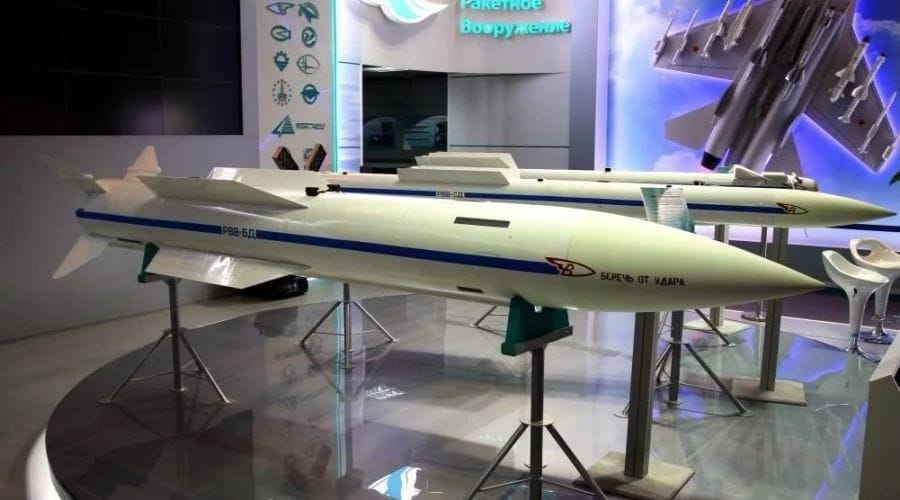
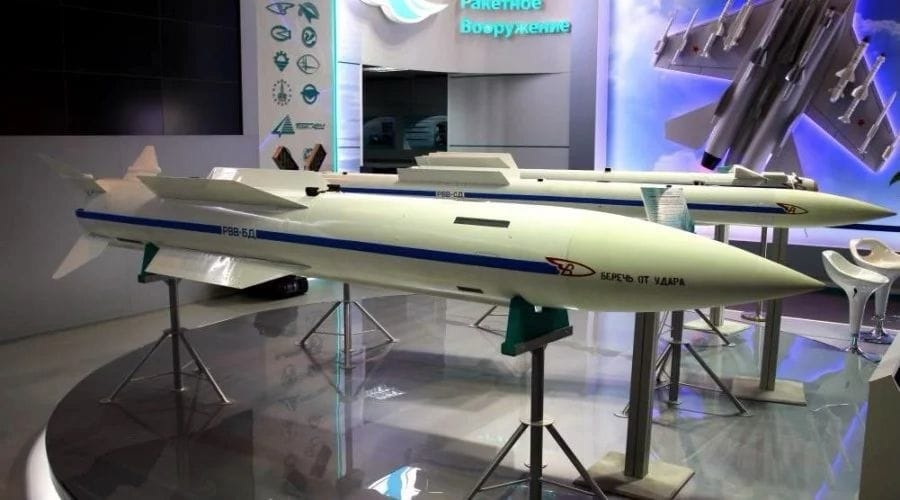
(Photo: the hypersonic R-37 missile)
The Russians are prepared to share the source code for the software. Not even the French have done this with their Rafale sales, let alone the Americans. With the source code, India can also mount its own domestically produced missiles on the fighter jets (such as the Astra MK-1 and MK-2, BrahMos, Rudram 1 and Garuda missiles). You can also (fully) customise the fighter jets to suit your own preferences and systems (for example, communication with anti-aircraft guns and ground-based radars). None of this is possible with the Americans. Several components of a fighter jet have their own source code (radar, engine, weapon systems, aerodynamics, etc.), but this most likely refers to the GaN-based AESA radar systems.
Several fighter jets are fitted with an AESA radar, but the GaN-based AESA radar is what is termed ‘state of the art’, a feature found only in 5th-generation fighter jets. This radar can perform multiple tasks simultaneously: tracking multiple targets at once, ‘jamming’ enemy radars and guiding multiple missiles simultaneously. With the source code, India can carry out independent updates, adapt the radar to its own preferences and further integrate the radar systems with Indian defence software and hardware systems. This gives the Indian Air Force a significant advantage in terms of military strategic autonomy. This would not be possible with the Americans.
The Sukhoi-57 (with its AI-controlled systems) has combat experience in Ukraine (albeit very limited), which can then be shared with Indian fighter pilots. The Russians are, in fact,somewhat reluctant to lose a Sukhoi-57 in Ukraine. In contrast, the Chinese J-20 variant has no combat experience whatsoever.
The Russians will not demand any (sudden) inspections, nor will they require real-time information on the fighter jets’ whereabouts. This would not be possible with the Americans.
The Russians will allow India to carry out its own maintenance on the fighter jets. With the Americans, it is well known that maintenance must be carried out in the US by American engineers using American software and companies. Furthermore, you have no insight into the software updates that are being carried out.
Indian defence studies have shown that India needs 42 to 45 fighter squadrons (a squadron comprises between 10 and 24 fighter jets, depending on the generation) to adequately protect its own airspace. India currently has 31 and is therefore severely short of fighter jets. The Sukhoi-57 is much cheaper than the F-35. A Sukhoi-57 costs around 40 million dollars each (and these will, moreover, be produced ‘directly’ in India). The F-35 costs between $80–110 million per unit (with production in the US, once Trump provides more clarity on his ‘ultimately’).
This article was translated, please find the original here.