

In Summary:
● Poland’s post-2022 military build-up reflects Warsaw’s view of Russia as an immediate threat
● Poland’s reliance on the US and South Korea shows its difficult security relations with Germany, France and Brussels and the limitations of Europe’s defence
● The key challenge is whether Poland can turn military rearmament into sustainable military capability
Poland’s military build-up
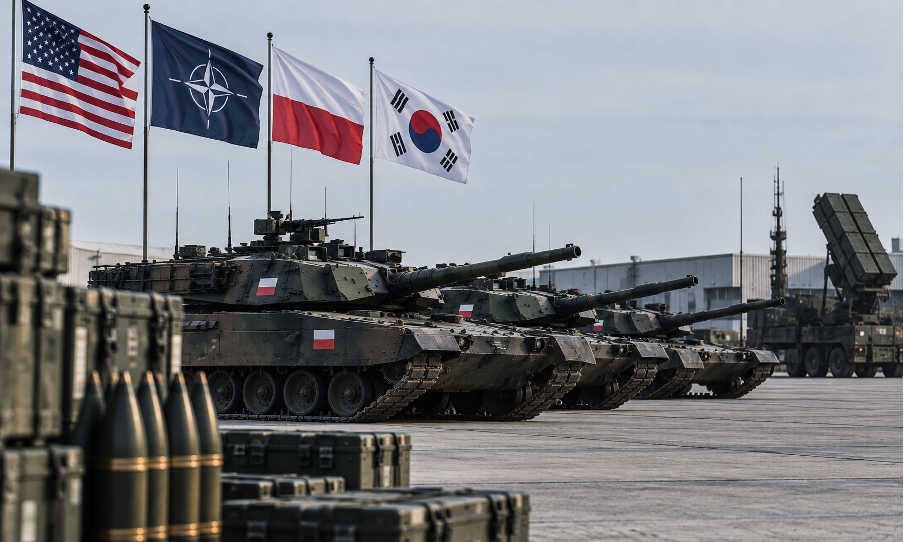
Poland is undertaking one of the most ambitious military build-ups in Europe. The modernisation of its armed forces actually began before 2022, but Russia’s full-scale invasion of Ukraine speeded up the process. Since then, Warsaw has invested in new tanks, artillery, air and missile defence, spending around 4.7% of its GDP on defence in 2025, while in 2026 the budget was raised to 4.81%. This places Poland beyond NATO’s 3.5% benchmark, which rises to 5% when broader defence and security related expenditure is included. But just as interesting as how much Poland is buying, is where it is actually buying from. The United States remains Poland’s main partner, while South Korea has emerged as a major supplier of military forces.
This raises a question: what does Poland’s post-2022 military build-up reveal about its perception of the Russian threat and its choice of strategic partners? And, consequently, can Warsaw deal with the scale of its rearmament into effective military capability?
Russia as a long-term threat
For Poland, the Russian threat did not begin in February 2022. Warsaw had viewed Moscow as a serious security concern for years, particularly after Russia’s war with Georgia in 2008 and its annexation of Crimea in 2014. As Dr. Łukasz Stach, researcher at the Centre for International Studies and Development at Jagiellonian University, explains, “The situation changed in 2014 when Polish decision-makers realised that there was a risk of a major conflict.” As a consequence, Poland pushed for a stronger NATO presence on the Eastern side of Europe, warning against underestimating the relevance of Russia. The invasion of Ukraine therefore reinforced an existing threat perception making the need for rearmament way more urgent. Polish Defence Minister Władysław Kosiniak-Kamysz has described Russia as “the greatest threat to Europe’s security, peace and stability”.
History also explains why Poland’s perception of Russia has differed from that of some Western European states. Dr. Floris van Berckel Smit, Postdoctoral Researcher in Political History at Radboud University, and Yuliia Korotia, Transatlantic Security Program Coordinator at the German Marshall Fund’s at the Warsaw Office, point out that “in Poland, memories of foreign occupation, the Second World War, and decades of Soviet domination have contributed to a strategic culture in which security and sovereignty are not taken for granted, and vulnerability to Russian power remains particularly salient.” Also, they emphasize that “countries such as France and Germany approached Russia from different historical starting points and, after the Cold War, generally placed greater weight on engagement, including economic engagement, and on the stabilizing effects of interdependence.”
These differences in threat perception have also shaped Poland’s relationships with France and Germany. Who Poland buys from therefore cannot be separated from the question of whom Warsaw trusts.
Who does Warsaw trust?
Poland’s procurement choices also reveal which strategic partners Warsaw considers most reliable. The presence of US troops in Poland, together with its role in NATO, has made their relationship central to Poland’s deterrence of Russia. Dr. Stach emphasises the importance of this relationship: “regarding the United States, Poland has always been very pro-American and Polish decision-makers have always seen the US as a main security provider.” This is reflected in Poland buying Abrams tanks, F-35 fighter aircraft, Patriot air-defence systems and Apache helicopters.
Domestic politics have also affected the choices made by Poland. Under the PiS governments, Poland’s already difficult relations with France and Germany became part of broader tensions with European partners. PiS was strongly Atlanticist and, therefore, sceptical of European defence initiatives that could weaken the role of NATO or the US role in Europe. Dr.Stach links this political position directly to procurement: “Law and Justice is very pro-American and rather eurosceptic, which also enhanced the willingness to purchase military equipment from the US.” It is important to note that relations with Berlin were already particularly damaged by disagreements over Nord Stream 2, migration and PiS’s demands for war reparations, while rule of law disputes further complicated Warsaw’s relationship with the EU. These political tensions also affected defence cooperation. For instance, in the case of France, relations deteriorated after Warsaw cancelled the planned purchase of 50 Caracal helicopters in 2016.
On the other hand, Poland’s turn to South Korea is particularly significant. Unlike the United States, South Korea was not a longstanding security partner of Warsaw’s, but it quickly became one of Poland’s most important suppliers, accounting for 47% of its major arms imports between 2021 and 2025. When the first major agreements were reached in 2022, Polish officials emphasised quality, speed of delivery and the involvement of Polish industry. The agreements also went beyond importing Korean equipment as they included plans for technology transfer, local production and Polish variants of Korean systems.
Dr. Piotr Śledź, Assistant Professor at the Department of Strategic Studies and International Security at the University of Warsaw, similarly emphasises the industrial dimension of the partnership: “South Korea offered Poland a higher level of inclusion of Polish defence companies into the manufacturing processes and technology transfer than any other feasible partner at the time (the U.S. in particular), even though this elevated the costs of contracts”.
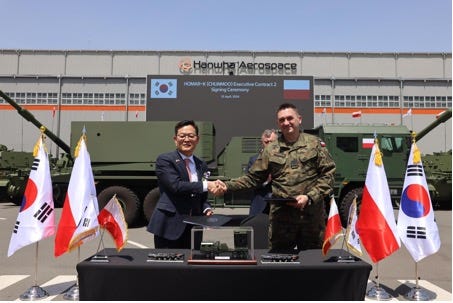
Dr. Śledź cautions that “the final shape of this cooperation is still to be determined, since not all the assumptions of the framework agreements signed in 2022 have already been specified within the relevant executive agreements, especially when it comes to the localized manufacturing.” This makes the South Korean partnership particularly revealing, showing us that Poland was not necessarily choosing countries with which it shared the closest strategic relationship but it was looking for suppliers able to meet the speed and scale of its rearmament. The urgency created by the Russian threat was also central to this decision. As Dr. Śledź argues: “it was arguably a decisive factor, given the timing.”
What does this mean for European defence?
Poland’s turn to South Korea also raises questions about Europe’s ability to meet the military needs of states aiming to rearm themselves. Dr. Śledź argues that the “Russian invasion of Ukraine found European manufacturers unable to promptly meet the Polish arms demand in 2022 due to either their limited production capacities (as in the case of main battle tanks), or general unability to provide necessary arms (as in the case of a Chunmoo-like rocket artillery system).” At a time when the EU is seeking to strengthen its defence industry and reduce external dependencies, it is interesting to see that one of its largest defence spenders has relied heavily on American and South Korean equipment. Dr. Stach reaches a similar conclusion, noting that “there have been significant delays to European military modernisation programmes, and Europe’s military industrial capabilities are limited.”
A central challenge for European defence is exposed: greater strategic autonomy will be difficult to achieve if European suppliers cannot provide the capabilities states need at the required speed and scale.
Buying weapons is only the beginning
The fact that equipment is acquired does not mean that there are enough forces to operate it militarily. Warsaw must expand its armed forces while simultaneously introducing new weapons systems. Turning these investments into military capability requires trained personnel, maintenance, logistics and the ability to integrate different systems into a force. As Dr. Stach also warns, “there is a risk that Poland will have equipment but not the personnel to operate and maintain it.” The number of military personnel rose from 116,200 in 2020 to 233,800 in 2025, while Warsaw is working towards a model of around 500,000 operational troops alongside a much larger reserve. Beyond personnel, Dr. Stach also expressed the challenge of integrating Poland’s rapidly expanding capabilities: “All equipment, personnel and command and control structures must be integrated into a single operational system that is supported by industry and the population.”
There is also a question of sustainability. Maintaining a large force and new complex equipment will not be cost-free. Therefore, Poland’s rearmament will not be struggling only with how much new equipment it acquires, but with how it will be able to turn that equipment into a sustainable force.
Conclusion
In conclusion, Poland’s post-2022 military build-up is the result of a threat perception. Russia’s invasion of Ukraine only reinforced concerns that had long been present in Poland while adding a new urgency to strengthen deterrence. Another point of interest, as we have seen, is about Poland’s choices in terms of allies. A final point of reflection should focus on whether Poland’s rearmament will be able to succeed, having seen the intensity and speed of its military force.
Hi nice piece ! I wrote an article about German Rearmament which fits perfectly with your article.
Thank you, Viola, for capturing the core dilemma of Poland’s rearmament brilliantly: balancing immediate threat perception with industrial and structural realities.
One additional angle that underlines this challenge is financial sustainability and EU fiscal rules. Allocating a record 4.8% of GDP to defence creates a massive budget deficit for Warsaw. While Poland actively advocates for exempting defence expenditures under the EU’s Excessive Deficit Procedure, this remains a subject of intense debate with Brussels. Navigating these fiscal boundaries will be just as crucial for Warsaw as building military capacity.