


In Summary
Particularly from 1977 onwards (following General Zia Ul-Haq’s coup d’état), efforts were made – through the extensive Islamisation of society – to create a stronger Pakistani identity and, thereby, to ensure the survival of the State of Pakistan.
The ‘two-nations theory’ is to be implemented not only at the administrative level, but also in every aspect of daily life. The struggle against India thus becomes a civilisational struggle that transcends all ethnic divisions.
Initially, this Islamisation led to greater loyalty to the state and the army, particularly during the Soviet invasion of neighbouring Afghanistan in 1979. Subsequently, regional tensions increased due to persistent under-representation in central power structures in Rawalpindi (military centres) and Islamabad (political centres).
Ethnic tensions continue to rise due to an ‘oligarchisation’ of the economy, to the benefit of the military and (their) political elite. The conflict with India is being used to alleviate these tensions and restore loyalty to the army.
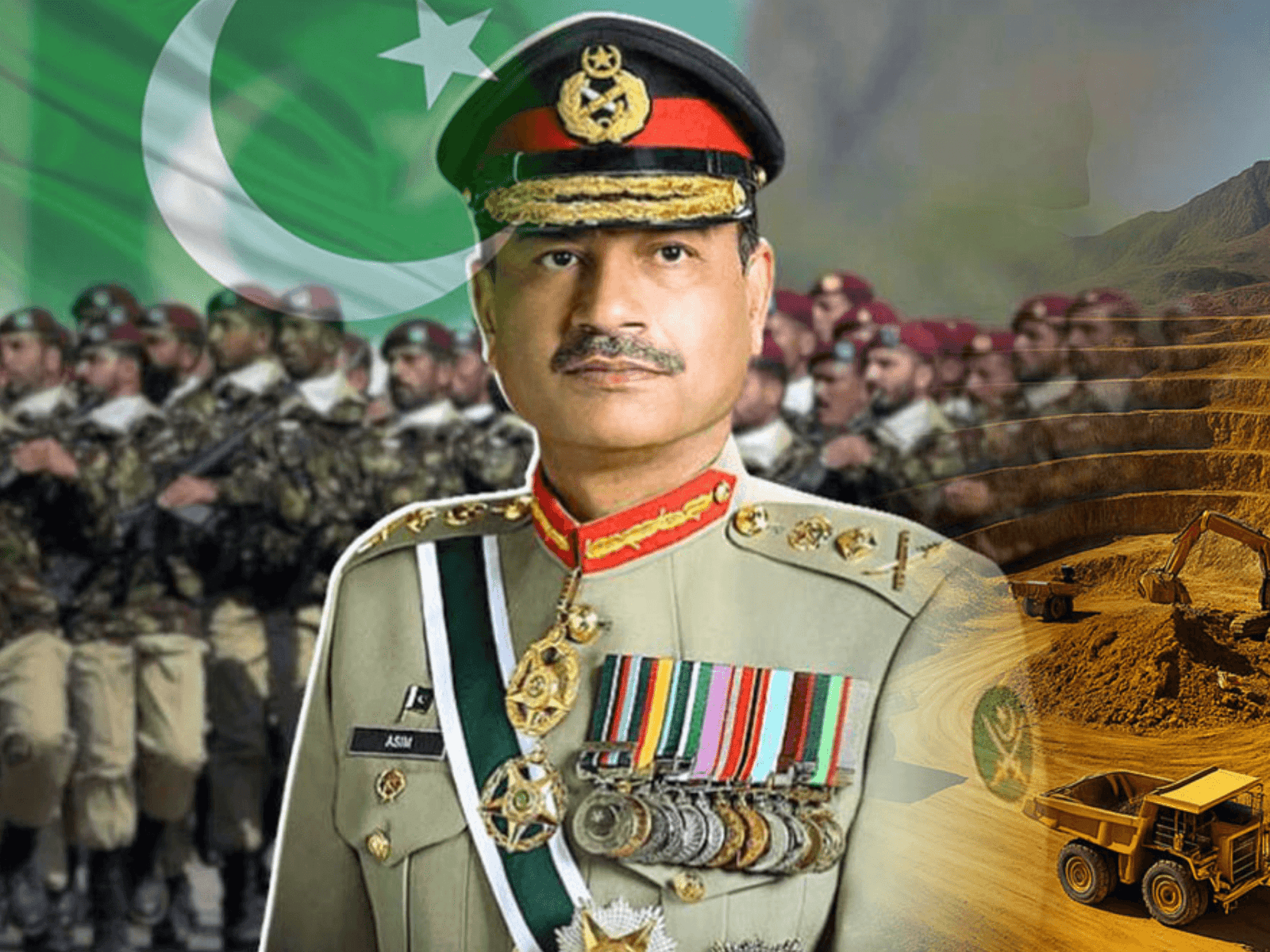
Regional Update: India | On 17 April 2025 (five days before the Kashmir attack), the current Chief of Staff of the Pakistani Army, Asim Munir (the most powerful man in Pakistan), delivered a remarkable speech. He stated that the ‘two-nations theory’ is still very much alive. Hindus and Muslims are, by definition, different from one another in every respect. And not only that: Pakistanis were instructed to pass this on to their children, so that it would never be forgotten. A Kashmir within India, with a Muslim majority, therefore belongs, by definition, to Pakistan. Pakistan’s honour is forever linked to Kashmir.
Islamisation and ‘shared’ identity
The idea that Hindus, by definition, differ from Muslims in every respect received significant reinforcement in 1971 (the genocide against Bengali Hindus, led by General Yahya Khan) and in 1977. In 1977, General Zia Ul-Haq staged a coup d’état and Prime Minister Zulfikar Ali Bhutto was executed shortly afterwards. Ul-Haq realised that, in order to create a strong Pakistani identity (and thereby ensure the survival of the state of Pakistan), the ‘two-nations theory’ had to be actively implemented not only at the administrative level, but also in every aspect of daily life. A thorough Islamisation of all aspects of society and the army was set in motion. There has been no deviation from this policy since. A strict form of Sharia was implemented across the board, with substantial financial support for strict mosques and madrasas (Koranic schools), and ‘Jihad’ was given a more prominent role within the army and the education system.
A stricter implementation of Islam (and thus a greater divergence from Hindu India and Shia Persia) would transcend regional identities and enforce greater loyalty to the imams, who in turn would project loyalty to the state of Pakistan and the army.
The struggle against India became more than a local territorial conflict; from Pakistan’s perspective, it is now a clash of civilisations, a Jihad, of Islam against Hinduism. Since then, Pakistani society has undergone a fundamental transformation.
Initially, this Islamisation led to greater loyalty to the state and the army. In particular, the 1979 invasion by the ‘unbelieving’ Soviet Union against the Afghan ‘Muslim brothers’ meant that all population groups (notably the Pashtuns) underwent a profound Islamisation during this decade-long ‘holy war’. It also provided the military leadership with the basis for establishing and supporting countless jihadist groups in Pakistan and Kashmir. However, this ‘shared Islamic identity’ did not lead to more equitable representation within Pakistan’s centres of power in Rawalpindi (military centres) and Islamabad (political centres), both of which are in Punjab. This remains firmly in the hands of the Punjabi generals and politicians.
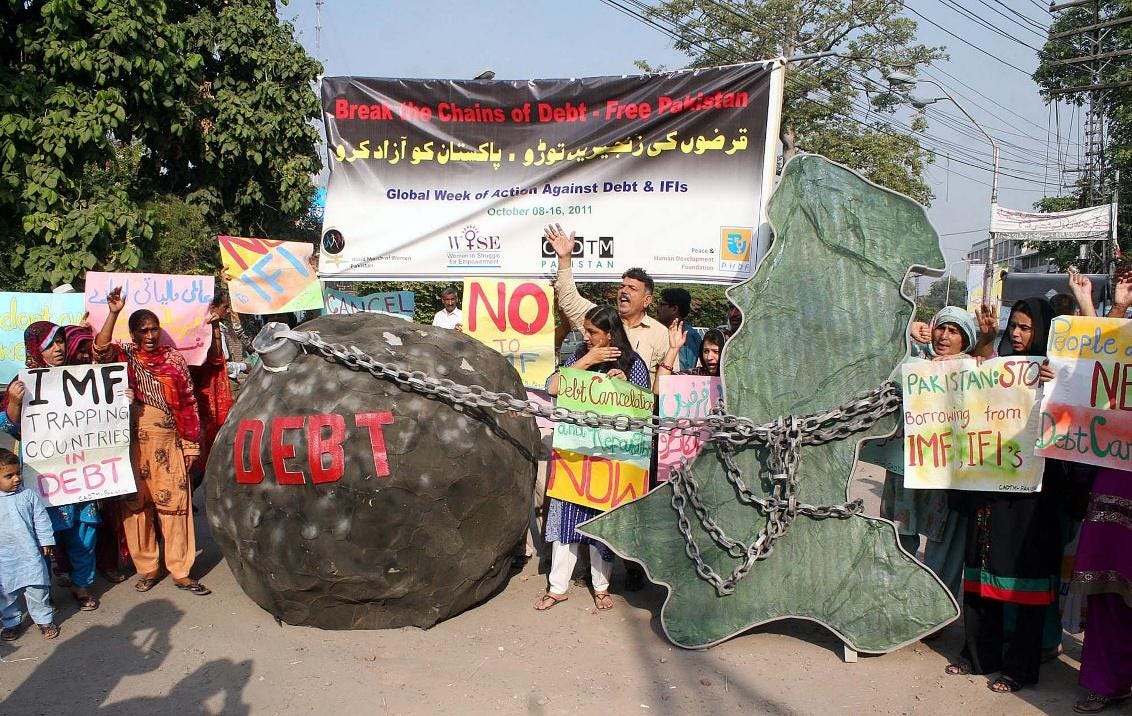
(Photo: Pakistanis protesting against the IMF loans taken out by the Pakistani government)
The internal military colonial empire
On top of this, the army exercises firm control and has vested interests in almost all economic sectors, with profits largely remaining within the military leadership. The Baloch, in particular, are left empty-handed, as they see their natural resources disappearing into the coffers of companies owned by the military leadership. The protection of the Pakistani market against excessive foreign competition safeguards the army’s enterprises. Civilian businesses often complain about the unfair advantages enjoyed by military-owned enterprises, such as tax breaks and better access to state-owned land. Formal and informal cash flows make the Pakistani military leadership some of the wealthiest people in Pakistan, with private golf clubs and luxury property in the West. The Punjabi population itself is not spared either, resulting in economic mismanagement and a history of 24 IMF emergency loans (a world record). Negotiations are now underway regarding the 25th.
The military leadership, including generals such as Qamar Javed Bajwa and Asim Saleem Bajwa, has repeatedly been linked to considerable personal wealth. For instance, the investigative platform FactFocus reported that the wealth of General Qamar Javed Bajwa’s family grew to more than 12.7 billion Pakistani rupees (55 million dollars) during his term of office between 2016 and 2022. Lieutenant-General Asim Saleem Bajwa also came under fire due to an extensive business network built up by his family, with interests in fast-food chains and property developments in Pakistan and the United States.
The army’s influence extends far beyond personal wealth. Various military institutions manage extensive business empires:
Fauji Foundation: One of the largest conglomerates in Pakistan, active in sectors such as cement, energy, food production, financial services and healthcare. Officially, the proceeds are used to support veterans and their families.
Army Welfare Trust (AWT): Active in insurance, banking, property and agriculture.
Shaheen Foundation: Affiliated with the Air Force, active in property development, education and media companies.
Bahria Foundation: Affiliated with the Navy, active in shipping, education and property.
The Baloch are carrying out attack after attack against Pakistan’s military infrastructure; the Pashtuns in the north-west are keen to join Afghanistan; the Sindhis are increasingly looking towards having their own state by the sea; and in Gilgit-Baltistan there have been protests against military oppression and, in some quarters, even in favour of joining India. Meanwhile, in Punjab, anger remains high over the imprisonment of Imran Khan, and support for the army has hit a new low. In the past, launching a war against India of its own accord and/or allowing terrorist groups to carry out attacks has always helped to spark a new ‘rally round the flag’, particularly in the face of a counter-response from India. This also provided ‘public’ protection for the army’s political and economic interests. After all, there is once again talk of a ‘clash of civilisations’ against Hindu India, which transcends all ethnicities and internal problems. The question is whether India will allow itself to be exploited by this ‘rational’ calculation once again this time, and how it might strike back differently.
This article was translated, please find the original here.
