

In Summary
When one considers the interests of the Pakistani military and political elite and their grip on Pakistan, the attack in Kashmir is entirely ‘rational’. Kashmir is merely a political theatre for the Pakistani generals and (their) politicians.
Since its foundation, Pakistan has been characterised by two internal power struggles: 1) between the democratically elected government and the Pakistani army, and 2) between the elites of Punjab province (the largest province and the power base) and the other major ethnic groups.
The Kashmir issue helps to unite the various ethnic groups behind the authorities, whilst at the same time upholding Pakistan’s ideological foundation, namely the ‘two-nations theory’.
Any resistance by prime ministers to the interests of the army is met with execution or imprisonment, as was the case with Imran Khan in 2023.
Regional Update: India | On 22 April 2025, yet another brutal terrorist attack took place in Kashmir, resulting in a resurgence of the conflict between India and Pakistan – two nuclear powers – which has lasted for more than seven decades. Looking at a map of the Indian subcontinent, no one can avoid the realisation that peace between India and Pakistan would bring enormous benefits to the populations of both countries.
The 1.4 billion Indians and 255 million Pakistanis could collectively turn the Indian subcontinent into an economic, geopolitical and, potentially, military powerhouse; after all, we are talking about a combined population 3.7 times that of the EU and five times that of the US, a geography perfectly surrounded by solid natural barriers, and a potential mega-internal market for all industrial sectors.
This was a vision also held by the Indian independence fighters and leaders, as well as the vast majority of the British Indian population, both Hindus and Muslims. An idea that persisted even after the partition of India and Pakistan in 1947 and formed the basis for the six official peace initiatives over the past seven decades; all initiated by India.
And yet; in response, India has received nothing but four conventional wars and countless (Pakistan-facilitated) jihadist terrorist attacks. On 17 April 2025, the Pakistani Chief of Defence Staff, Asim Munir, stated that Pakistan’s honour is tied to Kashmir. As long as India still holds part of Kashmir, peace with India is impossible.
It sounds illogical; to forsake such enormous potential benefits for both nations for the sake of a border dispute in a single province, which has now been split in two for decades (and, in doing so, to allow Pakistan itself to be used as a safe haven for terrorists)? It sounds illogical because it is indeed illogical when viewed through the lens of national interests and from a democratic perspective.
However, from the perspective of the interests of the Pakistani military and political elite and their grip on Pakistan, this is entirely ‘rational’. Kashmir is merely a political theatre for the Pakistani generals and (their) politicians. Pakistan’s problem with India is not Kashmir.
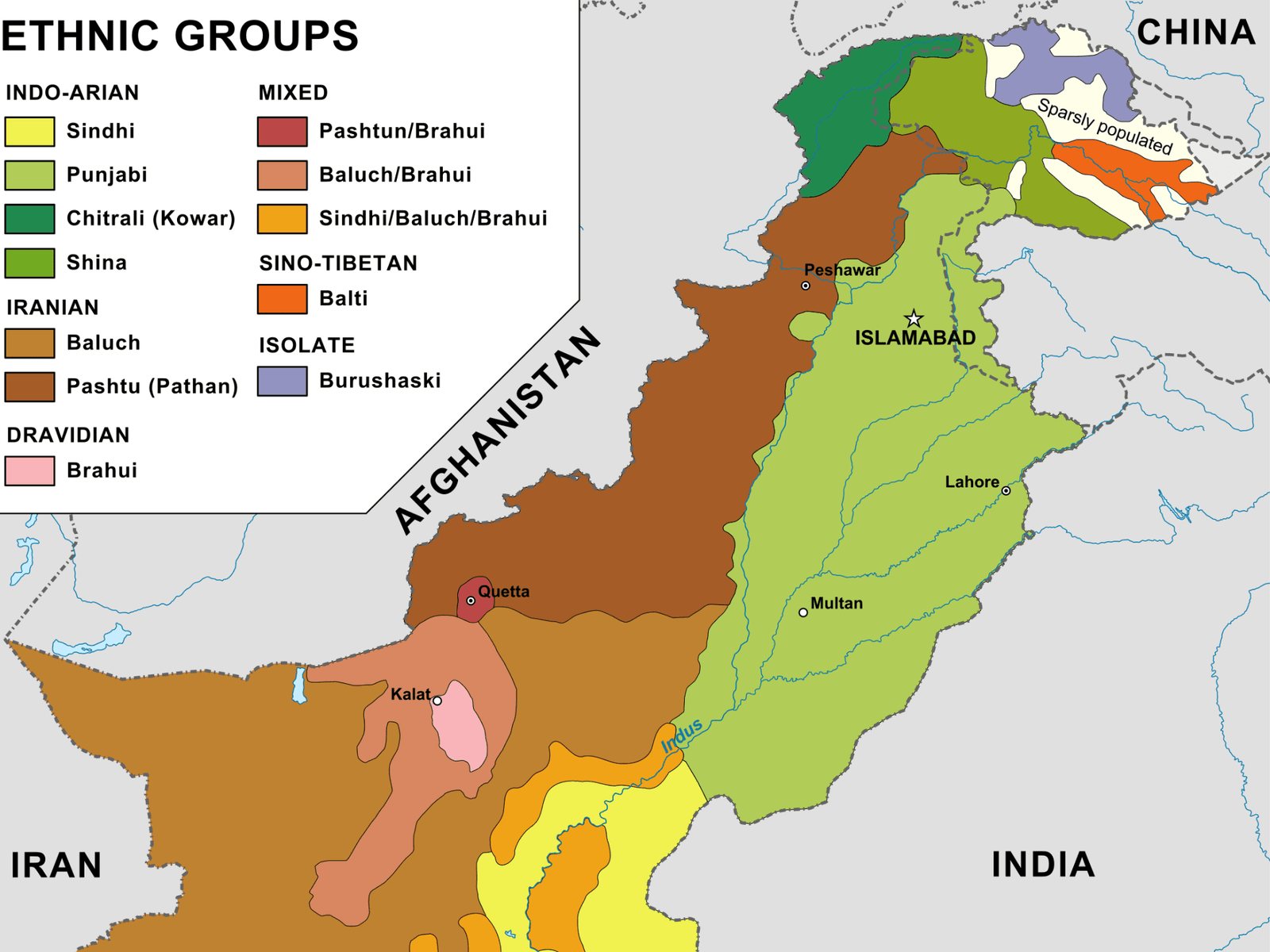
Since its inception, Pakistan has been characterised by two internal power struggles: 1) between the democratically elected government and the Pakistani army, and 2) between the elites of Punjab province (the largest province and the power base) and the other major ethnic groups in the provinces of Sindh, Baluchistan, Khyber-Pakhtunkhwa (Pashtuns) and Gilgit-Baltistan. Kashmir and the perpetuation of the conflict with India are pivotal to the ideological legitimisation of existing power structures and even of the very existence of the state of Pakistan.
(Photo: Prime Minister Imran Khan (PTI Party), Prime Minister between 2018 and 2019)
The dream of a modern Islamic secular state
In recent months, the Pakistani security forces have had their hands full dealing with the massive protests across the country. Since the highly popular Prime Minister Imran Khan (of the PTI party) was deposed in 2022 and has been in prison since 2023, the Pakistani population’s distrust of the army has reached an all-time high, even amongst the Punjabis (the power base of Pakistan and the army). Imran Khan promised the Pakistani people a modern Islamic semi-secular state, modelled on that of Pakistan’s founder, Muhammad Ali Jinnah. For the umpteenth time, the army intervened and seized power once again.
Imran Khan, too, was a fervent advocate of ‘tackling’ the Kashmir issue, just like the previously democratically elected leaders before him (amidst all the coups and the ongoing de facto military regimes). On the one hand, this stems from attempts to unite the various ethnic groups behind the authorities; on the other, it is a matter of remaining true to Pakistan’s ideological foundation, namely the ‘two-nations theory’ (the idea that Muslims and Hindus, by definition, cannot live in the same country or form a single nation).
Ever since independence in 1947, the creation of a Pakistani identity has been the priority of the Pakistani administrative and military elite. After all, Pakistan comprises many ethnic groups, spread across the provinces of Punjab, Sindh, Balochistan, Khyber-Pakhtunkhwa (Pashtuns) and Gilgit-Baltistan. Ever since the creation of the state of Pakistan, the administrative and military power base has been in the province of Punjab, which led to great mistrust amongst the other ethnic groups (particularly the Baloch and, more recently, the Pashtuns) from an early stage. This mistrust of the Punjabi military and political elite, severe under-representation in the central government and the suppression of their own language even led, in 1971, to the secession of the Bengalis in East Pakistan (almost half of the Pakistani population at the time), who went on to create the state of Bangladesh.
Furthermore, the military authorities have played an increasingly prominent role in central government since Jinnah’s death in 1948. Externally, they present themselves as the guardians of the state of Pakistan. Internally, however, the army has severely curtailed the democratic process in recent decades, to the benefit of its own political and economic interests (in almost all sectors). Pakistan has now become a military state, in which the ‘democratically’ elected government and political parties are installed only with the blessing of the military leadership (as was the case with the appointment of Imran Khan in 2018 and of the current Prime Minister, Shehbaz Sharif, in 2022). Any resistance by prime ministers to the interests of the army is met with execution or imprisonment, as in the case of Imran Khan in 2023.
This article was translated, please find the original here.
