



“If the 20th century ran on oil and steel, the 21st century runs on computers and the minerals that feed it.” - Jacob Helberg, U.S Under Secretary of State for Economic Affairs
In Summary:
Latin America possesses significant reserves of critical minerals, including Argentine lithium, Chilean copper and Brazilian rare earth elements, positioning the region as an important player in the global energy transition and strategic competition between the United States and China
Mineral wealth alone does not guarantee economic or geopolitical leverage: developing domestic processing, refining, technological infrastructure and manufacturing capabilities is essential to retaining value locally
Brazil, Argentina and Chile have adopted different approaches to mineral development and international partnerships, reflecting divergent industrial priorities and geopolitical alignments
Despite the complementarity of their mineral resources, regional cooperation is hindered by political fragmentation
US efforts to diversify critical-mineral supply chains away from China create opportunities for investment and technological cooperation, but also raise questions about national sovereignty and the risk of remaining dependent on external processing capabilities
Ultimately, the article argues that Latin America’s challenge is to transform its mineral wealth into collective industrial and geopolitical leverage through regional coordination, shared infrastructure, research partnerships and commitments to local processing, rather than allowing countries to negotiate separately with external powers
National Capabilities
Latin America holds deposits of resources essential to energy transition and advanced industry and manufacturing. Lithium for batteries, copper for electricity networks and renewable energy, and rare earth elements used in magnets, electronics and defense technology. As the United States seeks to reduce its dependence on China for critical minerals, these reserves have positioned Latin America as a strategic arena. However, just how strategic depends on developing the technological infrastructure and industry that make up national capabilities to fully extract minerals’ economic and strategic value.
Everaldo Gonçalves, senior Geologist, journalist, Former Professor at the University of São Paulo and Federal University of Minas Gerais, former President of CPFL and Director of Eletropaulo, argues that the answer to the mineral race is tied to national sovereignty and industrial capacity. “The ambition is not only to supply the United States or Europe by increasing exports and aligning that way, but to develop the technology and infrastructure needed to process minerals domestically.”
Latin American countries possess different mineral reserves, with Chile producing a lot of copper and Argentina, lithium, for example. Possessing the second-largest reserve of rare earth minerals in the world, estimated at 21 million metric tons in 2025 according to the U.S Mineral Commodity Summaries, Brazil has a role to play too. Its scale and well-established mining sector, alongside recent Bill nº 15.506, which formally provides a framework for exploring such minerals, seem to point to ambitions of becoming an alternative supplier to China. This ambition is, however, complicated supply chain limitations whereby much of the value chain itself remains outside Brazil, with minerals often exported unprocessed to be refined and manufactured abroad.
The country’s production potential is significant. As Gonçalves points out, “Goiás has become the epicentre of Brazil’s rare earth industry, with production already underway at Minaçu’s Pela Ema mine, operated by Serra Verde. In April 2026, the company agreed to be acquired by American group USA Rare Earth in a transaction valued at approximately US$ 565 million in financing from the US International Development Finance Corporation (DFC), while a further US$750 million commitment from the US Department of War was announced in August.”
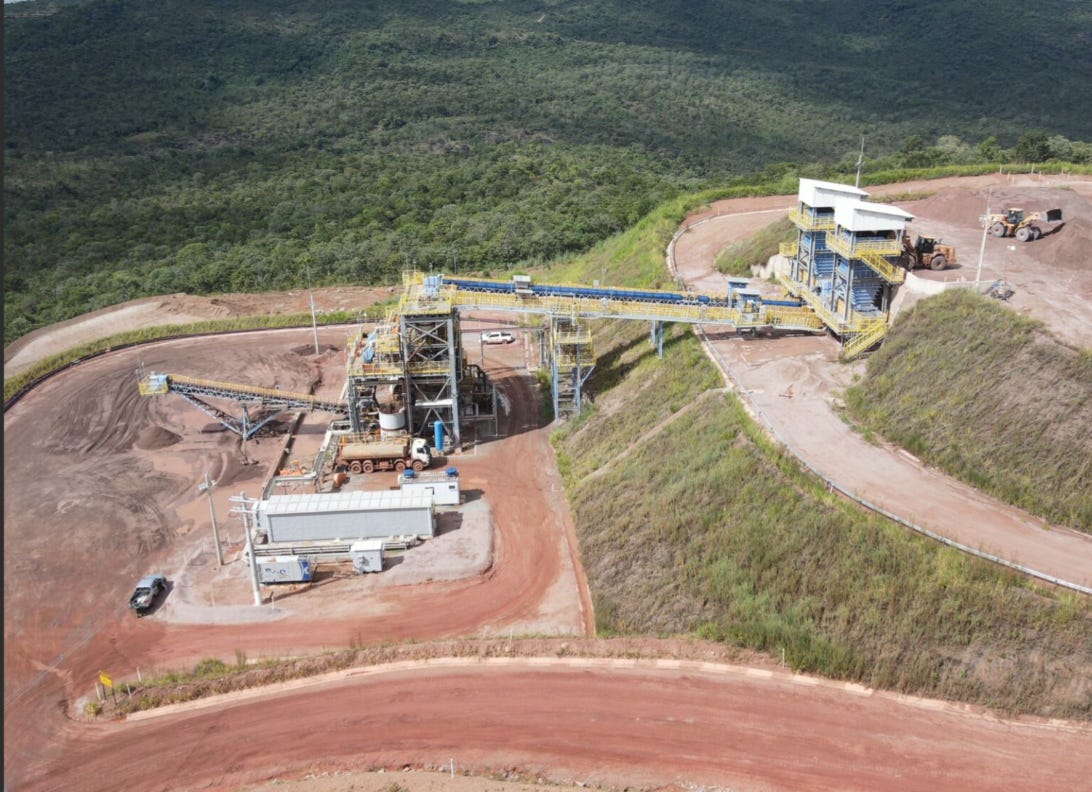
The operation exploits an ionic clay deposit associated with the Serra Dourada granite, where relatively low-grade ore can nevertheless be processed through comparatively simple leaching techniques using water and soda. Commercial production began in 2024, making Serra Verde the first large-scale producer of all four magnetic rare earth elements outside Asia. Importantly, it produces a mixed rare-earth concentrate instead of finished permanent magnets or individually separated rare earth oxides, requiring further downstream processing to generate the desired end-stage.
As for the goals of other mineral-rich nations like Argentina and Chile, strategies vary. Against this backdrop of limited political and strategic alignment in Latin America, the United States has advanced two initiatives that seek to strengthen its regional partnerships and reduce strategic dependencies on China. Pax Silica is a US-led initiative launched in December 2025 to secure and diversify supply chains underpinning artificial intelligence, semiconductors and critical minerals; Argentina, Chile, Costa Rica and Panama joined on 26 June 2026. The Shield of the Americas, launched in March 2026, is a US-led hemispheric coalition focused on regional security and cooperation against transnational threats, with Argentina and Chile among its founding members, while Brazil remains outside the initiative.
Argentina, for one, has seen a surge in lithium investments, and Argentine President Javier Milei’s political leadership remains closely aligned and engaged with Washington. Brazil, on the other hand, lives through the worst moment of its long diplomatic history with the USA, and is on the outside of the mineral boom led by Trump. Chile’s posture, of relatively limited engagement with Mercosur as an associate state with a free trade agreement, leaves open the question of its own priorities. Altogether, this lack of political alignment in Latin America puts into question whether this common pool of minerals will pave the way for greater collaboration or competition in the region.
Islands Over Land
Though reserves do vary in type and number, the region’s minerals could complement one another, since the end goal of manufacturing doesn’t necessarily overlap. For example, a single battery requires Argentine lithium, Brazilian rare earths, and Chilean copper. As such, non-alignment on the minerals question is seemingly more about the political side of things than resource-focused. Brazil and Argentina have long been important partners in Mercosur, but the relationship is complicated. Current ideological differences between Lula and Milei, disagreements over Mercosur’s trade-policy and EU-facing strategy, and competition over regional leadership in the context of Brazil’s greater economic weight and Argentina’s effort to preserve influence over the bloc make a potential cooperation more difficult.
Over the course of the last presidential elections in Brazil, won by Lula on October 25th, massive street protests’ posters announced: “Brazil is nobody’s backyard”, indicating a strong popular sentiment that Brazil’s riches should be Brazilian, and that intervention from the USA is unwelcome; that, coupled with the recently elected President Lula’s September 6th speech on sovereignty reinforce the idea that Brasília does not intend to easily give in to American strategy when it comes to its natural resources.

And if mineral policy is shaped by domestic political agendas in the absence of a coordinated regional strategy, perhaps these differences will be detrimental to a Latin America-wide mineral plan - that is to say, without a regional plan, each country bargains alone. Chile has developed a policy aimed at adding value to lithium, including public-private partnerships and research capacity. Argentina’s lithium boom has attracted substantial investment, though the Argentinian approach differs from Brazil’s more industrial-policy-oriented model. Overall, the Chilean position illustrates well the limits of regional integration; it is not a member of Mercosur, but maintains partnerships with other international actors that reflect a presence of geopolitical ambitions, if not regional alignment.
Ricardo Lopes Kotz, a researcher at Universidad del Pacífico’s Political Economy Department in Peru, observes “Countries may share a broad political orientation without sharing a common foreign policy or mineral strategy. The region’s mineral sectors also have distinct commercial logics: lithium is closely tied to batteries, while copper is essential to electrical systems and technologies such as solar panels. In that sense, cooperation is possible but not automatic, it may require negotiation.” As a result, Latin America may resemble islands over land: countries linked by geography and resource potential, but pursuing separate routes to investment, technology and influence.
US-Brazil Relations
Though the US-led Shield of the Americas has been presented mostly through a security lens, it has economic implications expected to reverberate through supply and resource chains. In the context of Washington’s aim to source materials from trusted partners and within the logic of competition with China, being part of emerging partnerships significantly impacts a country’s ability to position itself as a relevant and reliable actor.
For Brazil, participation is a lot less straightforward than it seems. It has stayed outside the Shield, just as it declined to join China’s Belt and Road Initiative. Kotz interprets both decisions as deliberate efforts to preserve room for maneuver. “Brazil is trying to negotiate with competing powers rather than formally align with either, but this strategy of non-alignment and remaining a friend to all is increasingly difficult to maintain as competition between the USA and China intensifies.”
In this case, the minerals themselves do not necessarily determine the diplomatic choice: political leadership, domestic constituencies and broader foreign-policy priorities also matter. Case in point, Gonçalves characterizes Brazil-US relations as being at their worst, pointing to tariff disputes, political pressure and threats of intervention under President Donald Trump. “But it’s important to note this relationship has a long history of economic interdependence, including earlier US involvement in Brazilian geological surveys and the development of major mining and steel institutions. The present tension therefore exists alongside longstanding ties.”
Minerals could provide a pragmatic channel for engagement and open avenues for negotiation based on common or complementary interests: US companies have an interest in securing supplies, and Brazil wants investment and technology. But the central question is: will foreign investment help build Brazilian capacity, or simply secure greater access to Brazilian deposits?
Kotz stresses “Minerals extracted in Brazil can leave with little processing and return as higher-value products after refining abroad, but it’s a problem to ensure that foreign investment from either China or the US contributes to creating value locally. For Brazil, critical minerals policy is centered on establishing rules for investment and exploration while offering subsidies for companies to develop processing and refining, so that ultimately Brazil moves beyond extraction to a more robust role in the supply chain.”
Despite featuring prominently in US strategy and attracting investment as a result, Brazil must create conditions to retain control over its minerals. Kotz says “China accounts for the overwhelming share of rare-earth refining and processing, including the production of magnets used in electronics and other advanced applications. Brazil may have the reserves, but building the industrial know-how to process them at scale is a longer-term project.”
Concurrently, shaky relations with the USA might complicate the path to multilateral negotiation and make the landscape of Latin America more opaque. Although Brazil was left out of the Shield of the Americas, policy discussion around the USA’s mining strategy stresses the importance of bringing countries like Brazil and Mexico closer. The two, as well as countries already integrating the mineral-supply chain initiative of the Shield, should take on a more developmental and less raw-material-exporter role. If Serra Verde proves anything, it is that the interest and capital are already there. What remains to be seen is what role will Brazil (and other Latin American countries in a similar position) play in such a supply chain.
Developments: From Mineral Competition to Cooperation?
Thus, it seems that possessing these minerals opens a wide field of possibilities. Thinking of the historical importance of minerals to geopolitical cooperation renders one incisive example: the European Union. Its predecessor, the European Coal and Steel Community, brought strategic industries under a shared framework after the Second World War. The arrangement did not erase national differences, just as it isn’t expected to in Latin America, but it did create a mechanism for cooperation around resources central to economic recovery and security.
Kotz sees the possibility that mineral assets could support significant economic collaboration cautiously “At present, there is no clear regional leader. Brazil might have the scale for the role, but its leadership depends on developing domestic processing, refining and magnet production. Without that technological base, it would struggle to lead a regional value chain beyond exporting of raw materials. The Shield of the Americas could, in principle, become a forum for dialogue and investment coordination among participating countries, and in that vein could help countries such as Chile, Peru and Argentina align parts of their mineral strategies. But considering US involvement and the security dimension of the initiative, there are concerns about external influence over domestic policy that it could also invite.”
A regional alternative would face its own set of obstacles: uneven mineral endowments, divergent political alignments and weak industrial integration. However, principles of cooperation could still be considered - shared standards, research partnerships, infrastructure links and commitments to local processing could help countries avoid competing only to attract outside capital.
The strategic competition over critical minerals is often presented as a contest between Washington and Beijing. For Latin America, it might be more important to think about its regional role in that larger competition. Mineral reserves create an opportunity, but the bifurcation in path to either collaboration or competition hinges on coordination and domestic industrial capacity. Bottom line, the common goal should be to create regional value and avoid the fate of being a collection of suppliers that each bargains separately with the powers seeking its resources.
A very interesting overview.
I learned a lot.
There are many different examples in the world of how countries use their resources.
Venezuela, for example, like Russia and Iran, is beautifully flushing its enormous natural wealth down the toilet. Or into someone’s pockets. Australia exports raw materials and is still quite successful. Norway turns its oil and gas revenues into financial assets and does pretty well. And Singapore has practically no natural resources at all and still thrives. So does Japan.
So processing raw materials is important, of course. But that is not what determines success.
What matters more, probably, is the quality of institutions and trust in the system.