


Background
Germany’s security cooperation with Kenya is increasingly becoming more visible. For our article, Why do Kenya and Germany double down on their relationship?, the HIG talked to Prof. Dr. Patrick Muthengi Maluki, Institute of Diplomacy and International Studies at the University of Nairobi and chair of Kenya’s Foreign Service Academy Council, and Dr. Hassan Khannenje, director of the HORN International Institute for Strategic Studies, to understand the key drivers behind the growing security cooperation between the two countries.
Maluki and Khannenje both argue that the Kenyan-German partnership illustrates shared interests in the domain of stability. At the same time, however, they are careful not to obscure the underlying asymmetry. Khannenje emphasizes that the cooperation is “a partnership of convergent interests with unequal resources,” one where mutual benefit coexists with the reality that “Germany’s financial weight still shapes which forms of cooperation get funded.” Maluki similarly highlights that “capacity-building is never entirely neutral.” Following this, the article (read here) engages with the question of who sets the security agenda in German-Kenyan cooperation?
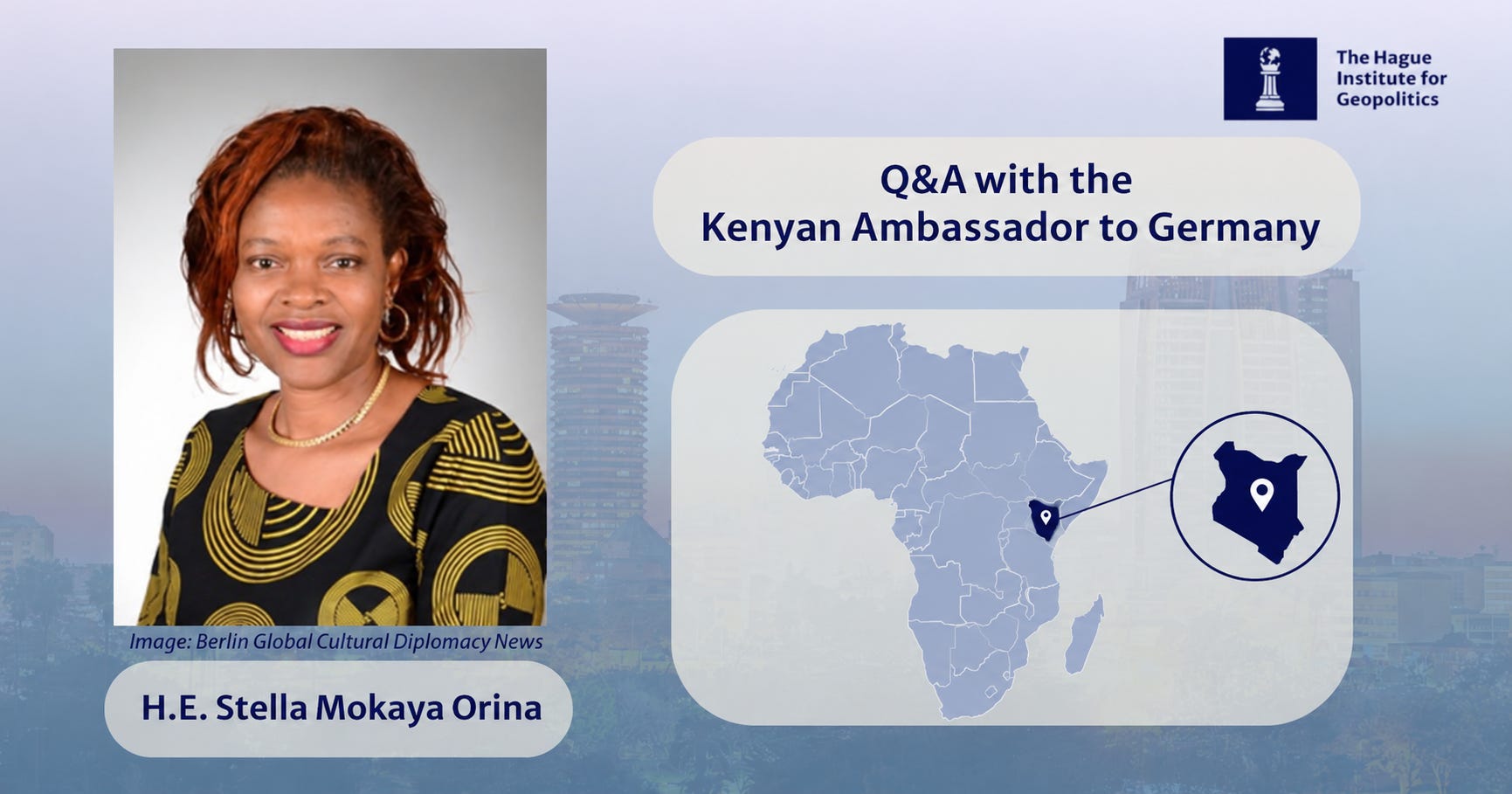
Discussing the Kenyan government’s security priorities and agreements with international partners, however, can become much more insightful when also engaging with the perspectives of those representing and shaping the outcome. The HIG therefore highly appreciates H.E. Ambassador Stella Mokaya Orina, Ambassador of the Republic of Kenya to Germany, also accredited to the Czech Republic and Poland, for sharing her perspective in the Q&A below.
Ambassador Stella Mokaya Orina discusses why security has become a more visible part of the bilateral relationship, what sets Germany’s contribution apart from partners like the US, UK and the Czech Republic, with whom Kenya signed a defence cooperation agreement in January, and how the Kenyan government keeps externally funded infrastructure under its own command and aligned with its own priorities.
Kenya and Germany have maintained close ties since 1963, when West Germany became the first country to recognise Kenya under international law. Today, their cooperation reaches from trade, migration and increasingly, security. What is driving this growing focus on security, and how do Kenya’s own priorities align with Germany’s evolving strategic interests in Africa?
“The growing security dimension reflects the natural development of our bilateral relationship. Of course, development cooperation remains important, such as work on institutional capacity, renewable energy, and technical and vocational training. However, economic progress cannot be sustained without stability.
For Kenya, our position in the Horn of Africa makes national security and regional peace essential to socio-economic development. Our contributions to peace operations under the African Union and the East African Community reflect this commitment. Protecting our citizens, critical infrastructure, and trade routes from regional threats is also necessary to safeguard the progress we have made.
Simultaneously, Germany’s evolving foreign policy framework places greater emphasis on strategic partnerships with stable, democratic states capable of acting as regional anchors. Berlin’s recognition of Kenya’s stabilizing role in East Africa and the Western Indian Ocean has made security cooperation a logical progression.
Crucially, this is not a departure from our development goals, but a protective layer built around them. Peace and security are the bedrocks upon which trade, investment, and social progress thrive.”
Kenya has deepened security ties with several partners (e.g. Germany, the Czech Republic, the US, the UK). Can you tell us a bit more about these partnerships, and does Germany bring a distinct value compared to other partners?
“In an increasingly multipolar world, Kenya follows a policy of strategic non-alignment and diplomatic diversification. Our security relationships extend across several partners, each of which brings different capabilities.
The United States, for instance, remains an important partner in intelligence sharing, counterterrorism, and regional logistics. Meanwhile, the United Kingdom has longstanding defence ties with Kenya, including joint army training through the British Army Training Unit Kenya (BATUK) and cooperation on maritime security. The Czech Republic, simultaneously, contributes through defence-industrial cooperation, equipment, and technical support.
Within this matrix, Germany offers a different yet equally valuable contribution, with a focus on institutional capacity-building, technology transfer, and the long-term development of our security capabilities.”
Following this, we need to emphasize that unlike approaches centered strictly on kinetic capabilities or donor-dependent military hardware, German engagement prioritizes long-term institutional empowerment. German cooperation emphasizes advanced technical training, civil-military coordination, Explosive Ordnance Disposal (EOD), and adherence to international humanitarian law. This consequently builds enduring capacity within our own security institutions and thereby enables us to independently manage complex security environments.”
The German-funded Counter-IED complex is described as serving Kenyan and regional institutions. In your view, how does the Kenyan government ensure that externally funded security infrastructure stays aligned with its own national and regional priorities, rather than donor priorities?
“A central question in international security cooperation is always how host nations ensure that externally funded infrastructure aligns with national priorities rather than donor mandates.
Kenya’s management of the German-funded Counter-Improvised Explosive Device (C-IED) complex at the Humanitarian Peace Support School (HPSS) in Embakasi provides a clear model of sovereign alignment. To elaborate, we need to investigate three core processes which function as guiding principles to ensure alignment with Kenyan national and regional interests.
First, Kenya retains operational authority. Regardless of where the funding comes from, security infrastructure on Kenyan soil remains under the command and control of the Kenya Defence Forces (KDF). The facilities are staffed, governed, and operated by Kenyan personnel.
Second, training and operational requirements reflect regional needs. The doctrines and curricula used at facilities such as the C-IED complex are developed around the realities of East Africa. They support regional peacekeeping and counter-insurgency efforts, such as the African Union Support and Stabilization Mission in Somalia (AUSSOM) and the East Africa Standby Force (EASF). Donor contributions are structured to integrate into Kenya’s pre-defined strategic operational requirements, not the other way around.
Third, infrastructure projects are negotiated through structured bilateral defence dialogues. Kenya defines the technical specifications, location, and operational scope based on its strategic needs prior to any resource allocation.
So, facilities like the HPSS reflect a shared vision: equipping African security forces to solve African security challenges.”
In your assessment and looking beyond individual projects, what would a genuinely equal and reciprocal security partnership between Kenya and Germany look like in practice? And how close is the current relationship to meeting that standard?
“A truly equal, reciprocal security partnership between an industrial power and a dynamic regional state cannot be measured by comparing military expenditure or financial resources. True symmetry in international security relations is built on mutual reliance, shared strategic formulation, and institutional respect.
Hence, it is important to transition away from unilateral donor initiatives toward joint policy formulation where both nations establish goals as equal strategic partners. Moreover, exchange of knowledge and capabilities is crucial. Germany brings advanced engineering, institutional experience, and defence technology. Kenya, in turn, contributes practical experience in counterterrorism, asymmetric warfare, and regional intelligence. Recognising this expertise is essential to a reciprocal relationship. Finally, the partnership should extend beyond supplying equipment to include joint research and development, co-production, and technological collaboration that strengthens Kenya’s domestic industrial capacity.
The Kenya-Germany security partnership is on a strong, upward trajectory. We have achieved deep alignment in strategic agenda-setting and a clear mutual recognition of Kenya’s leadership in regional security. To reach the full maturity of an equal partnership, our focus must now shift toward formalizing broader Defence Cooperation Agreements (DCAs) that encompass structured technology transfer, joint industrial initiatives, and regular high-level strategic dialogues. Kenya views Germany not simply as a donor of development aid or security equipment, but as a long-term strategic partner in building a stable, rules-based international order. As our security collaboration deepens, it will continue to serve as a model of mutual respect, shared responsibility, and cooperative security in an unpredictable world.”