


In Summary:
Anti-Ukrainian sentiment in Poland has moved from the margins to the mainstream: support for accepting refugees fell from 94% to 42%, and Polish politicians normalized harsher rhetoric.
As regards Ukraine: KO is expected to stay the course on refugee support, aid, sanctions, EU funding and grain policy; PiS remains tough on sanctions but squeezes refugee and humanitarian support; Konfederacja opposes refugee support and bilateral aid, questions sanctions’ effectiveness, and holds a hard line on grain.
Polish support for Ukraine stays robust, but a Poland that stops pushing would cost the EU one of its engines, and a rightward turn in 2027 could add to a more fragmented, transactional EU stance on Ukraine.
Background
The Poland–Ukraine relationship has moved in cycles of unity and resentment. In February 2022, Poles opened their borders and hearts to millions of Ukrainians. Support for accepting refugees reached a remarkable 94%. Rafał Górski, a journalist for Gazeta Wyborcza, recalls that it was “futile to look for dissenting voices, even amongst politicians with an extremely negative stance towards Ukraine.”
The year 2026 presents a different picture: beatings of Ukrainians in the streets, “Go back to Ukraine” chants, anti-Ukrainian protests, bullying of Ukrainian children in schools, and a growing number of Ukrainians leaving Poland. Only 42% of Poles now support accepting Ukrainian refugees, while 52% oppose it. Support for Ukraine joining the EU “as soon as possible” has fallen from 60% in March 2022 to a record low of 9%.
Górski attributes the mood shift to “a mixture of war fatigue, economic disputes, disappointment with relations between the two governments, conflicts over history and increasingly aggressive political rhetoric” that has built tension over the years. Russian propaganda on social media further amplified the division.
“Putin only pointed the way; the political class did the rest.”
Rafał Górski
What in 2022 was confined to the margins of public debate has moved into the mainstream, normalizing anti-Ukrainian sentiment and making harsher rhetoric easier to accept. The Overton window, Górski argues, “was not merely shifted to the right but, in effect, opened to far-right ideas.”
Open arms have thus given way to open hostility, just as the alignment between Poland and Ukraine was at its strongest. With the Polish parliamentary elections approaching in October 2027, the deterioration in bilateral relations raises a question: what will a changing Polish political landscape mean for Poland’s support for Ukraine, and, by extension, for the EU’s ability to maintain a united front?
Three leading parties and their Policies towards Ukraine
In the current observation, three Polish parties lead a CBOS electoral survey (Sep. 7-9):
Civic Coalition (Koalicja Obywatelska, KO) with 26.1% support.
Law and Justice (Prawo i Sprawiedliwość, PiS) with 15% support.
Confederation (Konfederacja) with 14.8% support.
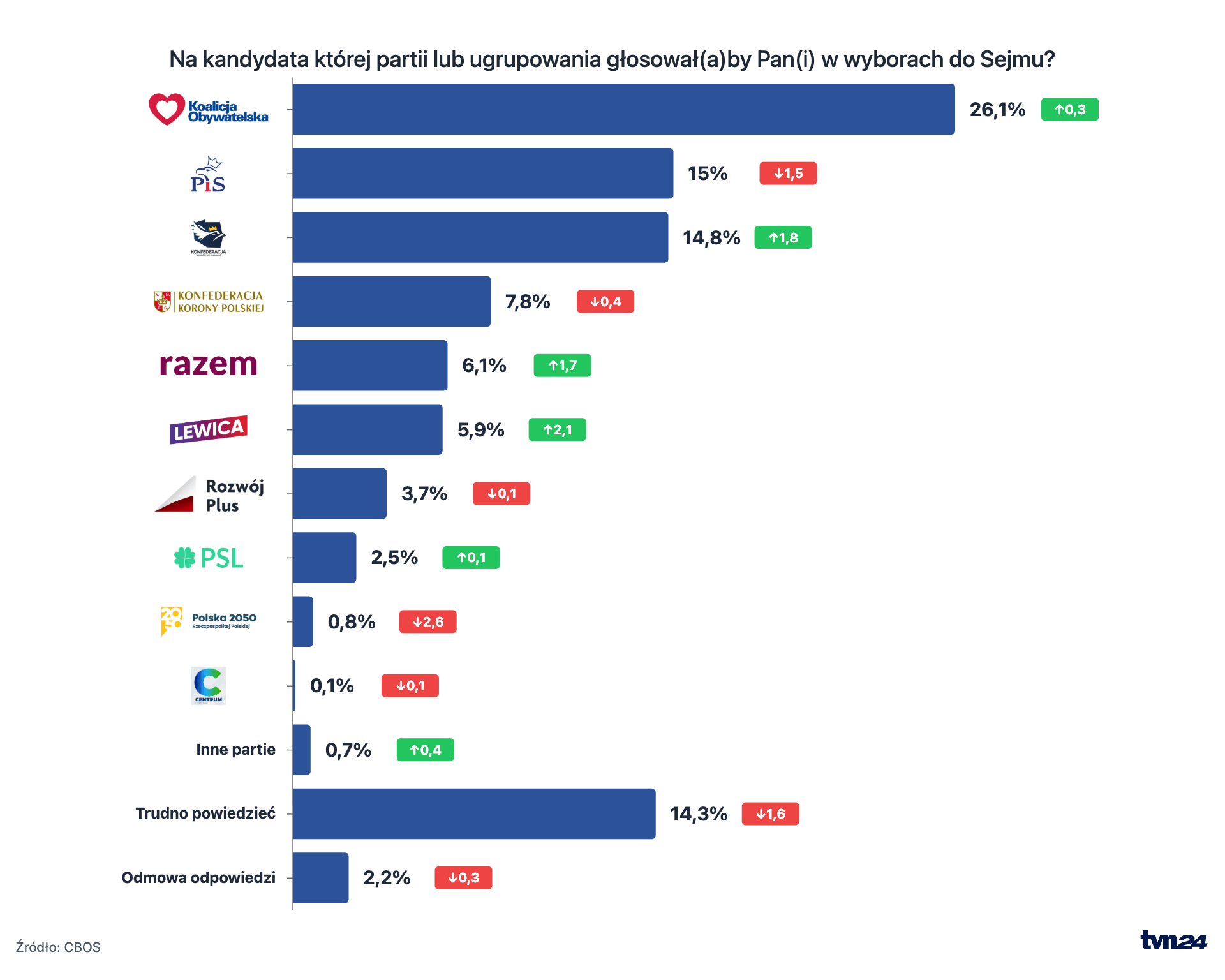
Górski suggests looking at these parties through their rhetoric rather than branding.
KO is marketed as left-liberal but is at heart Christian-democratic, centre-right and economically liberal;
Konfederacja, despite nationalist banners, is an “ultraliberal, pro-business party” close to KO on economics, built on “simple and low taxes” – the same idea that helped Donald Tusk win the office in 2007;
PiS is the outlier, combining social welfare spending with strong Catholic Church influence.
Additionally, Maciej Dachowski, who heads the Foreign Policy and European Integration Programme at the Casimir Pulaski Foundation and coordinates the Warsaw Security Forum, cautions that on refugee support, money, agriculture, and EU accession, the gap between the three parties’ positions is narrower than the campaign suggests. To provide a good overview of support for Ukraine, the analysis has been categorized into five dimensions:
1 - Support for Ukrainian refugees;
2 - Bilateral military, financial and humanitarian aid;
3 - Support for EU sanctions against Russia;
4 - Support for EU funding for Ukraine;
5 - Grain export policies.
Civic Coalition. KO was in opposition when the full-scale invasion began in 2022, but took over the government in December 2023. After 2022, KO reversed its skepticism about Ukraine’s readiness for EU and NATO membership, rejecting the “weak and corrupt” framing of Ukraine. Górski notes that KO puts greater weight on European integration and defense. Humanitarian aid to refugees and military support formed the two pillars of its response to the Russian invasion. On bilateral aid, Dachowski says, KO “defends the current line but has also stopped promising anything unconditional.” Geopolitical analyst at HIG, Michel Don Michaloliákos, expects KO to maintain support for Ukraine along all five dimensions, though the party is adapting its rhetoric to shifting public sentiments.
Law and Justice. PiS, which was in power in 2022, was also the first to support Ukraine when the invasion broke out. It sent Piorun air-defense systems, ammunition, and drones before the full-scale invasion even began. PiS supplied roughly 90% of Poland’s total military aid to Ukraine in the first 18 months of the invasion. However, former Prime Minister of Poland Morawiecki called it simply a “cold calculation of Polish national interest,” which was never meant to be unconditional. The situation became more complicated after Ukrainian grain flooded the market in 2023, harming the rural voter base of the PiS party. President Duda called Ukraine “a drowning man“ who “pulls his saviors into the water”. Górski explains that PiS’s campaigns need an enemy “at the gates”: first migrants, then the LGBTQ+ community, then Russia, and now a far-right-driven narrative of “bad Ukrainians.” Don Michaloliákos expects PiS to stay tough on sanctions but to squeeze refugee, humanitarian support and make it harder for Ukrainian farmers to export grain to the EU.
Confederation (Konfederacja). Konfederacja is the hardest party to assess. Górski notes “it has never governed, and its rhetoric on defence is inconsistent, driven more by opinion polls than by any coherent vision.” Dachowski states that Konfederacja treats refugees “as a question of identity and cost,” and openly questions the financial side of aid to Ukraine. Konfederacja is also sceptical of sanctions, though argues more about their effectiveness, rather than complete removal. The stance on grain remains harsh, driving a negative cross-party pattern. Such sceptical far-right rhetoric makes Don Michaloliákos consider it unlikely for Konfederacja to win an outright majority.
After the elections
Out of the five dimensions, Dachowski expects the most stable continuity on military cooperation (transit, training, maintenance and industrial cooperation), since it also serves Poland’s industrial interest. The consensus on sanctions remains strong and will maintain stable support, even among skeptical right-wingers. He also expects that all three parties will harden policy on money, agriculture and the EU accession. According to Dachowski, all three parties support financing Ukraine in principle. EU funding, therefore, is less a fight about Ukraine than about the next EU budget, where everyone is nervous that Ukraine’s accession would divert the cohesion and farm money which Poland receives today. The least stable and most contentious point remains grain. Under the fear of cheap Ukrainian imports hurting Polish farmers, “no Polish party can afford to be soft on it”.
Repercussions for the EU
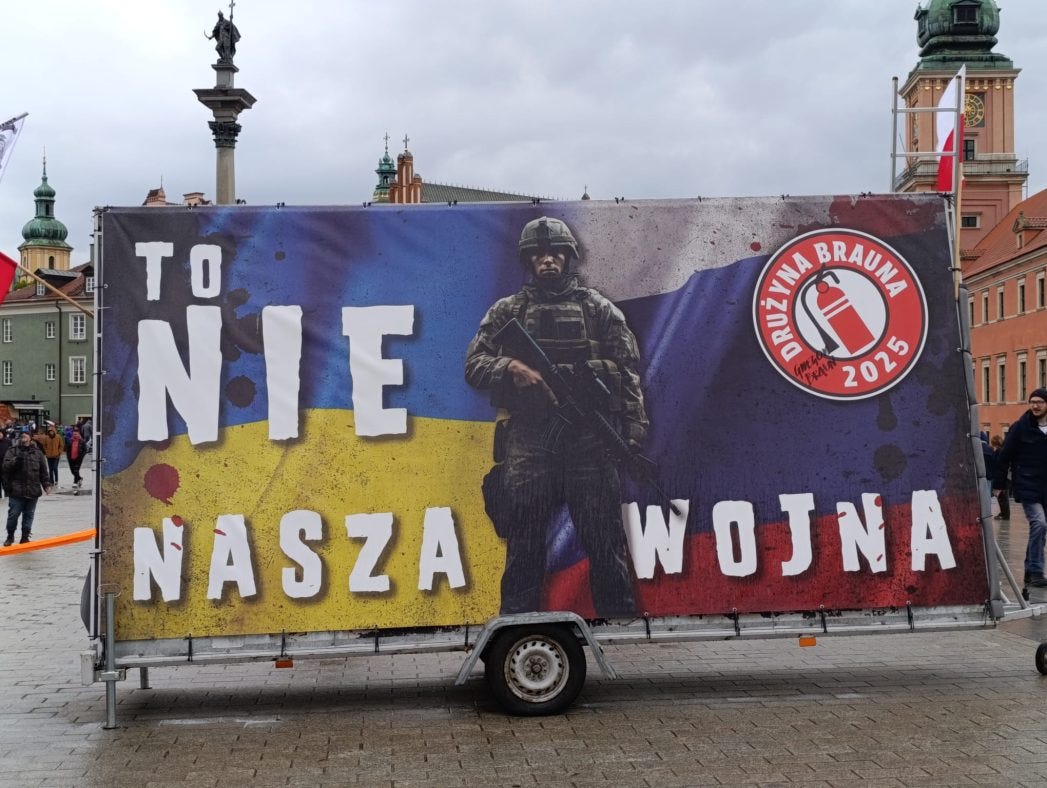
Poland’s next government matters to Brussels directly. While Don Michaloliákos does not expect a Polish veto under any likely scenario, he is worried that a skeptical government would “slow down and complicate” European support for Ukraine. A real risk case scenario, he believes, could be the PiS–Konfederacja coalition, which would “threaten all five dimensions of Polish support for Ukraine”. This outlook stems from the indirect effect of political parties’ increasingly harsh rhetoric regarding Ukraine, driven by fears of losing votes. Górski gives some examples: Pro-Ukraine-security PiS, competing with Konfederacja and Grzegorz Braun’s grouping, is setting harsher conditions for Kyiv; KO carefully toughens its message on benefits, agriculture, history, and EU accession without losing its liberal base. Dachowski highlights that for the competing parties, Ukraine is a convenient subject: “The costs are visible and local while the benefits are strategic and abstract”. Still, he points out that Polish voters have so far punished the most radical versions of that message.
Still, Don Michaloliákos believes PiS would not fully sacrifice its stance on Ukraine to accommodate a harder-line coalition partner. He expects that both PiS and KO will continue trying to mobilize support for Ukraine at the EU level, yet will adopt a more transactional approach toward Ukraine – “hard in rhetoric but pragmatic in practice, in order to keep the pressure on Russia and make sure that Ukraine will survive”.
As a wider risk, Don Michaloliákos flags the year of 2027, with France, Italy and Spain facing political shifts. A rightward turn in Poland, he says, could add up to a more fragmented, transactional EU stance on Ukraine. Dachowski believes that without Warsaw’s “tone, energy and willingness to lead,” EU cohesion would lose one of its engines.
Dachowski argues that the next fight is economic, specifically Ukraine’s entry into the single market, the common agricultural policy and cohesion funding. The annual report of the Warsaw Security Forum proposes using roughly €210 billion in frozen Russian assets to meet Ukraine’s defense and reconstruction needs, as well as to cover EU accession costs and to support frontline states. Don Michaloliákos notes that with Poland’s budget deficit growing, populists can try to convince the public that money flows to Ukraine instead of Poland. However, if Russian money is to cover part of the cost, argues Dachowski, “‘Russia pays’ stops being a slogan and becomes the thing that makes enlargement sellable at home.”
Conclusion
In September 2026, the moods of brotherhood and solidarity in Poland towards Ukraine seem to have been replaced by transactionalism and benefit-seeking.
“Poles might have created some kind of Frankenstein monster, a monster with occasionally anti-Ukraine rhetoric that they cannot manage at some moment anymore... they might end up needing to deal with sentiments that they cast themself but do not align with their actual points of view.”
Michel Don Michaloliákos
Dachowski warns the relationship “runs too much through leaders and emotions and too little through institutions”; “Regular formats and serious bilateral agenda that survives a change of government would make Polish support predictable regardless of who wins in Warsaw or in Kyiv.”
The election is not until autumn 2027, and as Górski notes, “a great deal can happen over the next year, both geopolitically and on Poland’s domestic political scene.” For now, Polish support for Ukraine stays robust. However, growing dissatisfaction with Ukraine will not simply disappear and will continue growing with the election date approaching. These very sentiments helped Karol Nawrocki win the presidential seat in 2025, with his slogan “Poland first, Poles first.” However, Don Michaloliákos explains that, in the very first Polish interest should be supporting Ukraine. If Ukraine falls, Russia will not see Poland as first. It will see it as next.
Excellent and highly nuanced analysis, Yurii! You’ve done a remarkable job laying out the complex political domestic dynamics in Poland and their broader implications for European support.
One crucial takeaway seems clear: if Ukraine wants to secure stable, long-term European backing, maintaining warm and highly tactful diplomatic ties with key partners (especially Poland!) will be essential. Navigating sensitive historic memory and economic tension with pragmatism and institutional dialogue could be just as decisive for Kyiv as its achievements on the battlefield.
no it is not