


In Summary
It is very difficult to ascertain exactly how much equipment Russia still has at its disposal, although its depots are running low and Russia appears to be able to deploy less and less heavy equipment on the front line.
Russia can probably carry on for a few more years with its stockpiled equipment; at the same time, it is also producing new equipment and receiving weapons from North Korea and Iran.
It is essential that Europe ramps up its production capacity, both to strengthen its own armed forces and those of Ukraine.
From tanks to scooters
After more than three years of war in Ukraine, everyone is wondering how much longer the warring parties can keep this up. For Europe, the key question is how much military might Russia still has in reserve and how quickly it can rebuild its armed forces for a new war following a (possible) end to the current conflict.
A number of trends are currently becoming apparent: when Russia invaded Ukraine in 2022 with a massive show of force, thousands of tanks and armoured vehicles rolled across the border. After more than three years of war, the picture has now completely reversed. Russian troops are using all manner of vehicles in their attacks on Ukrainian positions: electric scooters, motorbikes, Chinese golf buggies and ‘ordinary’ cars.
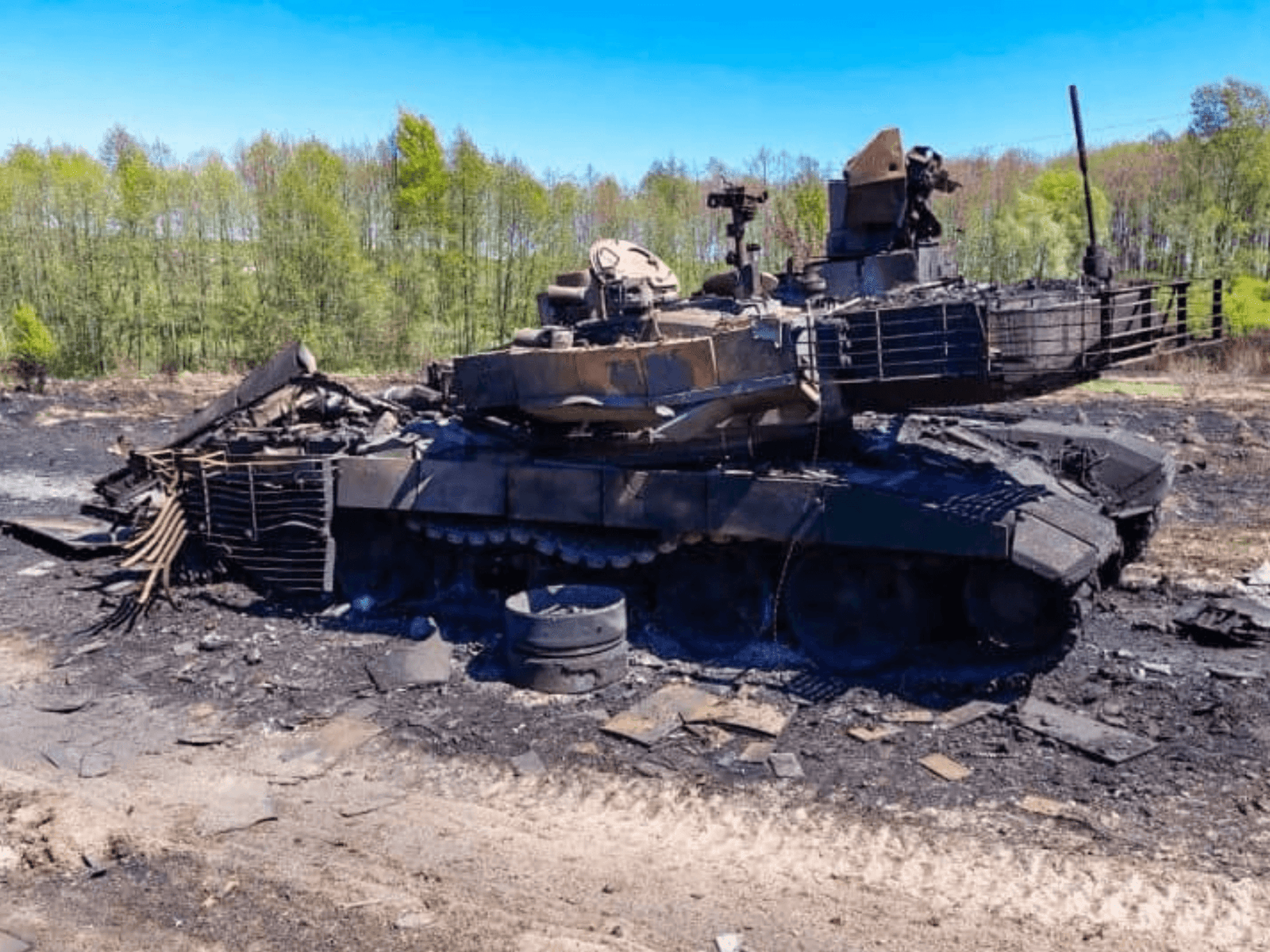
At first glance, this appears to be a sign that Russia simply no longer has any armoured vehicles left after three years of war characterised by exceptionally high losses. Russia has now lost more than 20,000 pieces of heavy equipment, including nearly 4,000 tanks. These are losses that, at first glance, seem unsustainable and impossible to make up for.
At the same time, there may well be a kind of strategy behind Russia’s use of motorbikes and scooters. The front line in Ukraine is dominated by drones, meaning that movement is quickly detected and large armoured vehicles in open terrain are an easy target for small FPV ‘kamikaze’ drones. Furthermore, large vehicles are unable to avoid anti-tank trenches and other obstacles. Although a motorbike or quad bike offers no protection (and such attacks are therefore very costly in terms of human lives), these types of vehicles are fast and manoeuvrable.
Given that manning on the front line on the Ukrainian side is thin due to shortages, a swift attack using motorbikes can sometimes make all the difference and clear the way for a breakthrough by heavier vehicles. What is happening on the front line is therefore not an absolute indication of the actual remaining strength of the Russian armed forces, although the large-scale use of civilian vehicles is, of course, a bad sign.
The Russian Soviet stockpile
Russia has inherited unprecedentedly large reserves of equipment from the Soviet era, spread across depots throughout the country. In 1991, the Soviets had more than 50,000 tanks and over 40,000 artillery pieces, which, following the break-up of the Soviet Union, ended up in the arsenals of the various former member states, the majority of which went to Russia. One advantage for analysing this is that many storage sites are simply in the open air and are therefore visible on satellite imagery. Open-air storage, combined with poor maintenance, corruption, (illegal) sales and ‘cannibalisation’ for spare parts, has meant that much of the equipment is in poor condition and often requires extensive refurbishment before it is actually usable.
Various open-source analysts have been monitoring the storage depots since the start of the war. Although it is difficult to carry out highly precise analyses using satellite imagery (partly because satellite images are often only made available at a late stage), certain trends are nevertheless visible: storage depots are being emptied at a rapid pace. In many cases, more than half of the equipment has been removed from storage, with the remainder often being in poor condition and suitable only for cannibalisation for spare parts. It is inevitable that, the longer the war lasts, certain types of vehicles and artillery will eventually become unavailable – although this is a matter of years, not weeks or months.
The fact that depots are running empty has several implications: first and foremost, it means that Russian industry has the capacity to make vehicles – often in poor condition – combat-ready. Furthermore, it shows that the Russian army has grown many times larger, as many new units are being equipped with equipment from depots.
Less equipment in storage therefore also means greater firepower for the Russian army. Finally, the depletion of stockpiles, combined with high equipment losses on the battlefield, is a sign that Russia is pulling out all the stops to defeat Ukraine and is suffering very heavy losses in the process. The Russian armed forces are larger than they were in 2022, but far less modern in terms of equipment and less well-trained.
New production and North Korea
As well as using old equipment from the Soviet era, Russia is, of course, also producing new equipment. It is difficult to estimate the exact numbers involved. Production of new tanks is said to have increased from around 40 per year in 2021 to 300 per year in 2025, although this figure is not undisputed. Furthermore, the cooperation between North Korea and Russia is entirely public, with North Korean and Russian military personnel fighting side by side. In addition to soldiers, North Korea also supplies equipment to Russia, such as artillery, ballistic missiles and ammunition.
The fact that Russia feels compelled to request artillery from North Korea is a key indicator that Russia is unable to produce sufficient new artillery pieces itself, whilst the Russian armed forces are heavily reliant on artillery in terms of doctrine. Although Russian domestic production of certain equipment may be limited, it can therefore rely on North Korea for artillery, amongst other things. In addition, Iran is making a significant contribution, including Shahed kamikaze drones, which are deployed in large numbers against civilian targets on an almost daily basis.
It is plausible that Russia, despite heavy losses, will be able to continue fighting in the coming years, albeit with increasingly inferior and ageing equipment. It is not unlikely that a large part of the armed forces will be equipped with increasingly ageing equipment from stockpiles (combined with civilian equipment), whilst elite troops will be equipped with newly produced, higher-quality equipment. In addition, Russia will become increasingly dependent on its few allies, such as North Korea and Iran, for equipment. This is also beneficial for those countries, as they can make good use of other Russian military technology (such as fighter jets) to modernise their own armed forces.
For policymakers
Bear in mind that, whilst Russia’s military capabilities have been weakened, it has not yet been neutralised. Russia can sustain the war of attrition in Ukraine for some time to come, partly through the production of new equipment, the depletion of Soviet-era stocks and supplies from other countries.
In exchange for weapons, Russia is likely to provide material and technological support to North Korea and Iran. It is therefore in the West’s interest to counter these supplies wherever possible, so that these countries do not acquire advanced technologies for, for example, submarines and fighter jets.
Ukraine is also losing a great deal of equipment. It is important that both Ukraine’s domestic industry and the European defence industry are able to keep pace with these losses so that Ukraine can continue to resist Russian aggression.
Russia has been weakened, but has no difficulty whatsoever in recruiting troops. It is likely that, should peace be achieved in Ukraine, Russia will rapidly rearm, taking into account the lessons it has learnt in Ukraine, such as the use of FPV drones. Within a few years, Europe could find itself facing a large Russian army, whilst defence production in Europe is still lagging behind. It is crucial to invest now (or rather, it already was in 2014) in much greater production capacity and to significantly expand the armed forces so that, even without the US, we can deter Russia or, in the worst-case scenario, fight it.