


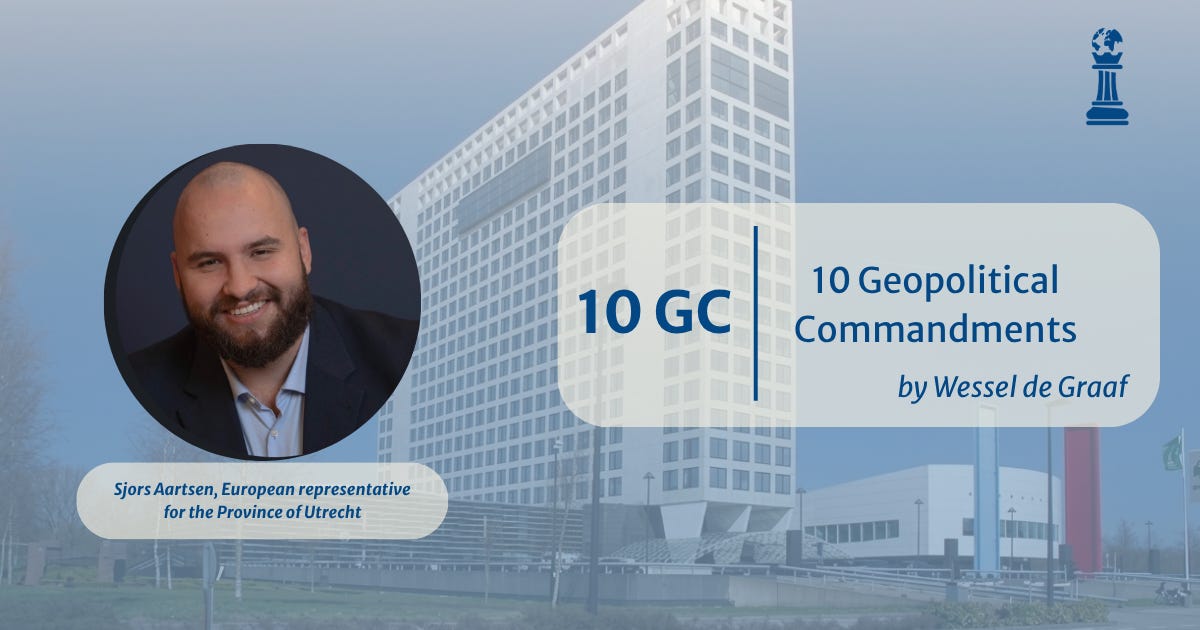
Geopolitics may seem abstract and far away, but it permeates all levels of Dutch public administration. In this interview, Sjors Aartsen, European representative on behalf of the Province of Utrecht, explains how international power balances, European decision-making, and global developments directly impact local, provincial and national policy.
Disclaimer: In this interview, Sjors speaks in a personal capacity. The views expressed are those of the policymaker and do not necessarily reflect the official position of the Dutch government.
I. For me, geopolitics means…
Everything between systemic competition and interpersonal contact, with a whole lot of layers in between. It is important to note that it is always human work. That is often overlooked.
II. Geopolitics is important for the Netherlands…
Incredibly important. Strictly speaking, there are few countries for which you can say geopolitics is not important, but for the Netherlands, that holds true even more. We are an open trading nation inextricably linked to the international legal order that struggles with cross-border and transnational issues. The major transitions of today can only be solved internationally, and therefore geopolitically. Our prosperity, security, environment, and climate crisis are geopolitical in nature. The solutions will therefore have to be found at a geopolitical level.
In my view, the Netherlands has not always maintained a very strong geopolitical stance. We like to flatten geopolitics into the eternal “merchant” story, which is a tired narrative that no longer fits the current era. Geopolitics is also not something that works particularly well in the Dutch political context. When we are in campaign mode, you rarely to never see attention paid to it.
Specifically for my role, I relate to the European system, in which Europe is both a geopolitical arena and a geopolitical player. The debate in the Netherlands about Europe and what we want there is immature in my opinion. That is emblematic of our level of geopolitical awareness and our systemic thinking as such. It is too often about the issue of the day, or we default to the idea that we shouldn’t burden citizens with it. I think certain actors within geopolitics actually benefit from this.
III. Geopolitically speaking, the Netherlands matters…
Yes and no. We need to be very clear about the limitations of who we are and the role we occupy within these systems. Yet, I think we are more important than the average person realizes. Especially economically, we play a crucial role, think of ASML, but also our trade-based economy and the economic interrelationships that result from it. Certainly within Europe, we have punched above our weight in recent years.
Furthermore, the quality of the Dutch civil service is excellent. Central government civil servants at the European level and the willingness with which previous governments played a key role in compromise-driven European politics make all the difference. If you know how to navigate that, you can achieve more than expected. The Netherlands is more important than it presents itself to be, and therein lies the potential to play a larger role in debates we currently leave untouched. I must explicitly mention the international legal order here. That is something that has faded into the background in recent years and which the Netherlands does not dare to stand up for enough.
IV. Geopolitics affects my work…
It is good to understand that the aforementioned systemic competition leads higher government entities to pursue desired shifts. I am actively engaged in translating that geopolitical stance into practice. In my role, I act as an intermediary: I see how policy is formed that hopefully ultimately makes an impact on the ground.
In European terms, what stands out are the Draghi and Letta reports. These reports are explicitly focused on our economic health and its sustainability, but they cannot be viewed as anything other than geopolitical. That is primarily due to the changing American stance and increasing Chinese competition.
What I find interesting is that 70 to 80 percent of European legislation and regulations must be implemented at the local or regional level. I see how this geopolitically driven policy thinking in Brussels leads to policy proposals that, through multi-level governance, reverberate through our communities, cities, and provinces. The interaction between these levels of government as communicating vessels to achieve effective policy is where I see the primary consequences of geopolitics.
V. My colleagues are also engaged with geopolitics…
Looking around me, I don’t think anywhere near all civil servants are sufficiently engaged with it. That is ideal for people in my field, because it keeps us very employable. After all, people are still needed to care about these issues.
To make it concrete. Political-administrative sensitivity is frequently discussed and expected of civil servants in advisory roles. Inextricably linked to that expectation is that a strategic advisor, manager, or director at a province considers what is happening in The Hague such as dynamics in Parliament and toward the Minister. Strangely enough, we seem to tacitly agree that this political-administrative sensitivity stops at the national border. Where we would find it unimaginable for a senior advisor not to know how the Minister feels about a topic, we find it completely understandable if that same advisor has never heard the name of a European Commissioner or has no idea what the European Union has done. The degree to which we find that “okay” continually surprises me.
For people in my domain, the task lies in broadening this knowledge, making it more accessible, and simplifying it. We can lament this reality, but we can also take steps to make it easier across government.
VI. I know where I can and/or should get my geopolitical knowledge today…
Definitely. I am quit a news addict, like most people in my field. I read several European newspapers daily and like to listen to specialized podcasts. I would also like to highlight a smaller outlet like Brussel Nieuws, which makes European news more accessible. Additionally, I have a Politico Pro account, enjoy reading the English edition of Le Monde diplomatique, and stay informed through Brussels’ counterpart to HIG: the Brussels Institute for Geopolitics.
I also try to stay connected with peers. Specifically for European affairs, LinkedIn can be a very useful platform if you set it up well and follow people who use it functionally.
VII. Our public administration could better anticipate geopolitical developments…
Taking the public administration as a whole, it is still rather disappointing. However, the expertise within the civil service is commendable. I regularly encounter people in public administration who impress me greatly. That applies to international departments of ministries, but also to the Permanent Representation in Brussels, which does outstanding work that many countries envy.
Decentralized authorities also house people with a great deal of expertise. I am impressed by organizations such as RIVM (National Institute for Public Health and the Environment), the Association of Dutch Water Authorities, or Rijkswaterstaat’s Brussels Office. There are nooks and crannies throughout public administration that you wouldn’t immediately link to geopolitics, but where truly expert people work. The extent to which they manage to align the entire public administration is an area where we can still make major strides.
VIII. Geopolitics demands new ways of thinking and collaborating…
Yes. Forms of cross-border or border-defying collaboration should not be constrained by your job description, but should arise from the necessity confronting us. It is crucial to involve broadly, discuss broadly, and decide quickly.
We cannot continue talking endlessly in traditional Dutch fashion until we conclude that geopolitical developments have already bypassed us. We must make choices and act. A multitude of perspectives from inside and outside government only makes those choices stronger.
IX. I can translate geopolitical and theoretical knowledge into practically relevant information…
Do I use academic-theoretical sources for my daily work? The answer is unfortunately no. We are simply too busy to keep up with academic journals.
I think theory such as normative political theory, IR theor, or empirical public administrationhelps develop a worldview and reference frames. It serves as a lens through which to view international events and bring structure to them (to make some sense of it all). It holds little predictive or prescriptive value for my daily tasks. But all those theories acquired during and outside my studies do help when confronted with exogenous developments and when advising leadership or colleagues on the backgrounds and impact on our work. Thus, it primarily serves that lens function.
X. Closing Remarks
It is worth not only focusing on geopolitics at the highest level, such as what Xi Jinping says to Donald Trump, but also seeking the connection to geopolitics within your own domain. Take a look at where your conventions come from, where norms and rules are drafted, and how that happens. Who is involved? Geopolitics is embedded in virtually everything we do and refrain from doing, and unravelling that is a highly valuable pursuit.