


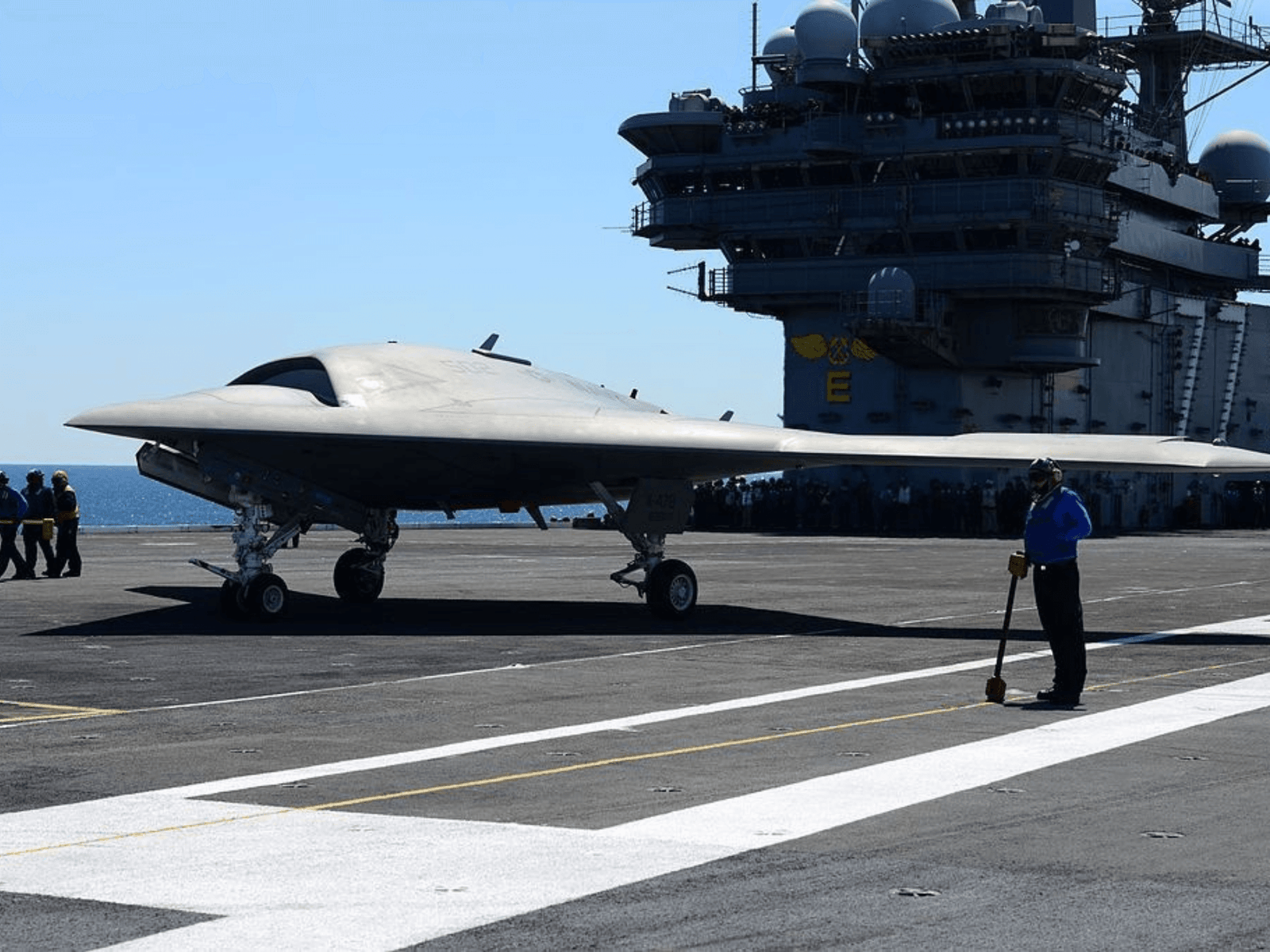
In Summary
The war in Ukraine is characterised by a massive increase in the use of drones, of all shapes and sizes.
But drones are also being used increasingly in other conflict zones (and beyond), such as in Myanmar, Turkey, Sudan and Haiti.
Drones pose a significant threat to conventional armed forces, but each type requires its own specific approach.
There are various defence systems in which investment is needed to prepare the armed forces for conflicts.
Defence Update | The ‘drone’ doesn’t actually exist: a taxonomy
Drones come in all shapes and sizes. In fact, the term ‘drone’ is not accurate, as it encompasses many different systems that sometimes have little in common with one another. To understand what is needed to defend against drones, it is essential first to set out the different types of drones that exist – from large to small. Whilst this overview is not exhaustive, it provides a good overview of the systems that are relevant today.
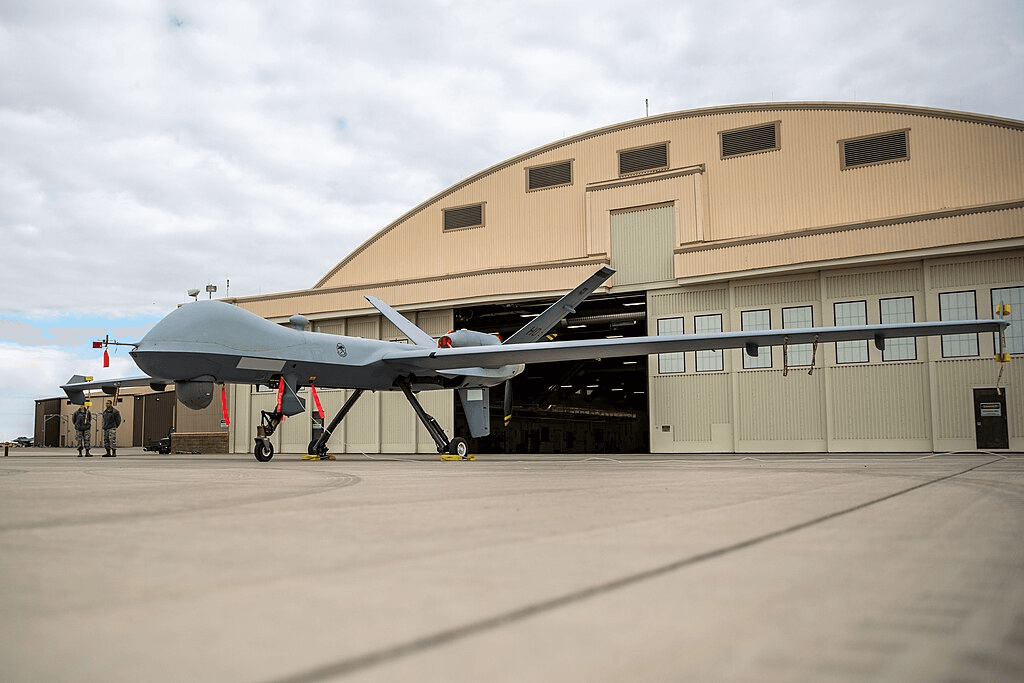
An MQ-9 Reaper of the Royal Netherlands Air Force. These US-manufactured drones are used for gathering intelligence, but can also carry out air strikes. Image from the Ministry of Defence, used under CC BY-SA 4.0, via
Firstly, there are large drones which are mainly used for gathering intelligence and carrying out air strikes. These often fly for hours at relatively high altitudes over enemy territory and operate in a similar way to normal aeroplanes: they take off from normal airports and are generally (remotely) piloted by one or more pilots. These types of systems are known, amongst other things, for their use as platforms for ‘targeted killings’ by, for example, the US. For instance, the Iranian general Qasem Soleimani was killed by a missile fired from an American MQ-9 drone measuring over 11 metres long and 20 metres wide. These drones often fly relatively slowly and are therefore an ‘easy’ target for air defences. For instance, the US has already lost at least 7 MQ-9s in Yemen during operations against the Houthis. On the other hand, Ukraine managed to use Turkish-built TB-2s (successfully) against Russia for an extended period during the first months of the war in 2022. Even now, more than three years after the large-scale invasion, Ukrainian TB-2s are still carrying out offensive operations. Many large drones of this type are also used for high-altitude intelligence gathering, such as the mysterious American RQ-170 and RQ-180 drones, about which little is known.
In addition, countries such as the US, China and Russia, as well as those in Europe, are working on even more advanced drones. These are primarily envisaged as ‘wingmen’ for advanced fighter jets. Given how advanced (and therefore costly) modern fighter aircraft are, it makes sense to increase their firepower by ‘pairing’ a number of fast drones with a fighter aircraft, allowing the pilot to control them from the cockpit, whilst the sensors of the fighter aircraft and the drone can coordinate attacks and, for example, carry a greater number of weapons.
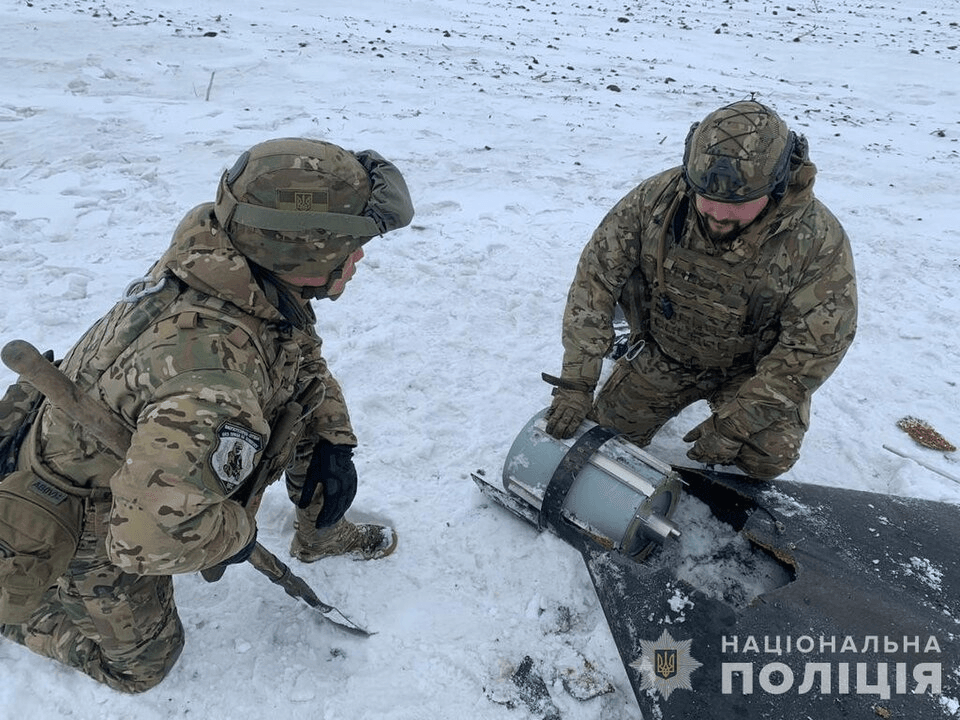
Ukrainian police officers are rendering a downed Russian Geran (the Russian version of the Iranian Shahed) drone harmless. Image by Національна поліція України (Ukrainian National Police), used under CC BY 4.0
Another prominent class of ‘drones’ is known for its use by Russia against Ukraine: the well-known ‘Shahed’ kamikaze drones. This category of drones – or rather, ‘one-way attack unmanned aerial vehicles’, also known as OWA-UAVs (are you still with me?) – encompasses many different systems: from relatively light drones, to converted propeller-driven aeroplanes packed with explosives, to jet-powered drones that could almost pass for cruise missiles. There are significant differences in terms of sophistication: whilst some consist of a very basic autopilot, a cheap AliExpress motor and commercial GPS guidance, others are equipped with cameras to map targets, the ability to make course corrections after take-off and a very long range – such as the drones Ukraine is deploying against targets in cities like Moscow. What many of these drones have in common is that they often fly slowly, are easily observable and, depending on their level of technological sophistication, are extremely cheap. This essentially makes them ‘disposable’: the loss of a few hundred need not be a problem, provided that a few dozen do reach their target. Their strength lies in depleting air defence ammunition, identifying weak spots where air defences are sparse, and the psychological pressure of constant, large-scale attacks. Where these types of drones often fall short is in power: due to their low-cost production and simple propulsion systems, they are often unable to cause significant damage to ‘hard’ targets, such as bunkers.
Within this family of drones, so-called ‘loitering munitions’ can also be included. These are more advanced kamikaze drones capable of flying around a conflict zone for extended periods, awaiting instructions from other systems (for example, on the ground or from reconnaissance drones) to launch an attack. Some loitering munitions can also detect targets themselves using cameras or other sensors. The advantage of such systems is that the time between detection and destruction is significantly reduced: the moment, for example, an enemy artillery piece is spotted, the nearest loitering munition can attack immediately. An example of this type of system is the Russian Lancet, which has been highly successful in attacking, amongst other things, Ukrainian artillery pieces.
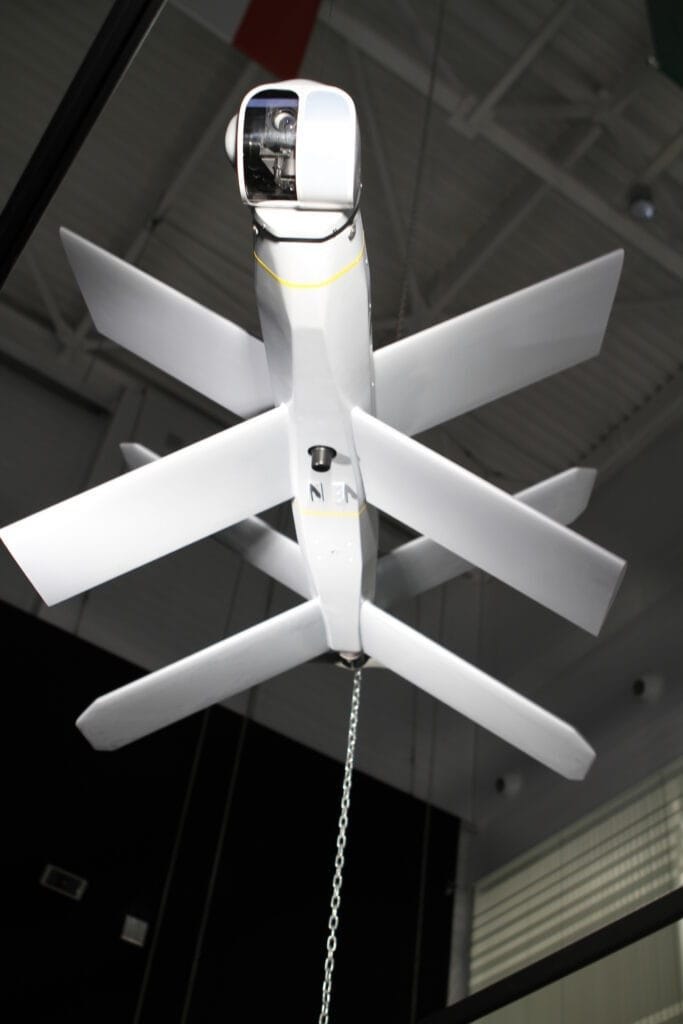
A Russian ZALA Lancet loitering munition. Image by Nickel Nitride. Own work, used under CC0
At that same tactical level, there are also dozens, if not hundreds, of different types of reconnaissance drones. These can range from commercial drones from China to much more advanced drones. These drones are much smaller than the large drones that need to take off from airports and can often be deployed at the tactical level. Some of these drones require a catapult for launch, whilst others take off like a helicopter or can be launched ‘by hand’. Certainly in Ukraine (but previously also in Afghanistan, for example), many units have their own drones for carrying out reconnaissance missions.
In addition, these drones can also be used offensively, for example by mounting grenades beneath the drone and dropping them on targets – a technique widely used in Ukraine. Finally, drones of this type can also be used to track down targets and guide munitions. For instance, the Russian Orlan-10 drone can use a laser to guide special artillery shells towards a specific target.
Finally, perhaps the most frightening, cheap and now widely publicised system: FPV (first-person view) drones. These are small, fast drones with a limited explosive payload. These drones are called FPV because they are controlled using VR headsets and a camera mounted on the front of the drone. As the control frequency can easily be jammed, many FPV drones are now equipped with kilometres of fibre-optic cable to maintain a crystal-clear camera signal.
In short: drones can be deployed for various purposes, such as offensive operations, gathering intelligence or augmenting an existing system, whereby the drone can be both a cheap ‘utility item’ and a highly technologically advanced and expensive ‘aircraft’. The propulsion system can also vary greatly: small reconnaissance drones and FPV drones are usually battery-powered, whilst larger drones are fitted with propeller engines. The most advanced drones are sometimes even fitted with jet engines, such as the RQ-4 Global Hawk. Furthermore, their deployment can also vary: whilst Shahed drones are used purely for strategic purposes (known military installations, energy infrastructure and other civilian targets), loitering munitions and FPVs, for example, are deployed in a much more tactical manner against mobile targets.
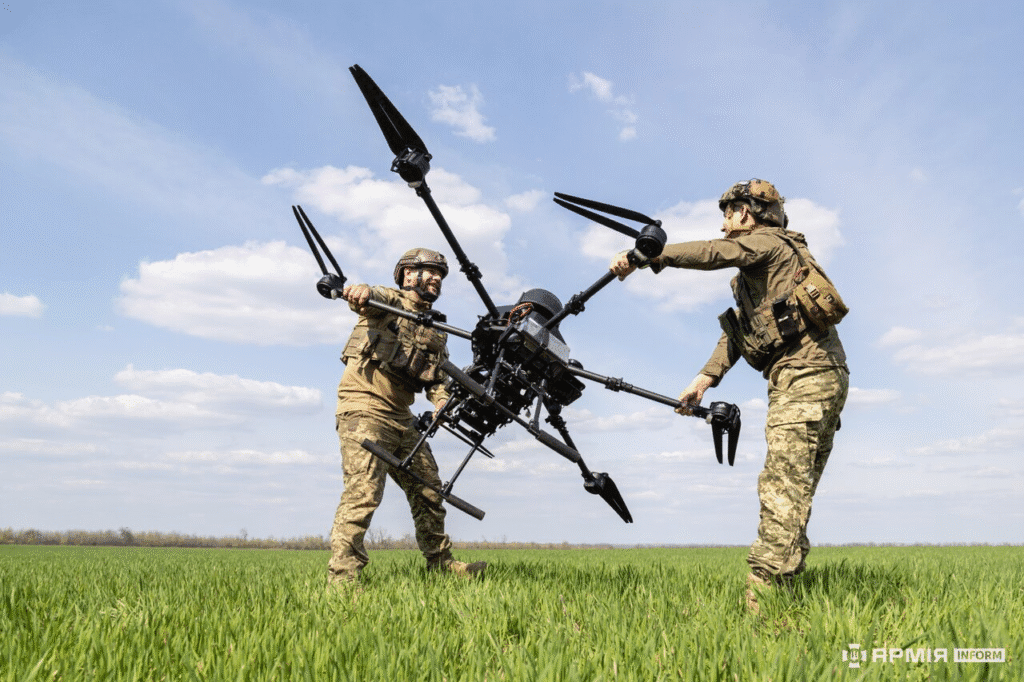
Ukrainian soldiers with a “Baba Yaga” drone. These types of large propeller-driven drones can be used to drop grenades, but can also carry FPV drones as a mother ship or be used as a platform to relay signals or carry out reconnaissance. Image by АрміяІнформ (ArmyInform), used under CC BY 4.0
Defence against drones
In fact, defence against very large drones is the most conventional: these drones fly (generally) slowly and do not possess the advanced defence mechanisms of manned aircraft – although this is changing with the emergence of ‘wingman’ drones. To shoot down this type of drone, ground-based air defence systems such as Patriots can be used, for example, or fighter jets. This is therefore relatively straightforward, as evidenced by the fact that the US loses many of these (admittedly rather expensive) drones over Yemen. The loss of a drone such as this is, of course, less costly despite its sometimes high price: no pilot is lost and there are therefore no casualties on one’s own side. To combat large drones, the destruction of infrastructure, such as airports and command centres, is also an option, although there are also larger drones capable of taking off from, for example, motorways or unpaved runways.
Shahed-type kamikaze drones, however, require a completely different approach. The large scale of the attacks and the relatively low cost mean that conventional air defence is not cost-effective. Using an air-to-surface missile from an F-35 or a Patriot system to shoot down an advanced intelligence platform (such as an RQ-4) is justified, but not to shoot down a Shahed costing less than 50,000 euros. What is needed to defend against Shahed-type drones are affordable yet effective systems. Ukraine therefore often uses mobile teams with heavy machine guns to shoot down Shaheds. This is certainly not always effective, as the Shaheds fly at high altitudes and are increasingly equipped with cameras to spot and attack mobile air defence teams. Helicopters are also being used in Ukraine to shoot down drones. A more high-tech solution against drones is, for example, the APKWS, developed in the US. This is a system that converts a cheap, unguided rocket into a laser-guided precision weapon at a relatively low cost.
Furthermore, this system can be mounted on a simple pick-up truck. In Ukraine, it is being used with great success, both against Shahed drones and, for example, against cruise missiles. In effect, this involves the production of highly cost-effective anti-aircraft missiles (or mini-missiles). Another promising concept is the use of lasers, the first of which are now becoming operational. This offers a highly cost-effective means of defence against cheap drones, although the development, energy consumption and deployment of laser systems are not straightforward (or cheap). In addition, FPV drones, amongst other things, are also being deployed in Ukraine to intercept reconnaissance drones, kamikaze drones and loitering munitions. These kinds of ‘drone battles’ are becoming increasingly common over the battlefield and, following the violation of Polish airspace by Russian drones, have also caught NATO’s attention. Another option is the use of radar-guided anti-aircraft guns.
Anti-aircraft guns were once the sole defence against aeroplanes, prior to the widespread introduction of surface-to-air missiles during the Cold War. As aeroplanes became faster and flew higher, slow-firing anti-aircraft guns were no longer sufficient. Now that there is an increase in slower, lower-flying drones, these guns are coming back into favour. Old systems, such as the Cheetahs formerly used by the Netherlands – which were decommissioned many years ago as redundant – now provide crucial protection against drones. Systems of this kind have shot down many Lancet and Shahed drones, as well as cruise missiles, in Ukraine. Many armed forces are now recognising the value of these systems once again, including the Netherlands, which is procuring so-called SkyRanger 30mm guns. Many of the modern systems combine a radar-guided gun with short-range missiles, for maximum versatility.
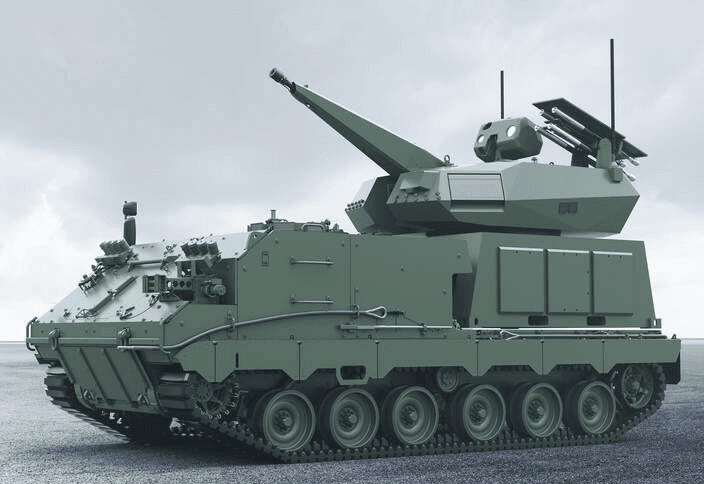
A SkyRanger 30 mounted on an ACSV G5 chassis, as procured by the Dutch armed forces. This mobile system combines a radar-guided 30mm automatic cannon with Stinger surface-to-air missiles for defence against drones. Image from the Ministry of Defence, used under CC BY-SA 4.0
At a more tactical level, defence against drones is just as crucial. In Ukraine, a great deal of equipment is being lost to FPV drones and other types of loitering munitions, and drones are responsible for 70 per cent of casualties. Protecting tanks, artillery or infantry against smaller drones is therefore crucial. The anti-aircraft guns described above can play an important role here, as they are suitable not only for defending stationary targets (such as an airfield or power station) against Shaheds or cruise missiles, but can also ‘move with’ army units to provide dynamic protection against loitering munitions and light reconnaissance drones.
For defence at even closer range, it is crucial to consider so-called ‘Active Protection Systems’ (APS), originally developed to defend armoured vehicles such as tanks against lethal anti-tank missiles. New Dutch Leopard 2A8 tanks, for example, are being fitted with the Trophy system, and modernised CV90 infantry fighting vehicles with Iron Fist, both of which originate from Israel. These systems use compact radars mounted on the vehicle to detect anti-tank missiles and then fire a projectile at them. Systems of this kind could be adapted to destroy, for example, FPV drones and loitering munitions. It should be noted, however, that most current APS carry only a limited number of projectiles, whilst cheap FPV drones can attack in large numbers.
Another important consideration for defence against drones is electronic. By definition, drones rely on signals and connections and are therefore vulnerable to ‘jamming’, such as the disruption of the radio frequencies used to control them. As discussed above, jamming in Ukraine has resulted in wireless FPV drones losing much of their effectiveness. However, drones that use GPS can also be rendered significantly less effective by disrupting GPS reception. Russia has made frequent use of this to limit the use of US-supplied GPS-guided munitions, and Israel also makes extensive use of this.
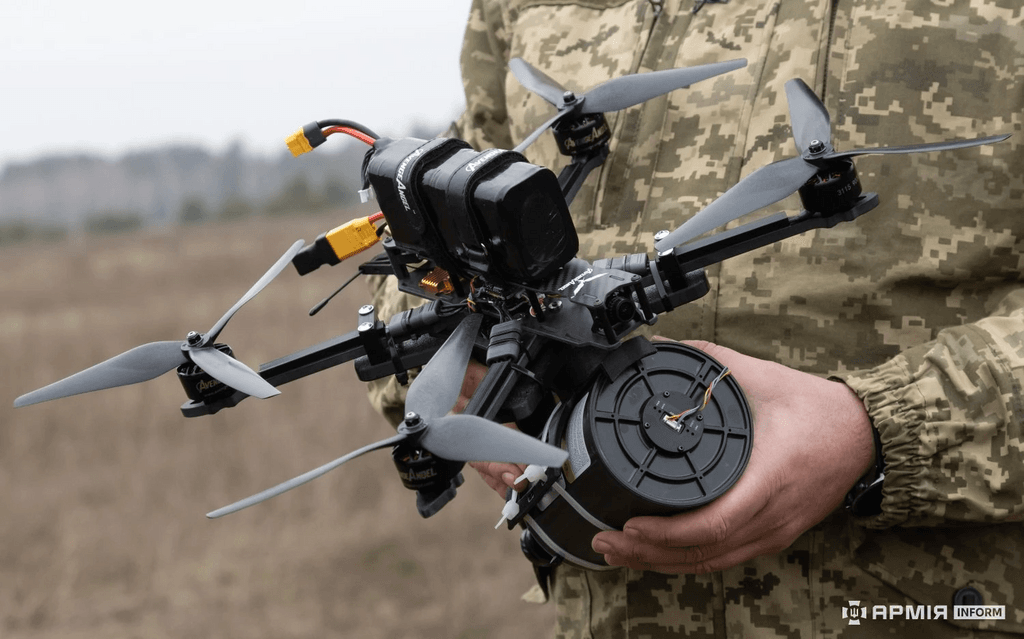
A Ukrainian FPV drone with a fibre-optic cable. Due to their wired control system, these types of drones are difficult to jam, but they are also heavier, more expensive, more complex and limited in range by the length of the cable. Image from АрміяІнформ (ArmyInform), used under CC BY 4.0
Finally, how can infantry defend themselves against FPV drones? In Ukraine, for example, shotguns are used for this purpose. These are firearms capable of firing a large number of ‘pellets’, rather than a single projectile per shot. This increases the likelihood of hitting the FPV drone.
For this reason, Russia is developing multi-projectile rounds that fit into standard assault rifles. A more advanced approach involves the development of optical systems designed to make it easier to target drones with standard firearms. Finally, there are also specialised anti-drone rifles that utilise jamming. Strictly speaking, these are not rifles, but they do look like them and are used in the same way. These types of systems ‘fire’ a powerful signal, causing the drone to lose contact with the operator and crash.
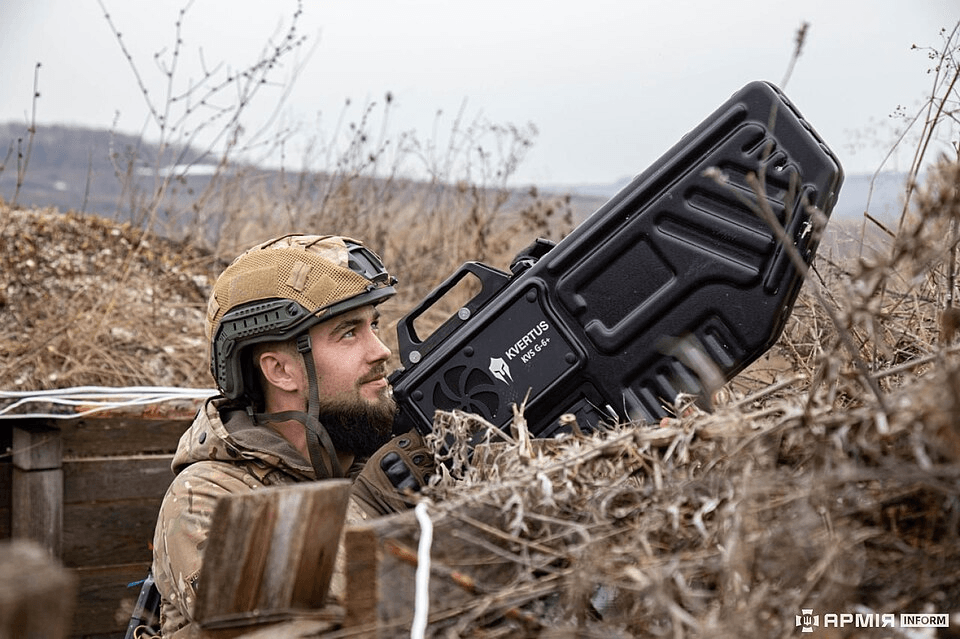
A Ukrainian soldier from the 61st Mechanised Brigade with an anti-drone rifle that uses electronic jamming to disrupt drones. Image from АрміяІнформ (ArmyInform), used under CC BY 4.0
In addition, there is also the importance of ‘passive’ defence: most FPV drones (and also many loitering munitions) have relatively little explosive power. If an unarmoured vehicle is hit, the risk of casualties is high, but even a simple, lightly armoured vehicle offers much greater protection for its occupants. This has led to almost all vehicles in Ukraine being fitted with extensive ‘DIY’ armour to protect against drones. This has gone so far that entire roads are being covered with nets to stop FPV drones, and Russia is even ‘wrapping’ oil refineries to protect them against the relatively weak Ukrainian long-range kamikaze drones.
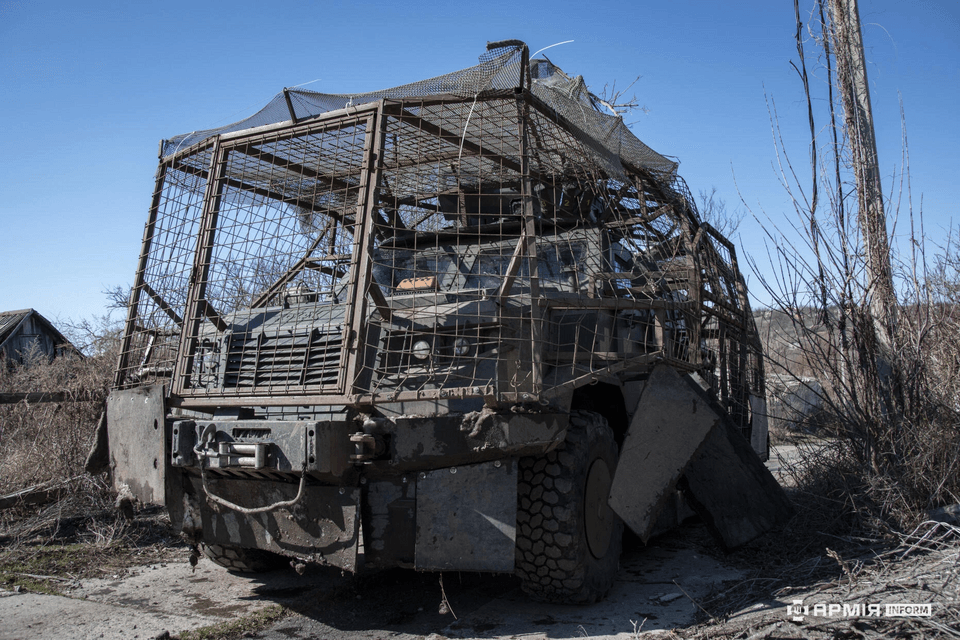
A Kozak-2M1 armoured vehicle with additional improvised protection against drones from the Ukrainian 81st Brigade. Image from АрміяІнформ (ArmyInform), used under CC BY 4.0
For policymakers:
Invest in layered air defence: a single system is insufficient to defend against drones. Each ‘class’ of drone requires its own approach. There is no silver bullet that can protect against all types of drones, aircraft and missiles.
Furthermore, it is essential to invest in greater stockpiles: Russia is deploying hundreds of drones a day. This requires a vast amount of ammunition for defence!
Defence against drones is two-fold: on the one hand, more air defence is needed for military units, and at the same time for the defence of ‘fixed’ targets, such as energy infrastructure. Both require their own systems and their own approach!
Invest in cost-effective drone countermeasures, such as lasers, anti-aircraft guns and low-cost guided missiles, both for the protection of infrastructure and for military personnel.
Furthermore, do not overlook the less ‘catchy’ forms of defence, such as electronic warfare and armoured vehicles. In the current drone landscape, it is irresponsible to deploy military personnel in unarmoured vehicles. Therefore, invest in the production of low-cost armoured vehicles that could potentially make the difference between life and death. Furthermore, the use of electronic warfare is essential at every level.