

In Summary:
Egypt and Ethiopia’s clashing rhetoric has increased controversy surrounding the GERD
Instead of bringing mutual gains, the GERD brought mutual hostilities
With the region in ever-growing tension, a resolution seems farther away than ever.
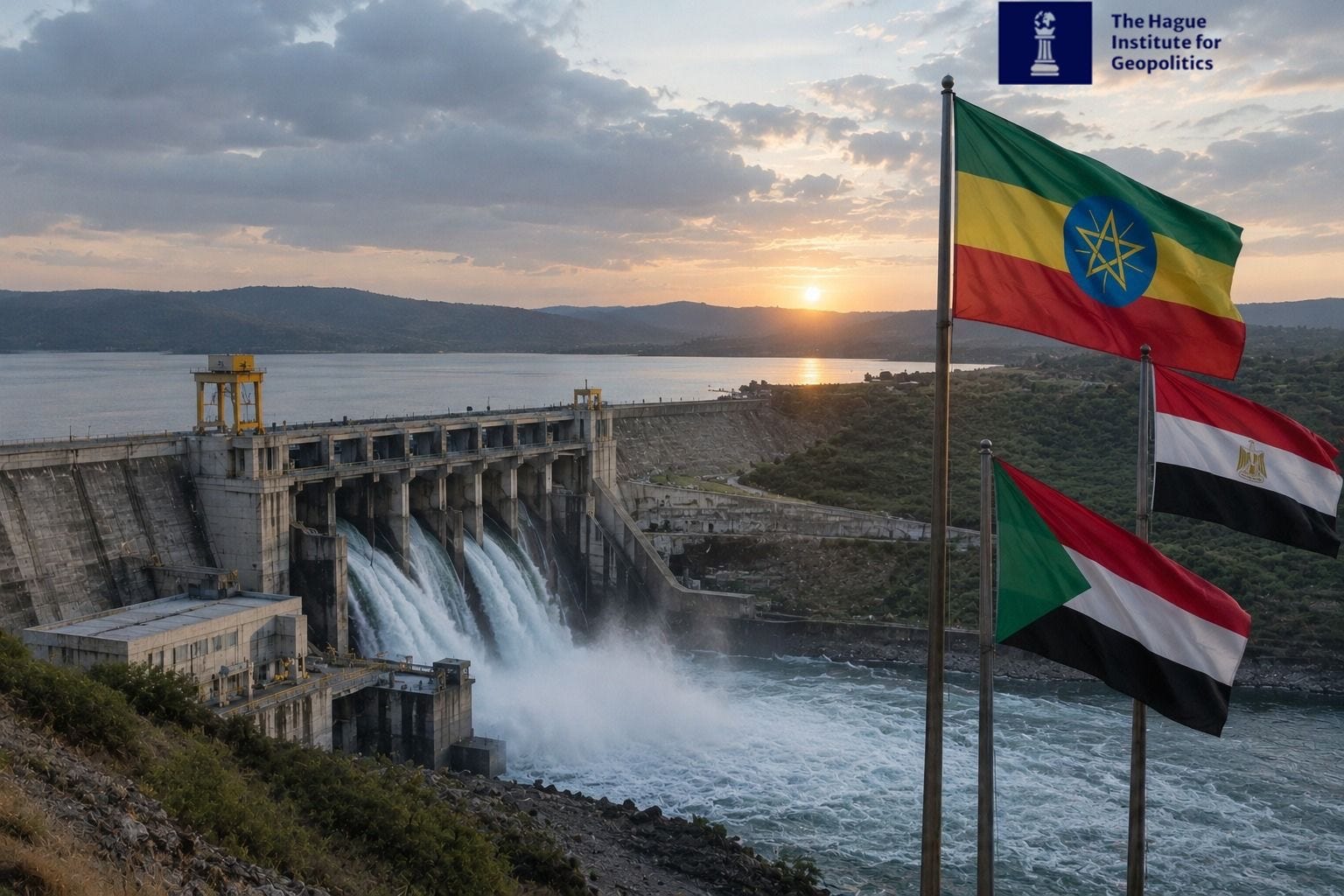
Located on the Blue Nile, with a capacity of 5,150 megawatts, the Grand Ethiopian Renaissance Dam (GERD) is Africa’s largest hydropower project. Construction started in 2011. A Declaration of Principles was signed in 2015. Subsequently, multiple negotiation rounds between Ethiopia, Egypt, and Sudan were held. Finally, the GERD was inaugurated in September 2025. However, instead of fueling development, the project increased regional tensions, and no binding agreement concerning the GERD was found. How did this technical project become mired in political fights, ultimately raising tensions in the region?
Technical dispute
As a downstream country, Egypt relies on the Nile to sustain a large part of its population. Being a historically dominant power in the region, Egypt has kept a watchful eye on the Nile. In 1929 and 1959, it signed water treaties which allocated it a large share of the Nile’s water. Some other countries in the region see these treaties as relics of a bygone colonial era. Meanwhile, Egypt uses them as a historical source of rights to the Nile’s water share. Pieter van der Zaag, professor of water management at TU Delft, further explains Egypt’s role in the region. He describes that Egypt has historically been involved with or consulted on the construction of upstream dams. This is in stark contrast to the GERD, which ended up being constructed unilaterally.
From Ethiopia’s perspective, the benefits justify building the dam unilaterally. The project is expected to double Ethiopia’s electricity production capacity, consequently fueling the nation’s economic development and industrial expansion. For nuance, it must be noted that these promises remain unfulfilled. The Arab Center in Washington DC points out that, in 2025, only 44% of Ethiopia’s population had access to electricity and part of the GERD’s capacity has instead been used for energy-intensive crypto-mining, something also mentioned by Professor Van der Zaag in his interview.
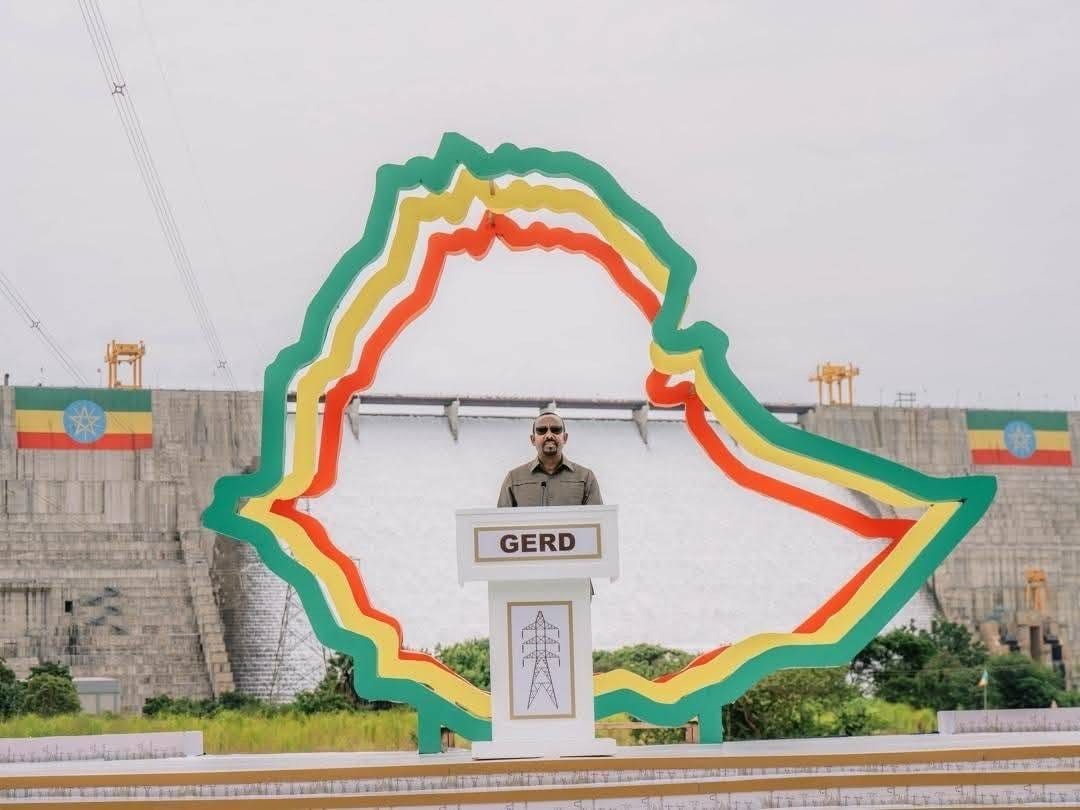
As these problems were not present at the time, Ethiopia still unilaterally pushed ahead with the dam’s construction. Eventually, the dispute was discussed during a June 2020 meeting of the UN Security Council, where Mohamed Edrees, Egypt’s representative to the United Nations, argued that the dam would “threaten over 150 million Sudanese and Egyptian citizens”. It also stated that hydrological and environmental assessment studies had not been carried out, and that the structural safety of the dam was not guaranteed. Finally, Egypt also claimed the dam would harm its share of water, with its Foreign Minister, Badr Abdelatty, stating that the country “will never allow any threat to Egypt’s historical water rights.” However, Van der Zaag puts this in perspective, as “the water is for energy production, it does not disappear. It will rejoin the river, which then continues flowing to Egypt. As the GERD is quite large, some water evaporates, but it is not a lot still.”
Political problems
Regardless, technical disagreements alone do not fully explain why the various talks between the parties failed. Political posturing and rhetoric worsened the situation. In Ethiopia, the project has been portrayed as one of national pride and unity, which will foster the development of the nation. This frame was reinforced by the fact that the GERD was largely funded by the Ethiopian people, with the government relying on bonds and a crowdfunding campaign besides financing from the state budget. For Egypt, the framing of the GERD is different, but no less consequential; its Foreign Minister described it as an “existential issue”. The Nile is also deeply intertwined with Egypt’s historical identity and civilisation. For example, Egypt’s president, Abdel-Fattah El-Sisi, stated that the river has been his country’s “only lifeline throughout history” during a UN speech on September 21st 2021.
This framing, centred on identity and history from both sides, has undoubtedly made the negotiations more difficult. Identity and culture are often regarded as indivisible issues. These issues cannot be easily divided to make concessions during the negotiation process. Whereas financial benefits can be conceded, identity cannot. Thus, though not unavoidable, issue indivisibility makes international negotiations more difficult.
With the use of such heightened rhetoric, the political leaders of Ethiopia and Egypt also manoeuvred themselves into a difficult political position. By presenting the issue as existential, it becomes hard to eventually back down, as this will make the leaders lose face vis-à-vis their domestic audiences. This is the concept of audience costs, where leaders’ credibility is weakened, and they face backlash from domestic audiences if they back down on an earlier threat or commitment. While this theory was originally conceived for democracies, research found it also applies to nondemocratic regimes.
Other domestic considerations further solidified Ethiopia’s rigidity in the trilateral talks. Prime Minister Abiy Ahmed’s platform of nation-building and national renewal had led to conflict with the old regime. Between 2020 and 2022 federal forces fought the Tigray People’s Liberation Front (TPLF), the country’s main political force until Ahmed became prime minister in 2018. An agreement that conceded anything to rival Egypt would have made him vulnerable to fierce domestic criticism at an already precarious moment. This aligns with Robert Putnam’s famous concept of the two-level game, where international negotiations are constrained by domestic politics as leaders can only accept an agreement that is also acceptable to their respective domestic audiences. In this case, Ahmed’s bargaining range was heavily restricted by potential domestic criticism of any concessions.
However, it was not only rhetoric that complicated the situation: during the African Union-led mediation, an Ethiopian decision further strained the trilateral negotiations.
In July 2020, the government unilaterally decided to start filling the dam. Therefore, it was in a strong position, with the project eventually being completed, regardless of whether an agreement would be reached. Yasir Mohamed, former Minister of Water and Irrigation for Sudan, describes observing that Ethiopia’s demands became stronger. When asked why Ethiopia was reluctant to sign an agreement, he answered, “Because they were comfortable; when they have their own dam, they control the water.” In his eyes, the success of the first year of filling without an agreement made Ethiopia gain more power during the negotiations. As a consequence of this development and the others described earlier, Egypt and Ethiopia were deadlocked.
Sudan: stuck in the middle
That deadlock makes it necessary to shift attention to Sudan. During the strained talks, it held an interesting position. Sudan was stuck between two greater powers and could either benefit or lose from the GERD becoming operational. Mohamed outlined the potential benefits and risks for his country: “Sudan has the small Roseires dam, which is very close to the GERD. If too much water comes, it cannot be stored. Sudan benefits from a regulated, steady flow, which would be very beneficial for agriculture and hydropower.” However, as he explains, these benefits are all contingent upon coordination: “the Roseiris dam is very close to the border. So if there is no agreement on coordinated operation or at least exchange of information, then the operation of Rosiris becomes very risky.”
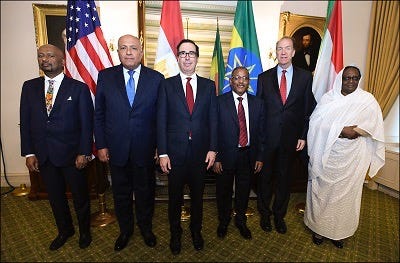
With these potential risks and benefits - and Egypt and Ethiopia locked in a stalemate - Sudan attempted to bridge the gap between the two greater regional powers. This yielded some results: Sudan’s diplomacy was praised by Ethiopia and Egypt for its cooperative role, leading to the 2015 Declaration of Principles. Later in 2019-2020, during talks in Washington DC, the US tried to mediate the dispute. This failed after a last-minute Ethiopian withdrawal. Mohamed described how Sudan subsequently worked hard to try to get Ethiopia and Egypt back to the table during April-June 2020. During this period, it also called for mediation by the US, EU and African Union. Eventually, the dispute was discussed in the Security Council, where Sudan expressed its frustrations with the lack of progress in the talks and reiterated its call for outside mediation. Unfortunately, these efforts ultimately did not lead to a final, binding agreement between Sudan, Egypt and Ethiopia.
From competition to cooperation
Considering all the problems in finding an agreement, would cooperation even have been possible? Mohamed notes how, in fact, the GERD was originally designed to foster regional cooperation, not competition: “If you read the 2015 Declaration of Principles, the original philosophy of the GERD was cooperation. The GERD would be a means to improve regional cooperation. Sudan and Egypt would buy surplus electricity from Ethiopia; they would get priority on that.”
Theoretically, such actions improve the negotiation process as they entail shifting the bargaining process from distributive to an integrative one. Distributive bargaining represents a zero-sum game, where value and benefits are only divided and claimed. Integrative bargaining, on the other hand, represents a process where both parties work to create value and ‘enlarge the pie’, leading to mutual gains. Sudan and Egypt potentially profiting from the GERD by receiving energy at favourable conditions, would be an example of this. The failure of this strategy was a missed opportunity, as Mohamed mentions how it fostered cooperation in other water-related disputes. He points at Turkey and Iraq, which “had similar issues over the Euphrates. But, in their negotiations, they included many points, over 25. Water was only one of them. For example, they also included transboundary cooperation on trade, agriculture and industry. So when you enlarge the pie, people see more mutual benefits, and they will sign.”
This strategy described above is one of issue-linkage, where parties collect multiple issues on different topics in one deal. As this allows parties to trade concessions and find new avenues for cooperation, it is a potential way to break a deadlock. When asked what Mohamed would advise future diplomats who try to broker a deal, his answer closely relates to this idea:
“My main advice would be to depoliticise the GERD. How do you do this? By thinking about what the benefits are for the three countries. That should not be only water benefits, but also other things. This would make a kind of interdependence that creates benefits. The people in Cairo, Khartoum and Addis Abeba can then more easily agree. You start with easier matters, and slowly build on that.”
Final thoughts
The GERD dispute started over technical disagreements, yet it became politicised through political rhetoric, the manner in which the project and the Nile were framed, issue indivisibility, and audience costs which locked political leaders into their positions. Ethiopia’s unilateral filling of the dam and the missed opportunities for issue-linkage further cemented the deadlock between Egypt, Ethiopia and Sudan.
As a result, the dispute became difficult to solve through negotiations, which explains the absence of any binding agreement.
The likelihood of a future agreement also seems to be lowering. The context of potential negotiations has changed drastically. Sudan is currently engulfed by a devastating civil war. Furthermore, as discussed in an earlier HIG analysis, Ethiopia and Egypt are reportedly backing opposing sides in this conflict. On 23 September, a war also broke out in Ethiopia. During this conflict between Ethiopia’s federal troops and a rebel alliance led by the Tigray People’s Liberation Front (TPLF), Ethiopia’s army chief already accused Sudan, Egypt and Eritrea of backing the insurgents. All three have subsequently denied these accusations. Thus, the GERD dispute - which was already hard enough to resolve on its own - is now part of a long list of issues in the region, likely making any potential negotiations even more difficult and tense.