


In Summary:
Falling fertility and rising life expectancy are aging populations worldwide, even though the global population is still growing.
An aging population can create labour shortages, increase pressure on pension and healthcare systems, potentially slowing economic growth. Governments have been responding through immigration, family-support policies and technological innovation.
Extending healthy life expectancy (healthspan) could ease some of the economic pressures of aging, but it does not reverse the pressure, and works only alongside migration, family and productivity policies.
Introduction
Throughout history, demographic changes have played a decisive role in a country’s economic characteristics, as a country’s population determines its labour supply, savings, and consumption. In the past decades, there has been a decline in fertility rates alongside an increase in life expectancy, which have raised concerns about future economic growth due to lower labour-force participation.
Demographic change, compared to other major economic factors, is a slow-moving force, making it hard to mitigate through policy interventions in the short term. Countries respond differently, from high subsidies for childcare and parental leave in the Nordics, to advanced technology in Japan and immigration in some EU states. With the growing youth scarcity and the retirement age increasing in many OECD countries, are current measures enough, or could developments on expanding one’s healthspan become a solution?
The demographic change
Despite the current rise in global population – with the 2024 UN World Population Prospects expecting it to reach 10.3 billion people in the mid-2080s – population has already peaked in 63 individual countries, including major economies such as China and Germany. Projections by the Institute for Health Metrics and Evaluation (IHME) differ from the UN’s prospects, however: a 2020 IHME study published in The Lancet projected a population peak of 9.7 billion in 2064, roughly two decades earlier.
Looking at individual regions, Eastern European countries are expected to experience significant population decline largely due to emigration. However, a worldwide contributing factor is declining fertility rates. Fertility is falling across most of Europe, while South Korea (0.80 in 2025) and China (1.02 in 2025) are among the lowest in the world. The IHME study also suggests that by 2050, 151 countries will have a total fertility rate lower than the 2.1 replacement level - the number of births per woman needed for a country’s population to sustain itself in the long term without immigration - and expects Japan’s population to decline by over 50% by 2100. A US National Bureau of Economic Research (NBER) report suggests that global fertility is likely already below this level.
“The real casue is that we get fewer children than previously. That affects all countries in the world. So it’s not only the Western countries, also other countries. So in particular, Africa still has higher birth rates, but also there, it’s falling”
Dr. Casper van Ewijk, Macroeconomist, Researcher and Advisor at Netspar
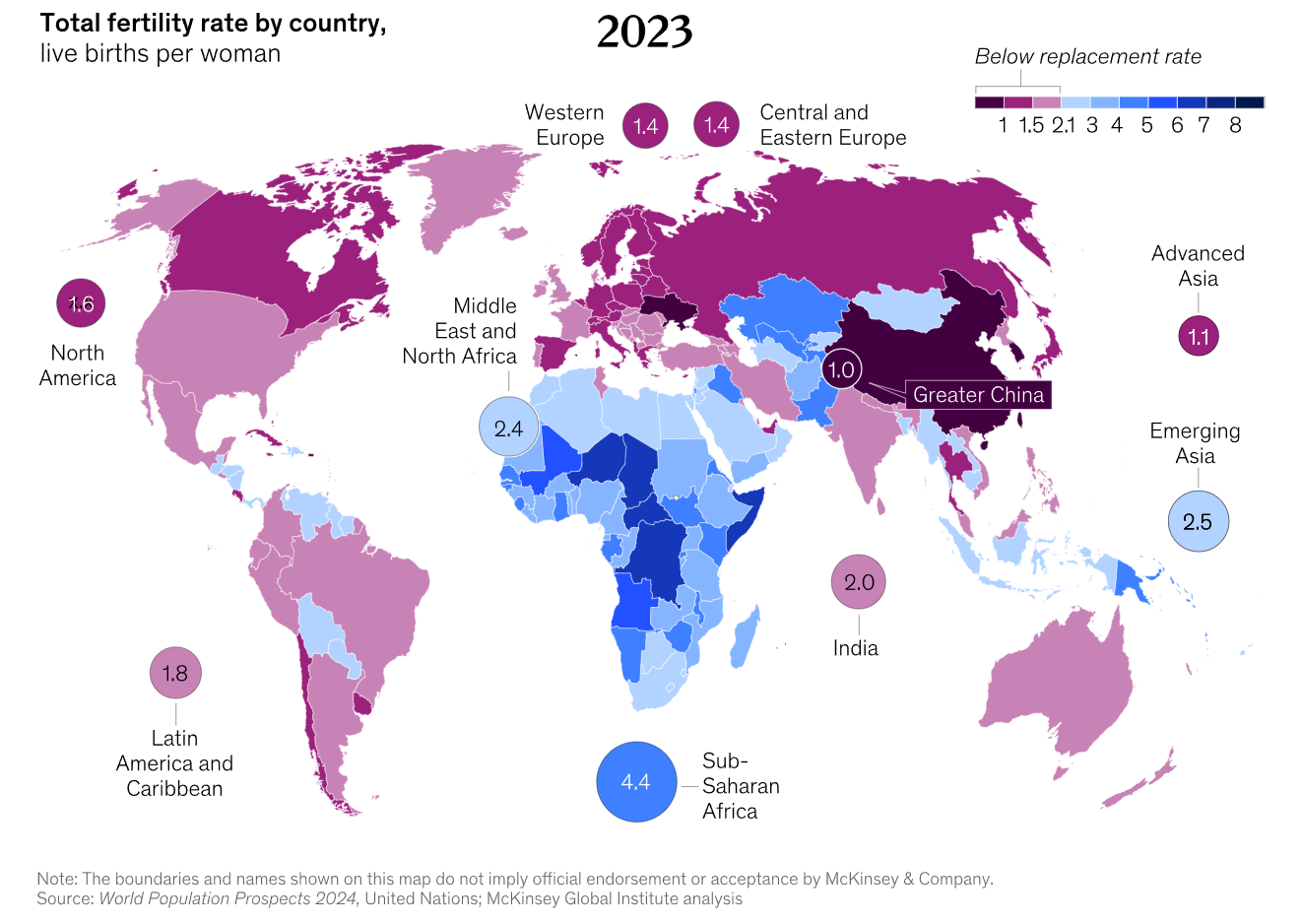
The decline in birth rate is attributed to several things, from improvements in global health and welfare and declining mortality rates, to the increase in the education of women, and a growth in female labour force participation. A McKinsey report says this pattern of demographic change is suspected to occur across all regions over time, while a study from Harvard researchers says the impact of aging is unlikely to be uniform across different economies.
While rising life expectancy as a result of improved global health and prosperity is a great achievement, combined with low fertility it leaves aging countries with fewer young people entering the workforce.
As the number of non-workers increases faster than the number of working-age people, aging can lower both labour-force participation and savings. Specifically in the field of healthcare, if the number of people in need of assistance increases while the number of people entering the workforce decreases, it can create staff shortages, putting pressure on labour markets and pressure on healthcare institutions.
The aging population could also increase dependency on public finances, due to higher spending on pensions, and long-term care. Dr. van Ewijk mentioned the concern over the rising old-age dependency ratio, meaning that the number of people aged 65 and over is increasing relative to younger people:
“So the pensions and the care for the old aged is paid by current taxes on the young. And that will be unsustainable in the future. (…) So you see that in Europe, with France, Italy, but also Germany, has a lot of state pensions and they might run into problems. (…) And that might affect the stability of the EU.”
This concern is not limited to advanced economies. India’s population is still growing, but its fertility rate has fallen below replacement level, and Thailand’s ratio of workers to pensioners is suggested to fall to the level of developed countries by 2030. This leaves emerging economies with a challenge that developed countries did not have: becoming high-income countries before aging.
Andrea Maier, Director of the NUS Academy for Healthy Longevity and Professor of Gerontology at VU Amsterdam shared her views on the effects of demographic change from a health perspective: “demographic change will influence countries’ ability to sustain services, retain skills and respond to crises. Competition for healthcare workers may intensify, while increasing care needs could place additional pressure on families, particularly women.”
On a more positive note, a review on aging explained that older workers often bring valuable experience and skills to the workplace, and that many older adults work, provide unpaid care or volunteer, with large societal and financial benefits.
“Manufacturing a larger and healthier older population means we’re investing in one of the most valuable resources any country has – an experienced older population that holds great wealth.”
Dr. Jay Olshansky, Emeritus Professor of Epidemiology, University of Illinois at Chicago
Some experts say these demographic trends can lead to a slower economic growth, while an NBER paper shows there isn’t a negative relationship between population aging and slower growth. Dr. Maier warns about making predictions based on population size alone: “aging countries can retain considerable influence through productivity, institutions, technology and a healthier population. The quality of human capital, and the ability to use it, will help determine how demographic change translates into power.”.
Addressing demographic change
Although fertility rates have dropped across Europe, the population in 16 EU countries has grown in 2025, due to positive net migration. High net migration has also helped in offsetting the aging population in Australia, and Canada brought in over 1 million people in 2023 to compensate for low population growth during the pandemic. However, in Canada and other high-income countries, the increase in immigration has created concerns among the public. The attitudes toward immigration are driven mostly by concerns about cultural, and economic impacts on the nation as a whole, such as housing scarcity.
Another attempt to increase the population is through encouraging childbirth. Nordic countries, have high subsidies for childcare and parental leave to encourage childbirth, and Hungary spends around 5% of its GDP on fertility and family programs. However, reports show that these efforts do not necessarily increase the fertility rate: In 2014, fertility rates were record low in Finland (1.25), Sweden (1.43) and Iceland (1.56). A Financial Times report shows that birth rates are not higher in countries where childcare is fully subsidised compared to those that spend less on family-friendly policies.
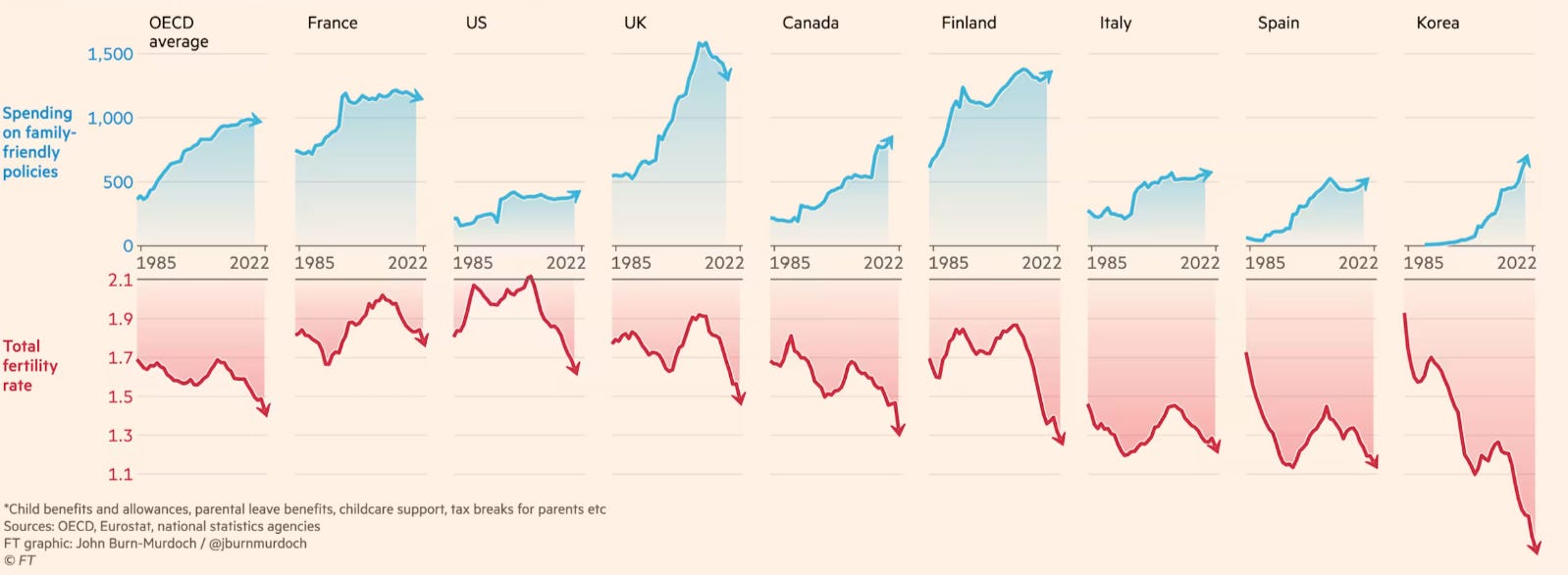
States, such as Japan, invest more in technology and automation to enhance productivity despite the decrease in the human workforce. However, its GDP per capita growth is still lower than that of Western European countries, despite a higher labour productivity growth. South Korea, with the lowest fertility rate in the OECD (0.80 in 2025), has tried to salvage its hyper-aging population both through parental support and increasing its productivity with technology.
Dr. van Ewijk suggests that both governments and people should prepare by saving: “Governments should take care of their finances, but also people themselves should save more. (…) Some 20-25% of your income should be put apart for the pension, and that’s not what people are doing. And then you end up with very low income after retirement, and that could give a large population living in poverty.”
Despite the efforts, the retirement age is expected to rise in around half of OECD countries’ age to increase labour force participation, and therefore an extended quality of life becomes highly important. The UK has already set a goal to increase its population’s healthspan by 5 years by 2035, and China has committed to a high-quality population development strategy that provides services across the full life cycle of its citizens. McKinsey says that no single measure will be enough on its own to sustain a country’s growth.
The potential of healthy longevity
“Humanity should declare victory in our effort to achieve life extension, but now the time has arrived to focus on extending the period of healthy life and not just life extension itself.”
Dr. Olshansky
As the population ages, the dependency on older workers increases alongside the retirement age, and long-term health becomes more important. Healthy aging could be promoted by the government through supporting healthcare systems, integrating policies aimed at improving working conditions and quality of life for older people. An International Monetary Fund (IMF) report suggests that policies that support the human capital of workers between the ages of 50 and retirement age, such as health promotion and preventive measures can significantly counter the effects of population aging on economic growth.
“Increasing healthspan can be an important part of the response. It can help preserve independence and enable people who wish to do so to remain in paid work, care for relatives, volunteer or contribute their expertise. These benefits can reduce some of the consequences of population aging.”
Prof. Maier
Dr. Olshansky emphasized the importance of social determinants of health, such as an environment that encourages simple physical exercise, which can also play an outsized role in facilitating healthspan extension.
Japan, Singapore and South Korea lead the International Longevity Centre’s (ILC) ranking for healthy life expectancy as of 2022, and their digital and health promotion policies have been noted to enable significant progress in healthy aging.
Alongside public health measures, there is ongoing research that aims to extend healthy human lifespan by reversing age-related diseases. Currently, in practice it remains at an early stage, with approaches such as epigenetic reprogramming using Yamanaka factors, intended to make aging cells act younger. Life Biosciences, a company aiming to reverse diseases of aging, released interim data from a small first-in-human safety trial of epigenetic restoration. In two of the three people with glaucoma- a disease in which vision loss is often considered irreversible - the company reported preliminary signs of improvement in eye tests.
At the University of Bonn researchers reprogrammed early-stage red blood cells into neural stem cells, gradually resetting their biological age over several weeks, in a study published in Aging Cell. The university says this offers a way to study how cells rejuvenate, which is relevant to age-related brain diseases.
Prof. Maier draws attention to the potential of precision geromedicine:
“Precision geromedicine has the potential to prevent or delay age-related diseases and preserve function by matching interventions to an individual’s biological and clinical characteristics. Realising this potential requires political willingness to regulate the field.”
Prof. Maier
Dr. Olshansky thinks a breakthrough in the field is highly probable within most people’s lifetimes, but says the challenge arises if advances are so slow that “demographic population aging occurs faster than the science can keep up”. Prof. Maier said that promising laboratory findings and changes in biomarkers of aging “do not establish additional years of healthy human life”, and that trials showing clinical benefit are needed.
The main financial contributors in the field of aging research include Saudi Arabia’s Hevolution Foundation that aims to invest up to $1 billion a year in aging research to prepare it for when the population starts to age. Additionally, the US has its own National Institute on Aging (NIA) that focuses on aging and extending healthspan.
Increased longevity has been associated with an increased per-capita income, as a healthier older generation would have fewer demands for healthcare and would be able to work and contribute to the economy for a longer period. It also could help by promoting innovation and national savings in aging countries. The IMF publication suggests that healthy aging is expected to contribute to around 0.4% annually to global GDP growth over 2025-50, as it increases labour supply and improves human capital of older people. Additionally, a study in Nature Aging estimated that a slowdown in aging that increases life expectancy by one year would be worth US$38 trillion in the US, based on US data.
‘’Even a small improvement in the extension of healthy life has been shown to have a likely dramatic positive influence on individuals and populations – the gains would be in the trillions.’’
Dr. Olshansky
However, doubts have been expressed regarding longevity’s true potential. Some experts note that the science on health expansion has several risks, such as safety and ethical concerns regarding human trials. Others found that due to the socio-economic inequalities in health and life expectancy, the capacity to extend working lives is unevenly distributed among populations. The Longevity Initiative argues that while longevity can help slow population decline, it cannot reverse it on its own.
“It could reduce the economic consequences substantially in some settings, but there is no universal estimate of the gap it could close. The effect depends on the number of people gaining healthy years, their opportunity and willingness to work, and how productivity and care needs change.”
Prof. Maier
She also emphasized the importance of coordinated policy response in investment to support families and improve opportunities for women and older people, alongside well-developed migration and integration policies, as “improving healthspan does not directly reverse low fertility or replenish smaller birth cohorts.”. Both experts suggested pursuing advanced research and public health measures simultaneously to adapt to the demographic change.
Conclusion
The demographic change that comes with the increase in life expectancy and a drop in fertility rates can have significant effects both on an economic and societal level. While aging can provide a skilled workforce, the decline in young people entering the labour market can lead to staff shortages, pressure on public funds and potentially slower economic growth. aging countries are responding through positive net migration, parental support and technological advances, however none of these measures seem to be enough on their own.
As the retirement age is expected to rise to increase labour force participation, a longer healthspan becomes more important. Research on reversing diseases of aging has the potential to facilitate a longer healthy life, however it is still in the early stages, and there are doubts about its safety, its unequal reach and when it could affect whole populations. Public policies aimed at supporting a healthier lifestyle could therefore be a more feasible way to improve healthspan, as their benefits can begin now. Extending one’s healthspan can be an important part of the response, as it is associated with an increased per-capita income, but on its own it does not reverse the challenges of low fertility.