


In summary:
David’s Sling, Barak MX, SPYDER, ELTA radars, and an AI command system, built over three years. Analysts say the real value is the integrated network and Israeli doctrine, not any single weapon.
Greek-Israeli ties have deepened since 2011. Both countries increasingly see Turkey as a threat, sharpened by the 2020 Kastellorizo standoff and a drone incident just days before signing.
Turkey calls the deal “devious” and points to it as proof of an anti-Turkish bloc. Greeks question who really controls the system, and some fear inheriting enemies they don’t need.
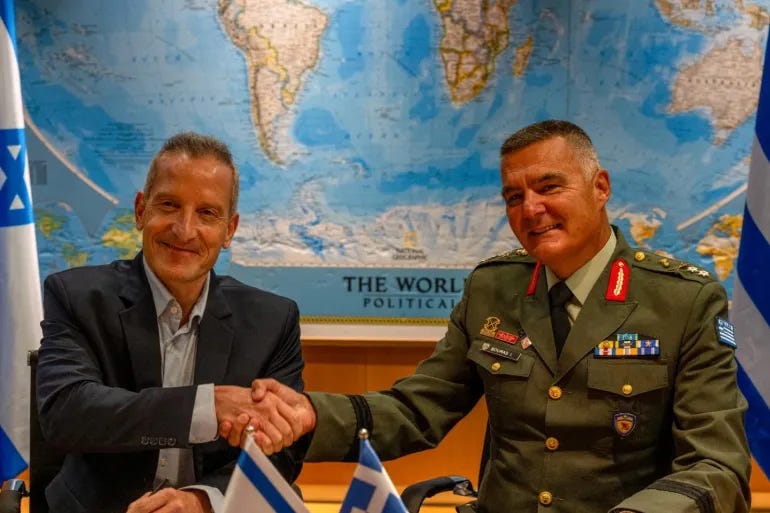
Greece and Israel signed a major air-defence agreement, the so-called “Achilles Shield” €3 billion agreement, on 31 August 2026. After a three-year negotiation, the Achilles Shield will be developed in three years with the help of Israel in stages. Israeli Prime Minister Benjamin Netanyahu described the Achilles Shield agreement with Greece as “one of the largest in the state’s history”. Therefore, as this step is one of significance for both Greece and Israel, the question arises:
Does the Achilles Shield agreement buy Greece security, or does it import risk alongside capability?
Achilles Shield: the import of new hardware capabilities or rather a doctrine?
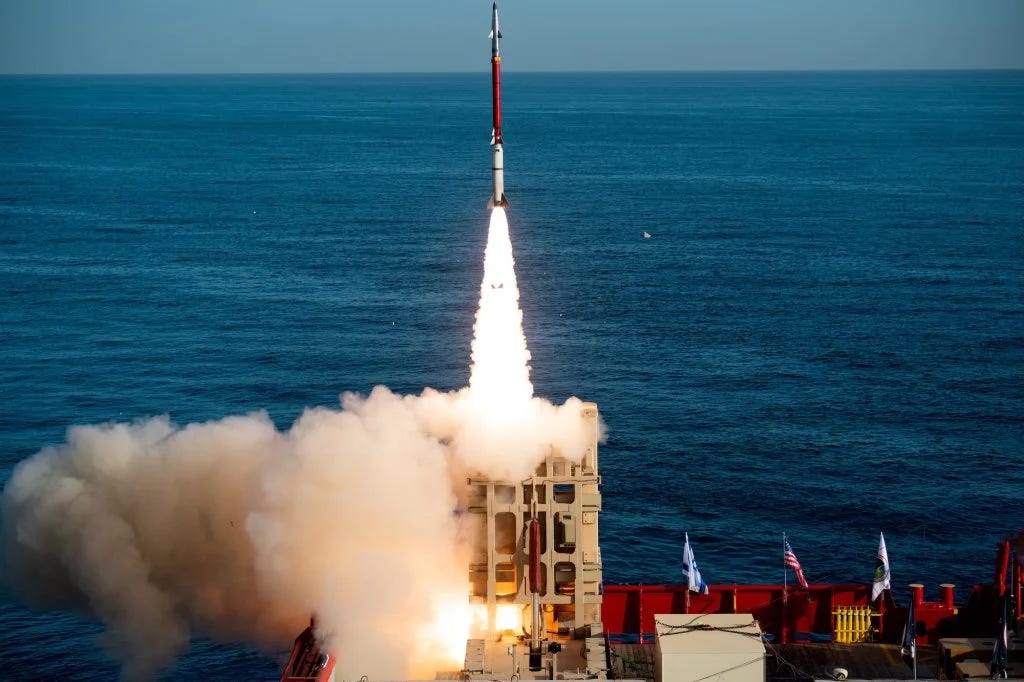
As part of Greece’s Agenda 2030 military modernisation effort, the agreement with Israel includes short-, medium-, and long-range defence capabilities; MMR multi-mission radars for air surveillance, manufactured by ELTA Systems, and a new national command and control system, incorporating artificial intelligence capabilities.
George Meneshian, a policy analyst covering the Caucasus, Middle East and North Africa, head of the Middle East Research Group at the Institute of International Relations (IDIS), suggests: “This is closer to importing a doctrine than importing hardware, and it’s arguably the more consequential and durable transfer.”
Aristeidis Dimitratos, Military Affairs analyst & Editor-in-chief at OnAlert.gr, agrees that the value sits in the integration: “Its value lies not merely in its ability to intercept a specific class of missiles, but in its integration into a network capable of identifying — in real time — the threat that is approaching, from which direction, and the most suitable available asset to counter it.” Dimitratos explains that David’s Sling and Interceptor for ballistic missiles, Barak MX for aircraft, helicopters, UAVs, cruise missiles and ballistic missiles out to 150 km, and SPYDER for rapid-response, short-to-medium-range interception of low-altitude targets, while overall enhancing mobility.
What the shield changes
Israel’s and Greece’s bilateral relationship has come a long way, as Greece was the last EU state to establish full diplomatic relations with Israel in 1990. Greece has historically been engaged more with Arab states, while Israel nurtured closer ties with Turkey. However, such dynamics changed, as Erdogan’s stance toward Israel hardened after the 2008-09 Gaza war. Greece’s and Turkey’s tensions intensified, marked by events such as the 2019–2020 Turkey-Libya Accords & Sea Corridor Blockade, which posed a geopolitical threat by ignoring Greece’s boundaries. The 2020 Eastern Mediterranean Maritime Standoff led to an increasingly strained relationship, as a Turkish seismic vessel carried out surveys in disputed waters near Cyprus and Greek islands, resulting in Greece planning rival naval exercises with France, Cyprus, and Italy. Related is Greece’s attempt to de facto nullify the Turkey-Libya Accords by a delimitation agreement with Egypt in 2020.
Since the annual joint military exercise Noble Dina commenced in 2011, Israel and Greece have grown increasingly closer ties. Engaging other countries in formats such as the 3+1 with Cyprus and the USA, and the Eastern Mediterranean Gas Forum, has always been part of the equation. In December 2025, Greece, Cyprus and Israel signed the 2026 Joint Action Plan targeted at expanding military cooperation through joint operational activities, Special Operations Forces (SOF) joint training, staff-level meetings and consultations on matters of mutual interest. Following a longer-term trend, this showcased another step in closer ties between Israel and Greece. While this plan is renewed annually, the 2026 version entailed more concrete joint activity.
What brought Athens and Tel Aviv together were geostrategic interests in the Eastern Mediterranean and the growing perception of Turkey as a threat. Greece and Turkey share a long history of disputes regarding maritime boundaries, airspace, and Cyprus. Netanyahu’s views Erdogan as “an antisemitic dictator”, while Erdogan views Israel as a direct threat to Turkey.
Notably, the Achilles Shield agreement could change the power balance in the Aegean Sea, the site of Greece’s longest-running maritime dispute with Turkey. Negotiations concerning the deal ran for some time, but three days before signing, Greece faced a concerning incident: On 28 August, a Turkish drone flew over the wider sea area between Samothraki and Lemnos, which was responded to by Greece with F-16 fighter jets intercepting the Turkish UAV, creating further tensions in the Aegean Sea. This serves as a reminder of the kind of threat Achilles Shield capabilities are built to intercept rapidly. Meneshian elaborates that “there is a view in Greece that Achilles Shield could, in fact, change the balance between the two states and serve as a deterrent.”
Furthermore, the agreement was received by Turkey as a “devious” deal, feeding into a wider Turkish narrative that frames Greek–Israeli cooperation as an Eastern Mediterranean bloc built specifically to box Turkey in. Turkey is perceived as a threat to Greece, but it is not necessarily the only one; its allies, such as members of the Mecca pact, may pose one too. Pakistan, Saudi Arabia, and Turkey signed the Mecca Joint Defence Agreement, including a mutual defence clause on August 7, 2026.
Dimitratos explains: “Relations between Greece and Turkey have been in crisis in recent weeks following a period of relative calm lasting roughly three years; the “Achilles’ Shield” agreement will undoubtedly have a negative impact as it is gradually implemented over the coming years. Turkey sees two of its major adversaries joining forces, with itself at the centre of the equation.”
Some argue that threats such as Turkey, Russia and Iran led to the formation of the 3+1 nations (an alliance between the US, Israel, Greece and Cyprus), which risks escalating tensions with Turkey. Michel Don Michaloliákos, geopolitical analyst for Europe at HIG, describes the position Athens finds itself in: “Greece is permanently playing chess on two geopolitical chessboards,” of continental Europe and that of the Eastern Mediterranean and the Middle East. Therefore, the Achilles Shield fits into the broader picture of Greece’s cooperation with other countries to create security on different levels. More importantly, Michaloliákos explains that: “Greece cannot fully count on Europe when it comes to Turkey.” With Turkey’s NATO membership and EU alignment, Athens bought a system elsewhere.
Michaloliákos also notes that Greece considered alternative systems such as the U.S. and France; however, price, technology transfer terms, and shared production tipped the decision toward Israel. Most importantly, purchasing the Achilles Shield offers Greece reassurance that the alternatives could not provide: given its tense relationship, Israel will not sell this system to Turkey. Especially in light of Greece’s prior experience, this guarantee matters. Greece learned its lesson when Germany sold submarines to Turkey after Greece was the launch customer. The UK sold Turkey Eurofighters, and France let the UK sell Turkey Meteor missiles.
To finance this deal with Israel, Greece pays from its own budget rather than through the loan mechanism of the EU, while the exact numbers are unclear: roughly 15-22.5% of the total, with a workshare of about €700 million across some companies. This is because a majority-Israeli system sits outside Security Action for Europe’s EU-content conditions.
The Achilles’ heel
Nonetheless, the Achilles Shield has an Achilles heel of its own. “(...) It represents a massive commitment for Greece—with political, economic, and diplomatic ramifications—that could potentially cause friction within the country’s domestic political landscape in the future. It is not merely an isolated weapon system that can be deactivated depending on political circumstances, as happened with the Russian S-400s in Turkey. On the contrary, it is an integrated, multi-layered air defence network worth over €3 billion, which will serve as a cornerstone of Greece’s air defence capabilities,” states Dimitratos.
Meneshian adds that “the political-perception risk (...): a highly capable system whose legitimacy is undermined by an unresolved public argument about who actually controls it.”
Some Greek citizens have reservations about the article, as demonstrated on X by Greece’s former Finance Minister Yanis Varoufakis: “This bodes ill for the majority of Greeks, for peace in our region and for Europe and West Asia more broadly. It must be resisted.” Michaloliákos says that some might fear that “Greece will inherit enemies of Israel that it does not need”. Geopolitical circumstances necessitate partnerships that might be faced with domestic concerns.